
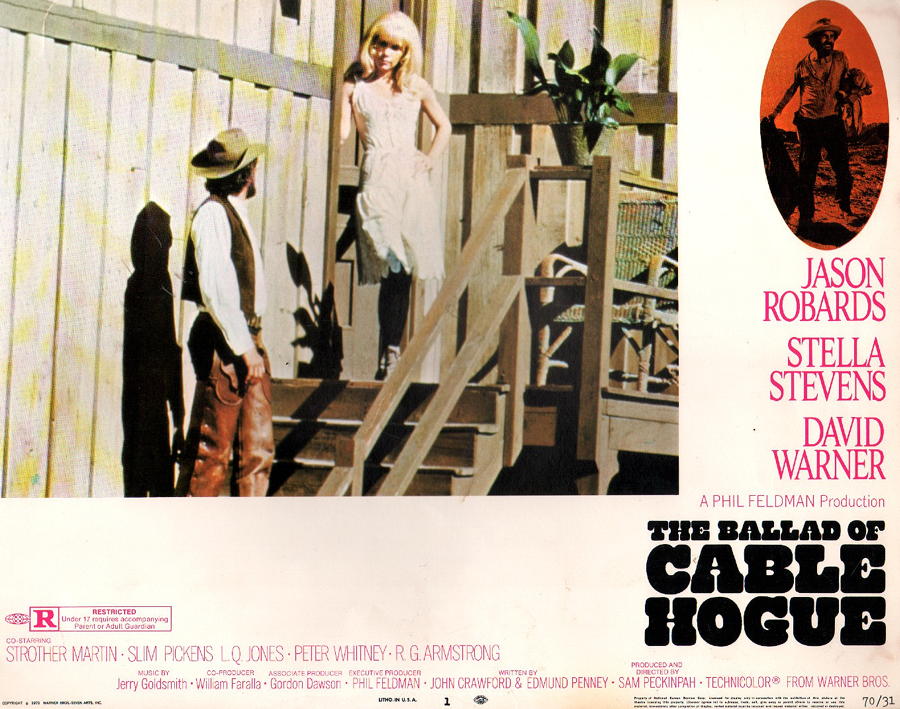
A few days ago it was the centenary of the birth of Sam Peckinpah. I confess that it took me by surprise. Sam took quite a long time to get into a position from which he could become a director of feature films so he was 35 when he made The Deadly Companions in 1960 after a writing career in television and independent film. In the so called ‘New Hollywood’ that developed during the 1960s he was already more than ten years older than the feted directors such as Francis Ford Coppola (born 1939) and Martin Scorsese (born 1942) who were at the centre of 1970s Hollywood. But for my generation, Peckinpah was a new figure, brought into the limelight by The Wild Bunch in 1969 and I didn’t discover his earlier films until later in the 1970s. I chose to celebrate his centenary with The Ballad of Cable Hogue, partly because it was one of the first Peckinpah films I saw in the cinema. I was intrigued by how it might look now, more than fifty years later.

The film has only a slight narrative and three leads. It was made for Warner Bros and Peckinpah began shooting while The Wild Bunch was still in post production in late January 1969. Some scholars note that comments were made about Peckinpah not being fully engaged on this new shoot while arguments with Warner Bros. over The Wild Bunch were unresolved. In the event the initial shooting period was literally washed out by heavy rains in Nevada. In addition, Peckinpah was heading towards his full-on alcoholism and this could make him even more ornery than usual. It says a lot for the cast and the crew remaining after some firings that what appeared in the final cut is one of Peckinpah’s best films which the director himself later claimed as a favourite. The strength of the film perhaps derives from its casting. Jason Robards is Cable Hogue, a prospector out in the desert with two ‘companions’ played by Peckinpah regulars Strother Martin and L. Q. Jones. They have only enough water for two so they take everything from Cable and leave him to fend for himself without water. Miraculously, he stumbles across a muddy patch in the sand and digs down to find water. Robards had appeared in three Westerns before, including in Leone’s Once Upon a Time in the West in 1969. He had also appeared in Peckinpah’s well-received TV adaptation of Katherine Anne Porter’s novella Noon Wine (1966) which was shot by Lucien Ballard. Robards looked the part of Cable Hogue but he also offered a fully-rounded performance suffused with wit, resilience and a grounded philosophical approach.

When Cable finally makes it back to the nearest town of ‘Dead Dog’ he is immediately drawn to the town’s ‘goodtime girl’ Hildy (Stella Stevens). Like Robards, Stevens had already had a long career of mainly secondary roles even though she was still in her early thirties and she was at first glance an odd casting choice. On the DVD I watched the only ‘Extra’ is a long interview with Stevens (shot in the 2000s) and she admits that she had never heard of Peckinpah when she was first considered. Later in the interview she said that she didn’t like working with Sam though she recognised what he had helped her to achieve. But like Robards she was a real professional and her performance is terrific in the hoariest old role. I presume that the fetishistic shots of her cleavage and later partial nudity led to the US ‘R’ rating because the two shootings in the film are not particularly exploitative. (The UK certificate was ‘AA’ a new rating in 1970 suggesting suitable for anyone over 14.)
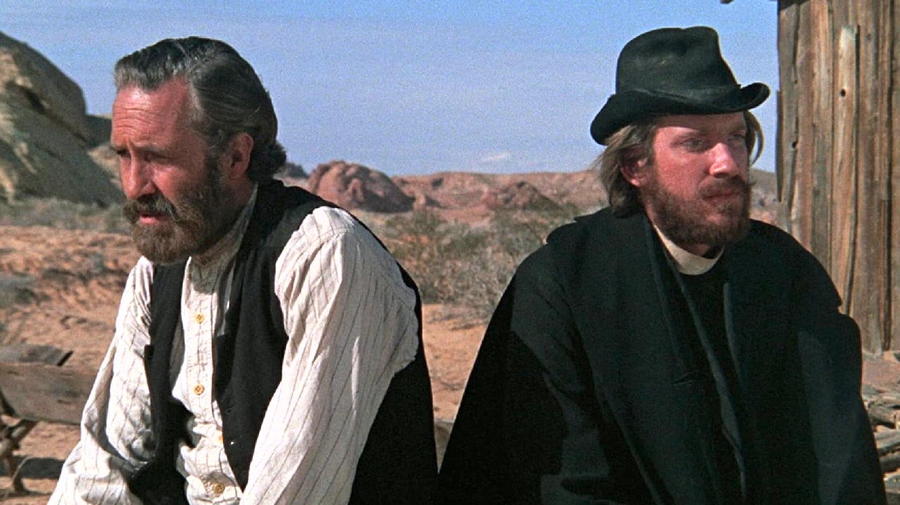
The third main character introduced the British actor David Warner as Rev. Joshua Sloan, a mock clergyman with a penchant for the seduction of young women. As with the Stella Stevens role, this was not problematic in 1970 and there is no suggestion that this constituted abuse. Warner had a stage background with the RSC and had starred in Morgan – A Suitable Case for Treatment (UK 1966) opposite Vanessa Redgrave. He would have a further uncredited role for Peckinpah in Straw Dogs (UK 1971) and later in Cross of Iron (UK-West Germany 1977) as a Wehrmacht Officer alongside James Mason. Warner matches the performance levels of Robards and Stevens. The rest of the cast comprises mainly Peckinpah regulars (with Slim Pickens and R.G. Armstrong joining Martin and Jones). The three leads were not necessarily associated with the Western but over their long careers they amassed over 600 screen credits between them. The Ballad of Cable Hogue is a ‘comedy-Western’. Stella Stevens claims it is also a romance and I think she’s right, although it is an unconventional romance. Certainly it is a humanist film with three strong central characters. I was surprised by how much I enjoyed the film. I’d seen it at least twice in the 1970s but I think I appreciated it more this time. The consensus appears to be that though the film failed at the box-office, its critical reputation has grown over the years. Following the success of The Wild Bunch, the film was unlikely to meet the expectations of many audiences. Peckinpah blamed Warner Bros. for their interference in post-production, their wrong decisions about distribution and their accounting procedures which meant that, as with The Wild Bunch, it was difficult to tell if the film ever made a profit. Against that the film was 121 minutes long and perhaps too leisurely for its material and it went way over budget, partly because of the bad weather but also because of Peckinpah’s behaviour.

Roger Ebert supported the film in his review and suggested it was a ‘New Western’. In that respect it does include several features of the ‘revisionist’ period of the late 1960s and early 1970s. The opening credit sequence closely resembles Peckinpah’s later film Junior Bonner (1972) in its use of multiple screens as a different form of montage. The film also features speeded-up action as well as at least one slow motion sequence. There is also a fleeting animation moment – a cheeky visual gag. Peckinpah referred to the ‘Keystone Cops’ as an element in the genre mix. There are also more conventional montage sequences, some of them accompanied by songs with one for each of the principals. The lyrics are all by Richard Gillis, ‘discovered’ by Peckinpah, with music by Jerry Goldsmith (Jerry Fielding who composed the music for The Wild Bunch and four later Peckinpah films was unavailable). One song is sung by Robards and Stevens. Cable Hogue is also a typical Peckinpah ‘End of the West’ film. I’ve seen suggestions that the film is meant to be set during the 1900s and the story time runs over several years, but until the closing sequence when three motor vehicles appear there are no obvious markers of the time period. The main narrative development is, however, Hogue’s acquisition of the stagecoach contract to supply water at a way station he builds on the plot where he has found water. When he finally sees a motor vehicle he knows he has to move on. The appearance of a motor vehicle is a crucial marker in both Ride the High Country (US 1962) and The Wild Bunch. Here it signifies the change in the economic opportunities brought by the ‘opening’ of the frontier.

The DVD and the Blu-ray of the film carry a commentary by a group of the best-known Peckinpah ‘scholar fans/fan scholars’ – Nick Redman, Paul Seydor, Garner Simmons and David Weddle. I can see the value of these commentaries but I do find them a clunky form of communication, preferring a shorter presentations to camera rather than a commentary over the whole film. These guys all know their stuff and they are certainly enthusiastic but I found the sound quality was a little muffled and it was hard to tell who was speaking at any one moment. Just in the first section of the film, however, it is interesting to hear one reading which picks out the discourse on religious narratives of the hero stranded in the desert and having a conversation with God. This is linked to Peckinpah’s childhood and his fondness for his maternal grandfather Denver Church. But another of the quartet sees the influence of Peckinpah’s early theatre training and likens the opening to The Tempest. I also listened to the discussion of the narrative resolution to the film – beautifully shot by Ballard and carefully choreographed by Peckinpah. It seems to me to be in some form of dialogue with John Ford. As I try to finish this posting I realise that I want to watch the whole film again as there is so much to enjoy here.
The trailer below was presumably created for the video release before the rise of widescreen TVs but it includes the theme song and some of the split-screen work. The film was originally screened at 1.85:1 in cinemas and the DVD/Blu-ray restoration is at 1.78:1. Cinematography is by Lucien Ballard who became Peckinpah’s ‘go to’ lensman fromThe Ballad of Cable Hogue is now widely available on streamers as well as physical discs. It’s an enjoyable watch and, like Junior Bonner, it proves that the often used ‘Bloody Sam’ label for the director doesn’t tell the whole story.

