
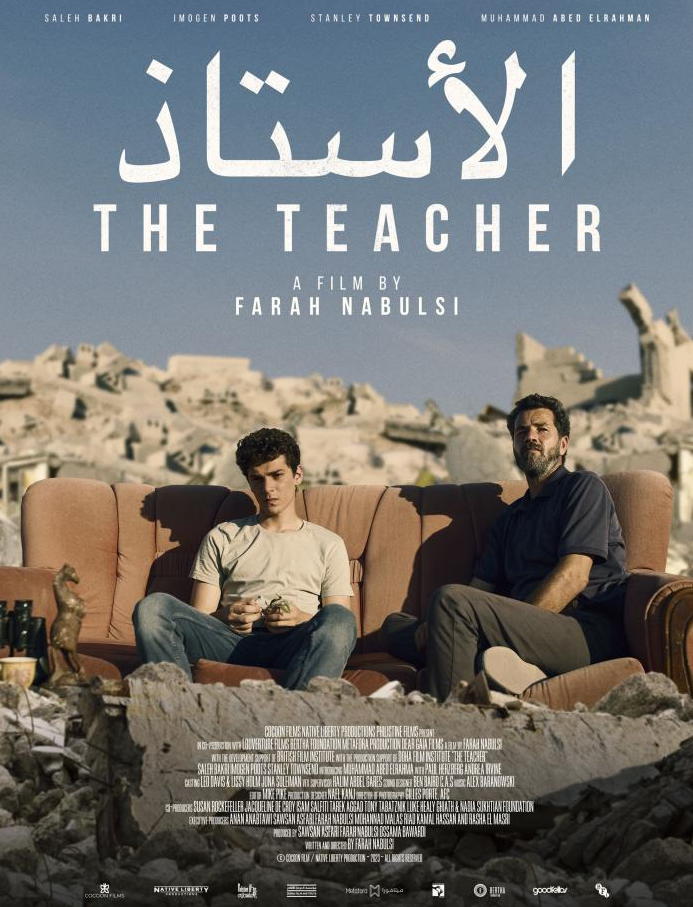
The writer-director of this film is British-Palestinian. Farah Nabulsi came to filmmaking relatively late and her first short film as a director, The Present, garnered good reviews and an Oscar nomination in 2021. Born in the UK in 1978 she had a career as a stockbroker before making a trip to Palestine in 2013 to explore her family roots. Involved in three short films from 2016 as writer-producer, she set up her own production company, Native Liberty Productions as not-for-profit organisation focused on bringing attention to Palestinian rights and the injustices of Israeli occupation of the West Bank. In The Present she was able to cast Saleh Bakri, the imposing and impressive Palestinian actor who starred in both Annemarie Jacir’s Wajib (Palestine-France 2017) and The Blue Caftan (Morocco-France 2022). He plays the eponymous lead in The Teacher.

I found watching The Teacher difficult, not because it is a bad film but because as someone passionately supporting Palestinian rights it feels almost too real at times in its depiction of the illegal occupation and settlement of the West Bank by Israelis. The relatively straightforward narrative focuses on a teacher in a high school in an unnamed West Bank city which may be Nablus. Basem El-Saleh (Saleh Bakri) teaches English and he lives in a village outside the city. He appears to live on his own but is close to two teenagers in his class who live in the same village with their mother, having lost their father. Yacoub is the older brother who has been in an Israeli prison and is returning to school as an angry young man. His younger brother, Adam (Muhammad Abed Elrahman) is in the same class and is clearly Basem’s star pupil. The ‘inciting incident’ in the narrative occurs when the teenagers’ house is demolished by the Israelis. I could not follow the justification for this but it happens far too often on any kind of trumped up charge. Basem has to restrain Yacoub from attacking the demolition crew but a little later Yacoub notices smoke in the nearby olive grove and rushes in to find trees ablaze and two Israeli settlers. He attacks them but is then shot dead by a settler with an automatic weapon. Everything in the narrative then follows from the shooting. Basem knows that the chances of a prosecution against the settler in an Israeli court are slim but he must try to persuade Adam not to seek revenge.

Nabulsi has alerted us to the two attacks on Palestinian rights that have been incessant over several years. Israeli settlements are illegal under International Law but they are currently encouraged by the extreme right-wing elements in Netanyahu’s cabinet. Destroying olive groves (and killing livestock) is a vicious attack on fundamental Palestinian rights. I don’t want to spoil the narrative further so I’ll stick to comments on the approach taken by Farah Nabulsi. She develops a second plotline inspired by a real event from some years ago in which an American migrant serving in the Israeli military is taken hostage by a Palestinian group which demands the release of over 1,000 Palestinians in Israeli gaols in return for his release. The American parents are in Israel and the father seems to have some influence. There is a clear parallel between the father of the soldier and Basem’s sense of his responsibility for Adam. We also soon realise that Nabulsi has kept back aspects of Basem’s earlier experiences and these are gradually revealed through flashbacks. I think this is possibly where the filmmaker’s lack of experience becomes a problem. Sometimes it is not easy to tell when we are in a flashback and it can get confusing.
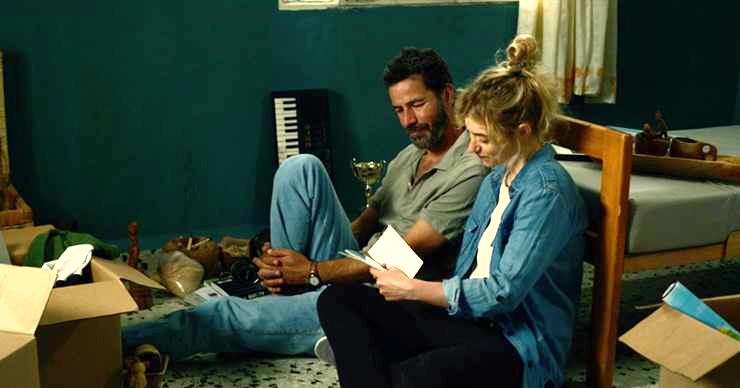
A more important false step for me is the inclusion of the character of Lisa (Imogen Poots) as a British volunteer/aid worker? She appears at the beginning of the film as a ‘counseller’ attached to Basem’s school who attempts to help Yacoub re-integrate into school life. I found this an unlikely scenario. She also becomes involved with Basem, which I thought was a distraction. It didn’t help that I found her dialogue hard to follow at times. This was probably the fault of my hearing or the cinema’s sound system but I had less trouble with the other actors. Saleh Bakri moves easily between English and Arabic with subtitles for the latter. But it may also be the common Anglo-American mumbling that represents more naturalistic speaking in contemporary cinema. I don’t want to be seen as criticising Imogen Poots’ performance as such, it’s really an issue about the script.

I’m happy to put these false steps down to Nabulsi’s inexperience and they are more than compensated for by her feel for what is happening on the ground in the West Bank. She was fortunate as a British filmmaker, supported by the British Film Institute and Palestinian companies as well as funding from Qatar, to be able to film in Palestine rather than Jordan or other alternatives. She did, however, experience some Israeli activities in the West Bank during filming. The excellent performances by Saleh Bakri and Muhammad Abed Elrahman allied to the location shooting by Gilles Porte make this a compelling watch and I note that many international reviewers describe themselves as ‘floored’ by the impact of the film. Sadly, many of us are all too aware of the actions of settlers in the West Bank so we know more about what to expect, and I felt angry for most of the time that people seemingly have to suffer in this way without recourse to justice. The film was completed and first screened at Toronto in September 2023 before the Hamas attack on Israel on October 7th and the subsequent Israeli response. Some viewers may be confused by a TV news report that appears towards the end of the film. I think that this refers to an Israeli attack on Gaza in 2014. I hadn’t really thought about when the film was set but that makes sense. After the Israeli government forced the withdrawal of settlers and withdrew the IDF from Gaza in 2005, the territory was still considered as ‘occupied’ under International Law and Israeli forces continued to control access to Gaza from the sea and to position military forces along the land border.
The Teacher was released in the UK in September 2024 by Miracle Communications Ltd. a small independent distributor. I doubt they had much money to promote screenings and I had to struggle to find stills to support this blog post. It must have been difficult to attract bookings in the present circumstances. I managed to see it in Hebden Bridge on Bonfire Night and I hadn’t seen it listed in West Yorkshire before. There were three screenings in all at Hebden Bridge Picture House. The screening I attended was supported by the local Palestinian Solidarity Campaign and I think future screenings may be at Palestinian Film Festivals elsewhere in the UK. I haven’t yet been able to find any news of a physical media or streaming release but please do look out for one, I think it is definitely worth watching. Farah Nabulsi is certainly a filmmaker with lots to offer and I hope to see more of her films. I think The Present showed on Netflix.


The title is screening in the Leeds Palestinian Film Festival – https://leedspff.org.uk/2024-film-festival/
LikeLike