
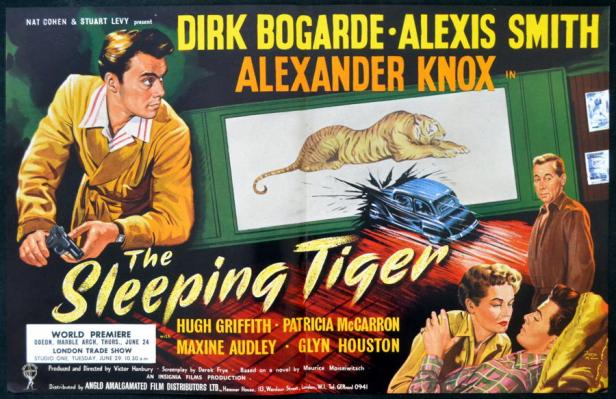
Joe Losey was a director who demonstrated great skill, imagination and creativity. I’ve watched many of his films and though I’m not sure I’ve ‘enjoyed’ all of them, I usually find something interesting and important. The Sleeping Tiger is a good example. I’m not sure it works but it is impressive nonetheless and it’s interesting for several reasons. Following his effective blacklisting in the US, Losey ended up in the UK in 1953 via Italy and joined a growing band of expatriate Hollywood personnel in London. For his first UK feature he borrowed the name of a relatively obscure British director from the 1930s, ‘Victor Hanbury’. The writers on the film, both blacklisted in Hollywood, similarly disguised their identity and Carl Foreman and Harold Buchman were credited simply as ‘Derek Frye’. The original novel was by Maurice Moiseiwitsch. The film is in effect a three-hander starring Dirk Bogarde, Alexis Smith and Alexander Knox. Smith and Knox, though both born in Canada were American citizens. There is a suggestion that Knox was another exile because of his politics while Smith was coming towards the end of the first phase of her career despite being only in her early thirties (she would later be successful both on stage and in television).
The production of The Sleeping Tiger was an ‘independent’ operation, organised and funded by US exiles and their UK partners. The significant company involved was arguably the distributor Anglo-Amalgamated run by Nat Cohen and Stuart Levy which had been around since 1945 and would grow in importance during the 1950s and 1960s before being taken over by EMI-ABPC. The film’s studio base was the venerable Nettlefold studio in Walton-on Thames which had been bought by another US exile known to Losey. The key figure in promoting the film was Dirk Bogarde who had been a rising star as a Rank player since the late 1940s and would finally ‘break out’ with the success of the Betty Box comedy Doctor in the House in March 1954. Bogarde convinced Losey to cast him by showing him Hunted (UK 1952), the Charles Crichton film which Bogarde believed was his best work in the 1950s. Bogarde was an unusual film star. He often seemed to play younger and strangely, as an ‘artistic’ young middle-class man, he was first cast in ‘hoodlum’ roles such as the young robber who shoots George Dixon in The Blue Lamp (UK 1950). This odd screen persona is relevant to his role in The Sleeping Tiger. He was top-billed in the UK but was barely known in the US.
Outline
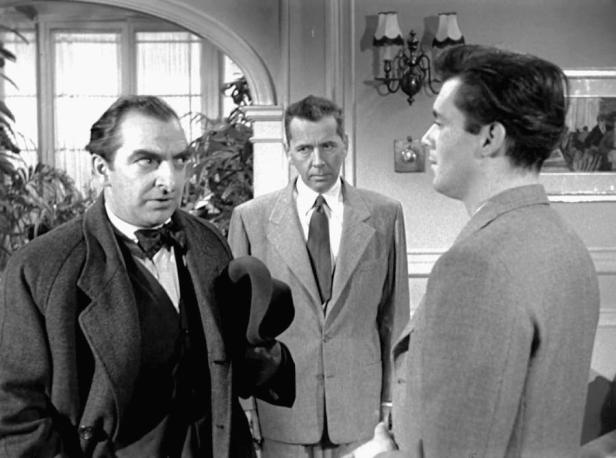
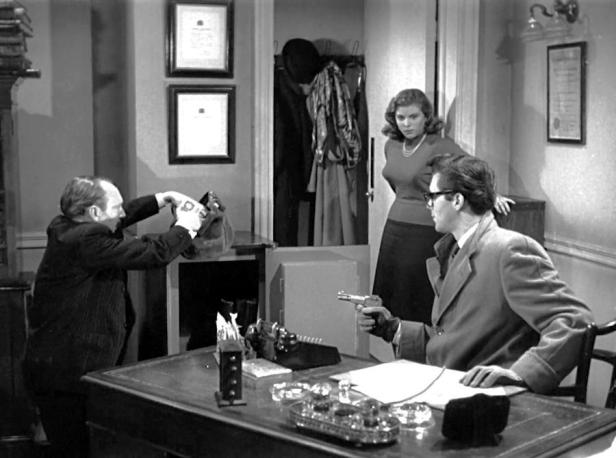
One night in the London suburbs, two men lurk in the shadows and attempt to waylay a middle-class man walking home. One of the two men pulls a gun and attempts a hold-up but his victim disarms him and the accomplice melts away. The young gun man is Frank Clemmons (Dirk Bogarde) and the man who disarms him is Dr. Clive Esmond (Alexander Knox). He takes Clemmons to his large house and invites him to stay. Esmond is a psychiatrist and clearly prosperous. He offers Clemmons a deal. He can stay for a short period but he must agree to allow Esmond to explore what has driven him to commit crimes. There are two women in the house as well. The ‘housemaid’ Sally immediately recognises Clemmons as a ‘bad ‘un’ and gives in her notice but Esmond’s younger wife Glenda (Alexis Smith) is not so easily disturbed. Soon, Glenda is taking ‘Frank’ out for morning horse rides and gradually a relationship develops. We assume that it becomes physical. There seems to be an assumption that Glenda is older than Frank (some reviewers refer to Glenda as a ‘cougar’ or a ‘forty-something’ woman). In fact , Alexis Smith was a few months younger than Bogarde but with his greased ‘pompadour’ hair and slightly fey mannerisms Frank does seem younger. Throughout the time Clemmons spends in the house, Dr. Esmond seems too busy to notice what is happening to his wife. Clemmons sneaks out of the house to visit a club and on a couple of occasions to commit thefts/robberies. A police Inspector comes sniffing around but Esmond is able to put him off. Eventually, Esmond proclaims that he believes he has ‘cured’ Clemmons, having discovered that the younger man’s unhappy childhood has led him to punish himself by committing crimes which he knows will see him arrested. Frank is presented as ‘cured’ much to the dismay of Glenda who tries to convince him to stay with her. It all ends badly.
Commentary
The psychiatrist faced with a problematic/criminal patient who tries unorthodox methods of treatment is relatively common in both UK and US films of the period. In the UK the Nigel Balchin story about an ex-soldier who has nightmares about his wartime experience became a successful film Mine Own Executioner (UK 1947) and later Herbert Lom played a psychiatrist in the long-running TV series The Human Jungle (UK 1963-4). To be frank, Dr. Esmond isn’t a patch on either Burgess Meredith in the 1947 film or Herbert Lom on TV in terms of psychiatry. On the other hand, The Sleeping Tiger has some merit as a ‘crime melodrama’. It’s a beautifully made film with excellent photography by Harry Waxman and a score by Malcolm Arnold and the performances are generally very good. I’ve seen one or two comments about the ‘intensity’ of the performance and this has been attributed to Losey who aims for something ‘bigger’ and ‘harder’ than was common in British pictures of the period. There are many familiar melodrama moments of mirror imagery and Bogarde and Smith together really create sparks for me. Bogarde is disturbing as the interloper. Smith is on edge, maintaining her ‘cool’ but showing the vulnerability beneath. Alexander Knox often played relatively dull but serious characters and he is well-cast here. I quite like the club which Clemmons frequents, taking Glenda there a couple of times, but the impact is let down a little since the club appears to be in a back street in some Home Counties town rather than the Soho location that Frank mentions.
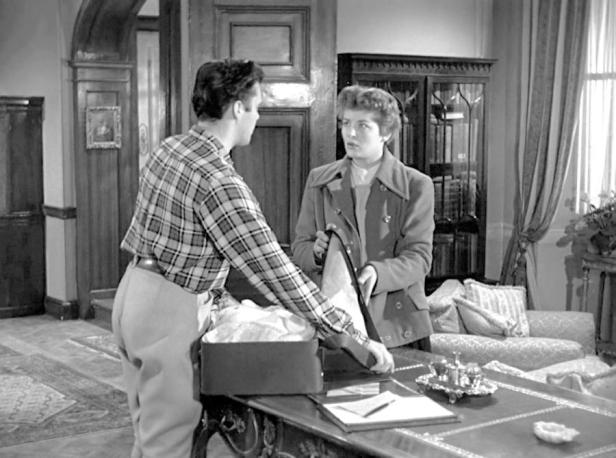
The budget on this film is quoted as $300,000 which was substantial in early 1950s UK (it represents around £107,000 in 1954) and at 89 minutes this was certainly intended as an ‘A’ feature. It does indeed seem to have had an ABC circuit release as the top half of a double bill and appears to have been described as a ‘moneymaker’ by the trade press in the UK. Dirk Bogarde and Joe Losey would later combine to great effect on The Servant in 1962 and several critics have seen this film as a precursor for that film’s even more controlling Bogarde character. By 1962 Bogarde’s career had been re-cast after his role in Victim (US 1961) and he developed a partnership with Losey which would in turn make him an international star, at least in Europe. I watched The Sleeping Tiger on an online print but I believe there is a Blu-ray available.
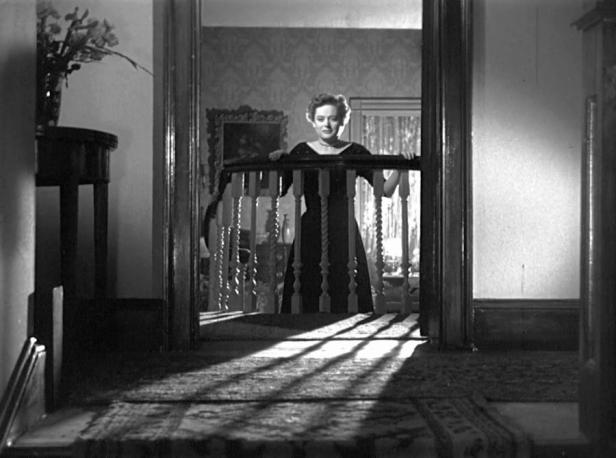
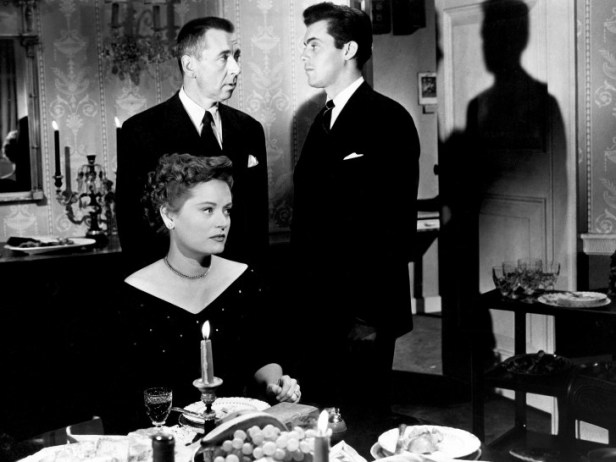
Inevitably perhaps The Sleeping Tiger is now promoted as a film noir, a ‘Brit noir‘ in fact, especially in America where the film was released by the small distributor Astor and where it initially sank without trace. There are some noirish scenes as depicted above but most crime films of the period have those and the other elements don’t suggest a typical noir narrative in my estimation. Glenda is less a femme fatale than a tragic figure in a dull marriage excited by the prospect of a fling with a young man who notices her. Still if the noir tag attracts viewers, I’m happy with that. If you haven’t seen it, I think it is definitely worth a look for its performances and photography alone. Here’s a clip from a visit to the Metro club – Glenda’s first time:
My main source of material on Losey is David Caute’s Joseph Losey: A Revenge on Life (faber & faber 1994). There is very little on The Sleeping Tiger in Tom Milne’s Losey on Losey (Secker & Warburg/BFI 1967) and what there is sees Losey contradict what is said elsewhere. He clearly didn’t think much of his first UK experience, though he recognised some of the possibilities involved in working with Dirk Bogarde. A later British film by Losey is also discussed on this blog – Blind Date (UK 1959).
 itp Global Film