
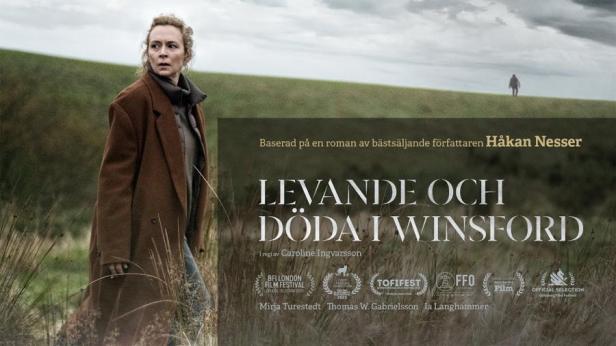
Is the UK’s passion for so-called ‘Nordic Noir’ slowly fizzling out? This adaptation of a stand-alone 2013 novel by the Swedish writer Håkan Nesser was finally given a limited release in the UK earlier this year by Bulldog, a distributor new to me, having been screened at the London Film Festival in 2023. I read the novel soon after the English translation was published in 2015 and I caught the film last week on Amazon Prime. Nesser is one of Sweden’s leading crime fiction writers, best known internationally for two series focusing on two rather different detectives, Inspectors Van Veeteren and Barbarotti. I believe the Van Veeteren books have been the basis for a Swedish TV series: the stories are set in a fictitious ‘Nordic’ country. Otherwise, this film is the first international cinema outing for Nesser’s work.
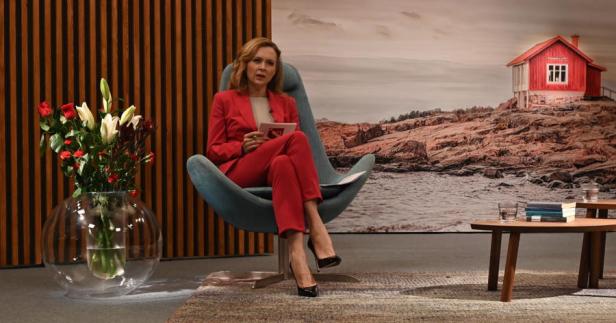
There is an important difference between the novel and the book involving the narrative structure. The novel includes several flashbacks whereas the film script by Michèle Marshall is linear. The story is set in Sweden, Poland and the UK and the film is a co-production involving Swedish and Polish production companies with public funding. In linear terms the narrative begins in Sweden with the failing marriage of Maria (Mirja Turestedt) and Magnus (Thomas W. Gabrielsson). He’s a Professor of Literature and a novelist and she was once his student but chose not to become an academic and instead trained as a presenter for television. Magnus has been accused of raping a young woman he met as part of his work but has not been charged and this might be the last straw in the breaking up of the marriage. Magnus insists on a winter holiday trip together to Marrakesh where he hopes to complete a writing project about a time a time in his youth when he was in a writer’s colony on a Greek island. Maria reluctantly agrees to join him though she would prefer to go to England. She acts as an editor for Magnus. They intend to drive across Europe and presumably take a ferry from Spain or France. They stop first in Poland where Magnus has an old friend and this proves to be the point of break up. It’s unclear exactly what happens but Maria leaves Magnus, taking the car and driving across Europe to take the ferry to the UK. She drives down to Exmoor where she rents a cottage near the village of Winsford in Somerset – thus the Swedish title of the film. Unlike in his two series, Nesser used ‘real’ locations in Somerset. The English title of the film is a pun which neatly references Maria’s sense of ‘dislocation’. She is ‘unmoored’ like a boat that has lost its mooring and she is attempting to live in what for her is the alien landscape of a wild moor.
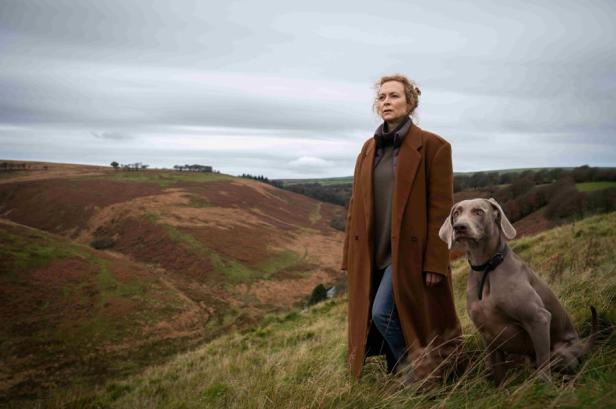
Unmoored is the directorial début of Caroline Ingvarsson. She has been praised for her earlier short films but this first feature has had a mixed reception. On the positive side she has elicited some strong performances from Mirja Turestedt and by Kris Hitchen as the single parent of a teenage boy who is Maria’s nearest neighbour on the moor. She has also been well served by the Polish cinematographer Michal Dymek, editor Agata Cierniak and composer Martin Dirkov, especially in the presentation of the landscape and atmosphere of Exmoor. The film uses Swedish, Polish and English dialogue. I had no problems with the English dialogue but I’ve seen reviews that are critical of the Swedish dialogue and acting performances. Narrative ‘mystery’ is set up by the appearance of a car with Polish plates on Exmoor and also an email threat that frightens Maria, implying that somebody ‘knows where she is’. I should also point out that there is one other important character – Maria’s dog Caspar. It is possible to bring pets into the UK but it is still a complicated process and I don’t think a casual ‘spur of the moment’ journey with a large dog like Caspar would get past UK Border Control. But this is not really a major problem compared to the lack of a resolution to the ‘mysteries’ outlined above. Maria does go back to Poland and does eventually report her husband to the police as ‘missing’ but the narrative ends with the results of any police investigation still ‘hanging’.
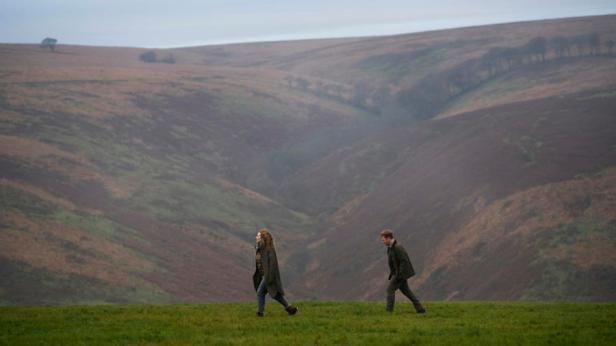
It’s ten years since I read the novel so I went back to see if it dealt with these mysteries. Unfortunately, the rental time limit for the film meant I wasn’t able to watch it again, but a number of points stand out when reading the novel. First, the novel is much more than a simple mystery/thriller as implied by the film. A long novel of over 400 pages, it spends a long time on Exmoor with Maria, gradually exposing her history and presenting an in-depth characterisation of this fifty-five year old woman with her dog. It is a psychological thriller in which we learn a great deal about Maria and about her marriage. The film doesn’t have the time to develop this and Mirja Turestedt has little to work on other than the mystery/suspense elements in the narrative.
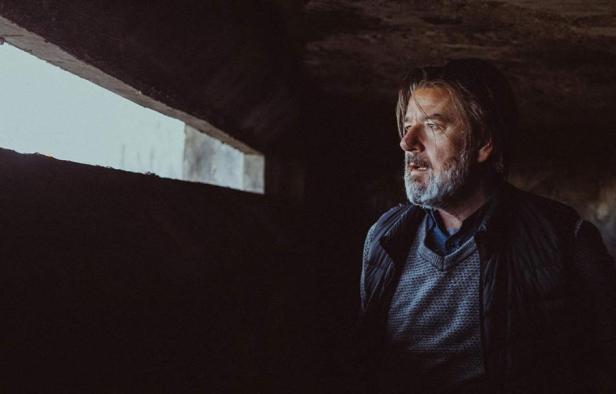
The novel is very good and I recommend it unreservedly – I understand that Håkan Nesser knows Exmoor very well and this is evident from the moorland scenes in the film. But overall the film adaptation is disappointing and I can only conclude that the rights were acquired on the assumption that it would do well as a mystery thriller but the adaptation isn’t up to the job. At some point it must have been decided that the book’s narrative could be shortened and simplified. But whereas the original narrative provides reasons for the ‘mysteries’ on the moor and has a surprise ending that makes sense, the film leaves the mysteries unexplained and lacks a convincing resolution. It’s a diverting watch but frustrating.
 itp Global Film
I watched “Unmoored” back in August at the National Media Museum. As the English language title suggests, Maria has lost control of her life, due to an incident she initiated on a lonely beach in Poland. She heads to Exmoor, England and is seen roaming the moors, like a character out of the Bronties! Alienated and becoming paranoid she decides to return to Sweden and face the consequences of her actions. The performance of Mirja Turestedt as Maria, is excellent and the photography on Exmoor, with its shots of wild horses and figures in the landscape, is very atmospheric. If I remember correctly, there is a certain amount of flasback in the film and I thought for a first time director Caroline Ingvarsson did a good job. However, as you state the plotline at times becomes frustrating. Who does the car with foreign plates belong to (I believe she actually attacks at at one stage) and who is the mysterious e-mailer. None of this is explained and leaves one asking questions and feeling dissatisfied, I don’t know, but it almost felt like the middle section of the film on Exmoor had been either trimmed at the script stage, or cut at editing. Nevertheless, a film worth seeing and a director to keep an eye on.
LikeLike