

The Assistant might be classified as one of the victims of COVID and Lockdown. After appearing at Telluride in 2019 and then Sundance in January 2020, the film had a limited release in the US. It was scheduled to expand this release but that plan was scuppered by Lockdown and transferred to streaming. This isn’t a ‘fun movie’ or escapist movie of the kind sought by households during lockdown but a serious drama attempting to engage with a core issue in the #MeToo campaign. The central character is a young woman in her early 20s who is trying to get a foothold in the film business with an eventual aim of making it as a producer. The film narrative offers us one day in her life when she confronts what she sees as toxic behaviour in the office and learns what the consequences might be.

Writer-director Kitty Green made this film after two well-received documentaries and her approach is carried over in the documentary-style presentation of ‘a day in the life’ of the young assistant Jane (Julia Garner). We follow her from the moment she gets picked up by a company car at some unearthly hour in the suburbs and is delivered to her office building in the centre of New York (I don’t know New York and this seems an area with cobbled streets?) . There is a minimal music score for the film which I think is present for the opening and closing sequences but there is no music for the bulk of the time in the office building. Jane is a diligent worker and we observe her doing a range of menial tasks and also dealing with telephone calls and messages. It appears that she has been hired as an assistant to the ‘Boss’ and she works alongside two male assistants who seem to be mostly working through data on their screens. The ‘Boss’ is never seen but his presence is palpable. He sends emails to Jane from behind his door and she speaks to him (I think) on the phone. We are not told anything, instead, as in a good procedural narrative, we pick up information and ideas as the narrative unfolds. The company seems to be modelled around a large independent operation, perhaps like Miramax was in the early 1990s, with offices in Los Angeles and London as well as New York. If this makes the narrative sound unexciting and potentially tedious, it perhaps is for some audiences but I found myself very much engaged by Jane’s day and I was working hard to try to work out exactly what was going on.
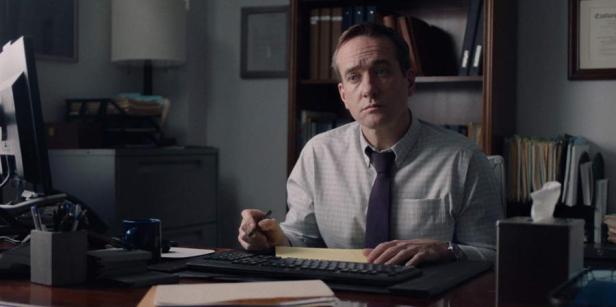
Jane is presented as a serious and hard-working young woman. She is dressed for the job in a simple high-necked top and high-rise trousers. She has to tidy-up the office, clear drinks and dishes and get down to deal with the photocopier. At one point she is required to look after two children. The Assistant is a shortish feature under 90 minutes. It works by gradually increasing the tension we might be experiencing as we realise that Jane is certainly at the bottom of the food chain and although she may be only occasionally the butt of jokes by the two guys who share her office space, the other incidents show the strain she must be under. For instance, she must deal with the wife of the Boss who often seems angry on the phone and she greets Japanese visitors, probably knowing that the Boss has not made himself available for the meeting they expect. The crunch comes in the second half of the narrative when Jane realises that a young woman who arrives from Boise, Idaho is being offered a job though she has relatively little experience of the film business. Jane sees the girl is young and pretty and has to accompany her to a hotel which is implied as being relatively up-market. Concerned for the girl’s safety, Jane decides to visit the Human Resources team and discuss her fears, especially as she believes her Boss is heading for the same hotel. What follows is the crunch-point of the story. Jane haltingly explains her fears to ‘Wilcock’ played very well by Matthew Macfadyen. He oozes false bonhomie, assuring Jane he is there to listen but then turns her description of events on its head and lays out the ugly truth about her position in the company. It’s a put up or shut up scenario. I won’t spoil any more of the narrative, but if you’ve wondered what all the fuss is about with #MeToo this film nails it.

Photo: Ty Johnson / Bleecker Street
I think that, as some reviews predict, this film divides audiences. On one level some audiences just won’t cope with its slow pace and lack of ‘action’. Others will be gripped by Jane’s dilemma. Some audiences will understand if Jane drops her complaints while others might feel angry towards her if she doesn’t stick to her guns. Where do you stand? The original point about ‘independent’ film production in Hollywood – and especially for women – was to get away from the studio’s ‘men in suits’ who interfere with how films are made. Jane is a bright young graduate from Northwestern who wants to become a producer, but there are hundreds of others just like her. Does she just need to grit her teeth and get on with it to secure her future career ? I’m not sure where I stand, although of course I’m totally against the whole way in which this young woman is treated and the first priority must be her mental health. People starting their career need to be tested certainly and the best way to learn often involves some form of ‘failing’ but the responsibility is with the company to ensure that failure takes place in a supportive environment. In the company presented here, instead of that support there is a toxic culture that has been allowed to develop.
I think it’s significant that this project had more than the usual number of producers. There are six main producers and a further eight ‘executive producers’ and one co-producer. Three of the six producers are women (including Kitty Green herself). Too many producers is sometimes a sign of a production that has no clear direction but that isn’t the case here. Kitty Green seems to have a clear vision and she is in control. I think it is mainly the result of seven small production companies being involved. Despite its low score on various review sites, I recommend this film as an intelligent and well-directed documentary drama about the film business. The Assistant is currently available on BFI Player and via Amazon or Apple in the UK. It’s available on most streamers in the US.
 itp Global Film