
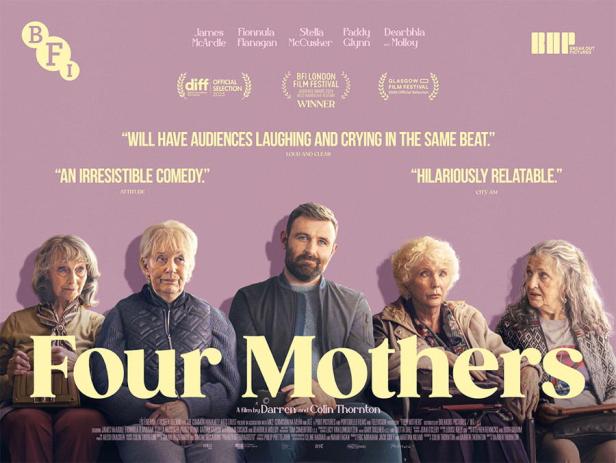
Four Mothers received a limited release in the UK and Ireland in May 2025 and I confess that I didn’t pay it much attention at the time. It was a BFI release in the UK and is now streaming on BFI Player. Clearly I was wrong to overlook the film. It turns out to be a loose and slightly extended Irish remake of the Italian film Mid-August Lunch (2008) which I enjoyed watching during lockdown in 2020. It uses the same basic premise of the Italian film but none of the specific characters or narrative details. In this case the central character is a novelist who has just had his first major breakthrough – a Young Adult novel that is being published in America. He is being promised an invitation to tour the US and before that to take part in interviews via internet phone links. Edward (James McArdle) is a gay man. This is not a ‘problem’ in itself but it does put him in a particular situation in the current American culture wars, especially the book banning in schools, but this is not explored here. More importantly in this case, Edward is also the carer responsible for his 81 year-old mother Alma (Fionnula Flanagan) who is recovering from a stroke which has taken away her speech and her mobility. She now communicates via an iPad which voices her ‘commands’ to her son.

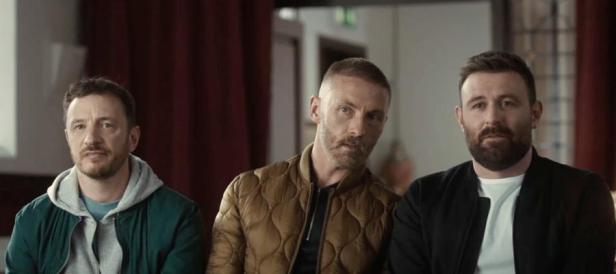
In the build-up to his American trip, Edward must work out how to organise his mother’s care but before he can make too many plans he finds himself landed with more responsibilities. Two of his friends decide to go to a Pride event over the weekend in Spain and then his psychotherapist also decides to go to the same event and all three bring their mothers to be looked after by Edward. The only reliable friend who is still going to be in Dublin is James’ ex, Raf (Raphael), who at least has the advantage of being the driver of a community bus service – as well as being much more ‘sorted’ in terms of his own situation. The narrative drive in the film is Edward’s anxiety about his career finally about to take off and his realisation that his family issues are not resolved.
This is a comedy drama with a narrative that mainly covers a single weekend. Each of the four women has their own medical issues including mental health issues and their own unique quirks. Edward’s novel is about a gay teenage character and he will have to answer questions on the book tour about how much of it is autobiographical. This in turn will lead into issues about his relationships with his parents. Comedy drives the narrative but the drama also runs through the narrative line. This makes what is a serious problem about care for older people more accessible for a broader audience. It also means that it is more conventional as a genre film and for some critics this downgrades it. This is a shame because we all have to grapple with ageing process. This film succeeds for me because of the performances, particularly of the central pairing of McArdle and Flanagan who are both excellent. McArdle is, I think, a Scot of Irish heritage and is certainly convincing for me and Flanagan is a star in her own right with the most amazing and very eloquent eyes. I’m sure she enjoyed herself on this shoot. The rest of the cast is equally good and it’s great to see comedy roles for older actors. The film’s creative team is led by the brothers Thornton. Colin is associate producer and co-writer, Darren is co-writer and director. Most of the film is shot around the suburbs of Dublin with a single road trip out to Co. Galway. This latter seems to have upset some reviewers but I think it works as a device to expose how the mothers and sons were treated by the fathers no longer around – the mothers persuade Edward and his ex to take them to meet a TV medium in person at her isolated house. I note that the film seems to have been shot in a ratio of 2.00: 1, wider than the standard widescreen TV image but short of the wide ‘Scope framing of more expansive cinema films. This is a ratio often used by European TV dramas and I expect most audiences will watch the film ‘letterboxed’ on their TV sets.

I think there could be a few people offended by some of the language in the film (like some aspects of language use in Scotland, what might be treated as potentially offensive in England, is thought relatively inoffensive in parts of Ireland). I can’t really comment on the jokes about gay culture but I’m fairly sure the representations of the over-80s characters are well thought out. I enjoyed the comedy and I was engaged by the drama. I’d recommend the film for any audience (it has a 15 rating in the UK). Four Mothers is available via Apple and Amazon as well as the BFI Player in the UK.
 itp Global Film