
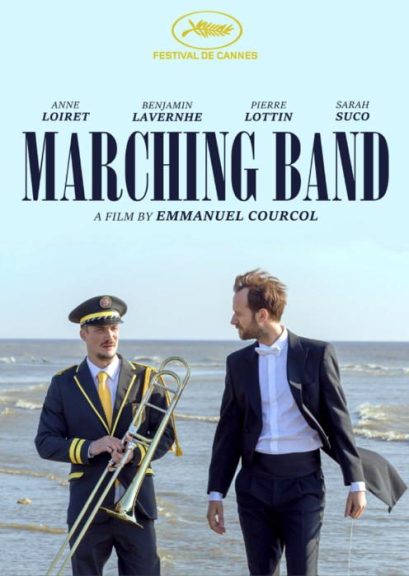
This French film did get a brief UK cinema release but didn’t take off in any meaningful way after opening on 60 screens. That’s a surprise, partly because on IMDb it has a high rating and numerous comments full of glowing praise and appreciation from various territories. UK reviewers were quick to note that the film shares some elements with the popular British film Brassed Off (UK 1996). That film had a wide release but The Marching Band is subtitled and treated as an ‘art picture’ so the large audience for Brassed Off has probably not been able to compare the two films.

But really, The Marching Band is not an art film and it isn’t actually mainly about brass bands. Its generic mix includes two French specialisms. One is a group of films that focus on the stories of hardship and despair associated with industrial decline in the Nord region of France which covers the the former coal mining areas and the surviving industrial plants and factories close to the French-Belgian border. These films focus either on industrial disputes or sometimes the comic possibilities of comparing the region’s population with the more sophisticated and affluent regions of Paris and other parts of France. The second group concerns music, communities and/or competitions. But it is a third genre, the family melodrama with a focus this time on life-changing disease, that in the end dominates The Marching Band.

Thibaut is a successful musician who has become an international conductor based in Paris. He’s something of a star performer but right at the start of the narrative he collapses and is diagnosed with leukaemia. A search for a bone marrow transplant reveals that Thibaut is adopted so his sister can’t help but he also discovers that he has a younger brother and he sets out to meet him. Jimmy lives and works in one of the small towns that were once part of the coal mining region. The pits had gone by the end of the 1980s and Jimmy works in a school canteen and plays the trombone in the local brass band which was once the colliery band. Jimmy is estranged from his wife and his teenage daughter and, although he has a supportive girlfriend Sabrina, he feels like a failure and is back living with Claudine, the woman who adopted him after his birth mother died when he was three. Reluctant at first, Jimmy becomes a donor. I won’t spoil the rest of the narrative but I will say that it doesn’t develop quite as I expected.

En fanfare was a sizeable hit in France going showing on over 900 screens at its widest release and earning over $20 million at the box office. It was also a hit in Germany and did reasonable business in Spain and Italy. Only in the UK and US was it disappointing box office. Unfortunately, it is rare for a popular French hit to do well in the UK. I remember being surprised by the failure of La famille Bélier (France-Belgium 2014) in the UK which had only a token cinema release here but had been a big hit in France. It too was a story about struggle and music and like En fanfare was on release at Christmas. Its Hollywood remake CODA (2021) won three Oscars. What is it about the Anglo-Saxon approach to music in French culture? Most French films with a focus on music are either about classical music, chanson or jazz and sometimes, like En fanfare, all three. Thibaut and Jimmy discover that they have both independently developed a taste for jazz – Clifford Brown an early 1950s trumpeter who died aged 25 is the brother’s shared love.

Music is central to the film and it is music that forms the basis for the brothers’ developing relationship which has its ups and downs. There isn’t a North v South conflict but the narrative brings out the social class difference between the brothers. Jimmy is initially worried that Thibaut is a ‘posho’ coming to slum it in the mining towns and is resistant to Thibaut’s attempts to encourage his brother’s musical talent. There is also an element of class difference in the casting in that Thibaut is played by Benjamin Lavernhe ‘de la Comédie-Française’, i.e. an actor similar in status to the players of the RSC in the UK. Jimmy is played by Pierre Lottin, just as good an actor but without the status – I don’t know if it is a contractual issue that la Comédie-Française has to appear in the credits. The class difference also divides the adoptive mothers too, though this is presented in a subtle way.

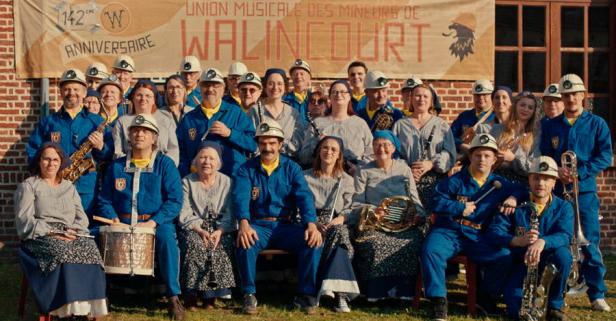
The film is co-written and directed by Emmanuel Courcol, an actor and writer making his third cinema feature as director. He had the original idea for the film several years earlier but recognised that he needed a woman’s perspective on the material and invited Irène Muscari to work with him on the script. She came up with the bone marrow transplant idea. There are several secondary roles in the film for women. None are expanded but all are essential to the development of the narrative. The key to understanding the narrative fully is the director’s interest in the relationship between the brothers and how this is fully realised in the context of the different kinds of music. The whole narrative is rooted in the director’s interest in the Nord region and its culture and he was determined to find a ‘real’ marching band that could be the base for the community and into which he could feed his carefully cast actors – who would ideally need to play an instrument themselves. He found his band, the Walincourt Miners’ Band through local contacts.
There is an interesting interview with Courcol in the Press Notes in which the interviewer suggests that the location shooting (most of the film was shot in Lallaing near Douai) conjures up the ‘British social comedy’ and Courcol responds by saying he thinks the brick buildings bring a sense of ‘authenticity’ to the setting, especially in the way that they are captured in the ‘Scope cinematography of Maxence Lemonnier. I have mentioned before that the broad swath of early industrial activity from Lille over the border towards Liège during the early 19th century followed quickly on from the Industrial Revolution in the UK. Films set in the region are well known for their ‘social realism’, also familiar in the UK. I don’t know if Emmanuel Courcol thought of Brassed Off or other films of British social realism and their occasional comic elements but I think there is a connection.
I note that one reviewer uses the term ‘feelgood’ to describe the ending of the film. I don’t think this is appropriate and Courcol himself says he hates the term. I won’t spoil the ending but I did find it moving and I thought it worked very well as it doesn’t signal a conclusion but it represents an important moment in the developing relationship between the two brothers expressed through their love of music. I recommend the film very highly after watching it on BFI Player (subscription). It is also available via Apple, Amazon and Sky in the UK.
 itp Global Film