

This film was part of One Hundred Years Ago programme. It was the first feature-length film directed by Sergei Eisenstein. As with his later films Eisenstein dominated the production, both directing and editing the film and writing the script with several comrades. The film was a joint production by the Proletcult Theatre, an avant-garde cultural organ committed to political agitation, together with Goskino, the main production and distribution film organisation in the Russian Soviet Republic. This was to be part of a seven-part series titled ‘Towards Dictatorship of the Proletariat’, but only three films were completed. The context for the film was an emerging film industry recovering from the Civil War and invasions by foreign states including Britain. The industry suffered from extreme shortages so that Strike was produced in 1924 but only released in 1925 due to the shortage of film stock. It was also the period of the New Economic Policy, considered a necessary step allowing capitalist and market forces to operate so as to recover from the devastation of war. And it was in 1924 that the Revolution lost the leadership of Vladimir Lenin. This led to conflicting factions within the Bolshevik party arguing for different strategies to take forward Socialist Construction.
There was already a film montage movement, led by Lev Kuleshov and including film-makers like Esfir Shub and Oleksandr Dovženko. Eisenstein had already used ideas of montage in his theatrical work along with ‘attractions’ which used shock tactics taken from the circus and the use of typage in representing characters. Strike is clearly the work of a young film-maker, experimenting with all sort of techniques and assembling a form that undercuts traditional approaches. The Festival Catalogue comments;
Whatever may seem a flaw in Eisenstein’s first, anarchic feature is, in fact, an attribute. Mismatches; discontinuities; disorientating camera setups; even the shot of a puddle that has been spliced in upside-down – any inanity we encounter in Stachka is there not by mistake but by design.
The production used several people who would become important collaborators. There is Aleksandrov Antonov, acting and assistant director. Whilst the cinematography is by Eduard Tissé who had experience in documentary film. The film does have a narrative, following events in 1903 and using an actual factory and workers alongside the Proletcult performers.
The action is divided into six parts, each one reel.
At the factory all is quiet
The introduction presents both the workers at the factory and the Capitalist owners, their satraps and their spies and agitators.
Reason to strike
The death of a worker sparks a strike and confrontation with the management.
The factory dies down
We see the life of the striking workers and their families whilst the owners plot to subvert the strike with the aid of the police.
The strike draws out
Privations affect the striking workers and their families. Spies and provocateurs work to subvert the strike.
Provocation and debacle
The provocateurs set fire at a liquor store. As crowds gather the firemen turn hoses on the people and mounted Cossacks arrive.
Extermination
The troops attack the workers and ordinary people; first in the empty factory, then in the nearby tenements and then across fields and a river, inflicting a large-scale massacre.
The film uses symbolism alongside the technical prowess and the satirical attractions. Non-diegetic motifs comment on character and story. Early in the film the circle becomes associated with the workers. The spies and provocateurs are associated in the title cards and then visually with animals. And the final brutal massacre is symbolised by an abattoir shot.

Extermination is indeed a violent and brutal tragedy. And in a contemporary viewing I felt it was difficult not to draw comparisons with the current massacres among oppressed peoples; most notably there is genocide in occupied Palestine. I personally felt that this final section could be screened silently, with out noise or music. In fact the whole film had a well-constructed musical score by a troupe of seven musicians. They received deserved warm applause from the audience. But I found it difficult to join in immediately after the film’s final devastating shots.
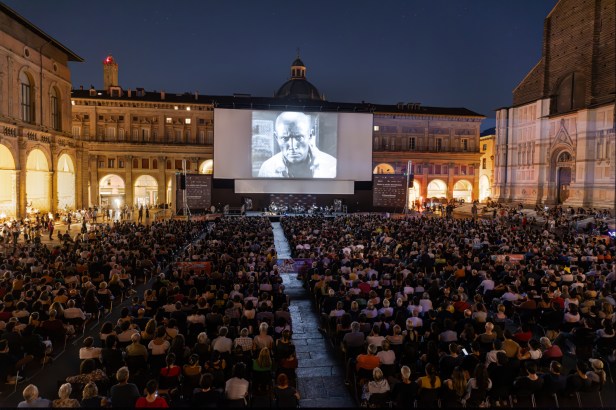
When the film was released in the Soviet Republics in 1925 it received mixed responses. And it had a very limited release outside of the Soviet Union. But even critical viewers would have been well aware that the defeat presented in the film had now been followed by the revolutionary victory over the Czarist regime. A contemporary audience presumably would be aware of that as a historical fact but not necessarily with sense felt by Soviet workers of the period. A Soviet film from the same year but presenting The Soviet Union following the Great Proletarian Revolution would make this point effectively. And there are three issues of Kino-Pravda, the newsreel produced by Dziga Vertov and the Factory of Facts, in this year, No’s 21, 22 and 23. The workers of this collective offer a different approach to montage from that of Eisenstein though they are also very innovative. Number 21, Lenin Kino-Pravda, is a tribute to Lenin, assassinated in 1924. Whilst in part a lament for the lost leader it is also celebration of his contribution to The Dictatorship of the Proletariat. It runs 29 minutes. The 35mm print projected in the Piazza Maggiore was from La Cinémathèque de Toulouse. The print was black and white and in the usual aspect ratio of the silent period. The title cards were in Russian with French sub-titles and then digital titles below the screen in English and Italian. This print was 1937 metres and projected at 18 fps, running time 94 minutes. The print was pretty good though it varied a little in some sections. And the Piazza Maggiore was full, so a couple of thousand people viewing the film, at least. Eisenstein’s next project, Battleship Potemkin / Bronenosec Potëmkin was also screened in the 1925 programme from a 35mm print as well as Dziga Vertov’s Man with a Movie Camera / Ljudyna z Kinoaparatom on a 35mm print.
 itp Global Film