
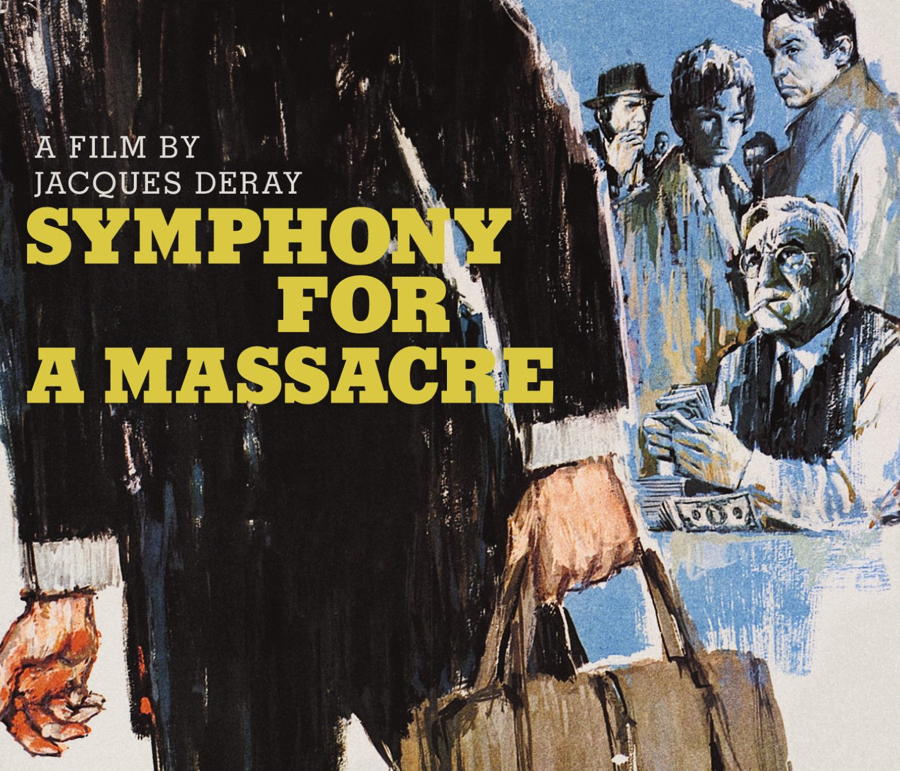
This is one of the films featured in the Radiance catalogue of Blu-rays using restored prints. I would describe it as a polar – the familiar French crime film genre (although the term came into use later in the 1970s, it includes the same elements). It’s directed by Jacques Deray and written by Claude Sautet, José Giovanni and Deray, based on the novel Les mystifiés by Alain Reynaud-Fourton. Strong on visuals, cinematography is by Claude Renoir and art direction by Léon Barsacq while the music is by Michel Magne. The film is presented in the 1.66:1 ratio in b&w.

Essentially this is a twist on the conventional ‘heist movie’ (Deray’s previous film was Rififi in Japan released in the same year). The local ‘Mr Big’ wants to bring a large consignment of drugs into Paris from Marseilles. He offers a group of five criminals in Paris the chance to buy a share in the project. They must each find a fifth share of the total budget and one of them must be prepared to carry the cash on the overnight sleeper from Paris to Marseilles. The five are something of a motley crew. Two are seasoned criminals, careful, organised and meticulous in planning – Paoli and Valoti, played by Charles Vanel and Claude Dauphin. They both have ‘respectable’ fronts with Valoti owning a successful restaurant. Clavet (Michel Auclair) runs a small-time casino (which is owned by Valoti?) and Jean Rochefort plays a character, Jabeke, whose income source is not so clear, but he is clearly a smooth operator. Rochefort was an interesting choice for his role. At this point in his career he often played comedic roles. He would become a front-line star later in the 1970s.

A rather rougher character is Moreau played by José Giovanni. Giovanni was an important ‘player’ in the polar, a former criminal whose story is told in Jacques Becker’s Le trou (1960). He went on to establish himself as a writer providing authentic details about criminal behaviour and criminal argot. One of his first co-writing jobs was Classe tous risques (France-Italy 1960) directed by Claude Sautet in which Lino Ventura has to get home safely to Paris after killing a man in Italy. Jean-Paul Belmondo is sent to Nice to drive him back. The journey from the South of France to Paris is a familiar trope of the polar and Belmondo made such a journey at the start of Godard’s A bout de souffle (France 1959). Symphony simply reverses the direction of the journey and the mix of generic elements remains the same.

The film opens with the first clue as to why the plans will fail. Valoti’s wife, Hélène (Daniela Rocca) is shown slipping out of her husband’s restaurant and visiting Jabeke. The suggestion is she will leave her husband and move in with Jabeke. Rocca was the Italian actor in the mainly French cast. What follows is a conventional narrative of the ‘falling out of thieves’ but it is told very stylishly and with fine details in the plotting. Paoli collects the money together and accompanies Moreau to the Gare de Lyon to catch the sleeper, but Moreau is attacked on the train and the money is stolen. I won’t reveal any more of the plot but eventually all will be lost. The neat twist is that the film starts with a woman and the second woman doesn’t properly appear until the final section of the film. I was a little thrown because the name I recognised in the cast list was Michèle Mercier. She became a big star in France the following year with the first of five films in which she played ‘Angélique’, the heroine of stories taken from the historical romance novels written by Anne Golan. These were lavish ‘Scope Eastmancolor pictures which sold well internationally and I caught one of the dubbed prints in the UK in the 1960s because I had read a couple of the novels in translation. Mercier’s name had stuck with me so I was waiting for her appearance as Madame Clavet. There are seven actors promoted in the credits and ‘listed alphabetically’ – the five men and the two wives.

In one of the two extras on the Blu-ray disc, Christina Newland discusses Jacque Deray’s career and discusses this film as a film noir, noting the women’s roles in the narrative. The designation film noir is fair enough, especially in a French context, but I prefer thinking about the film as a polar. The international visual style and theme of post-war angst associated with film noir had largely dissipated by the early 1960s and this film combines several elements that make up a different kind of crime film. Michel Magne’s jazzy score is matched by realist camerawork on the streets recalling the bravura of la nouvelle vague and reminding me of Chabrol’s Les bonnes femmes (France-Italy 1960) and Louis Malle’s Ascenseur pour l’échafaud (Lift to the scaffold, France 1957) as well as the films of Jean-Pierre Melville. One of the key elements of the polar has been argued to be the presentation of American culture in French films and a general discussion of the importance of developments in the relationship between France and America. In this film, Valoti is the one who drives the American car with its exaggerated tail fins and one of the major plot developments involves two Americans who win big at Calvet’s casino operation forcing him into an unwise decision about finding more money. Intriguingly, the Americans speak fluent French and they reveal themselves as international bankers, not tourists.

I found the ending of the film satisfying. There is really no ‘winner’. I enjoyed the details of the operation and the sense that it takes place in a ‘real’ paris. I highly recommend the film. The second ‘extra’ on the Blu-ray is one of those French TV clips that I really like, a discussion about the film with Deray, Vanel and Rochefort. Deray went on to become a successful director of crime films, especially in partnership with Alain Delon. His biggest commercial hit was probably the fashion conscious ‘costume gangster picture’ Borsalino (France 1970) with Delon and Belmondo. I saw that film on its UK run and also the 1974 UK release of The Outside Man (France-Italy-US 1972) an LA-set hit man movie starring Jean-Louis Trintignant, Ann-Margret, Roy Scheider and Angie Dickinson. I note that I have a copy of La piscine (France-Italy 1969) with Alain Delon, Romy Schneider and Maurice Ronet somewhere. I think I’ll search it out. Deray is certainly a major figure in the polar/crime film. Symphony for a Massacre is streaming in the US on several platforms but not in the UK at the moment. Here’s the trailer for the US Blu-ray from Cohen:
 itp Global Film