

My local cinema put on an afternoon screening of this film on Holocaust Memorial Day. I wanted to support the cinema and this particular type of Holocaust narrative seemed to offer something different. Thinking about the film now I have mixed feelings. On the positive side, the film is a genuine co-production with the Polish Film Institute and some funding came from Poland as well as from Hollywood. It’s a ‘Searchlight Pictures’ production and release with no use of Disney branding. Searchlight seems to have been reborn under Disney ownership as an ‘independent production/distribution company’ focusing on what the Americans call ‘specialty’ pictures. I’m not sure whether this film would be termed a ‘specialised film’ in the UK. Some reviews refer to the film as a mix of a road movie and a comedy drama. I’m not sure the road movie elements contribute that much but I think it is a sensitive film in the sense that it genuinely tries to deal with issues about remembrance and identity and the comedy is directed at human weaknesses in dealing with the Holocaust and its meanings.

A great deal has been written about the film betwee its first screenings at Sundance 2024 and its subsequent UK release in early January 2025. Even so I’ll just sketch out the pitch of the film which was written, produced and directed by Jesse Eisenberg. He also stars in the twin lead role with Kieran Kulkin. He began his research as long ago as 2008 when he read about heritage tours being organised for Americans travelling to Poland. He and his wife went to Poland to explore possible locations. The final script sees two cousins, David (Eisenberg) and Benji (Kulkin) joining a small group with a British guide. James (Will Sharpe) is non-Jewish but a scholar of Eastern European history with an Oxford education. The other tour members comprise a recently divorced middle-aged woman, Marcia (Jennifer Grey), an older couple from Texas (Daniel Oreskes and Liza Sadovy) and Eloge (Kurt Egyiawan) a refugee from Rwanda via Winnipeg who has converted to Judaism. This motley crew begins the tour in Warsaw and then travels to Lublin for the key scenes before David and Benji leave the group to visit the former home of their grandmother, whose inheritance funds have paid for their trip.

My first thought watching the film was that it was similar to watching a Mike Leigh film in that the script and the ideas it covers are very interesting but watching some of the characters (i.e. mainly the two cousins) is excruciating. Eisenberg himself is of Polish Jewish heritage and I thought I recognised some traits from Woody Allen and other Jewish comic actors. Kulkin isn’t Jewish (a considered casting decision by Eisenberg) and I’m not sure where his performance comes from but I found it difficult to watch. What made it worse for me was that he is the character who makes some of the key moral points and most cogent observations. Kulkin’s performance has been widely applauded and recognised by awards so I’m no doubt in a minority. I do think the script is quite clever. At one point David explains Benji’s behaviour by recounting the well-known story of the migrant experience of many groups in America – the first generation works hard in poorly paid employment focusing on a good education for their children who become professionals but the third generation are content “to sit in their grandmother’s basement and just chill”. This does indeed describe Benji but the story resonates with all the others on the trip as well. I wasn’t sure about the British tour guide, however. Will Sharpe is actually a multi-talented Cambridge graduate whose mother is Japanese and he spent part of his childhood in Tokyo. It might perhaps have been interesting to use some of this background in his character. Or perhaps I missed something about James?
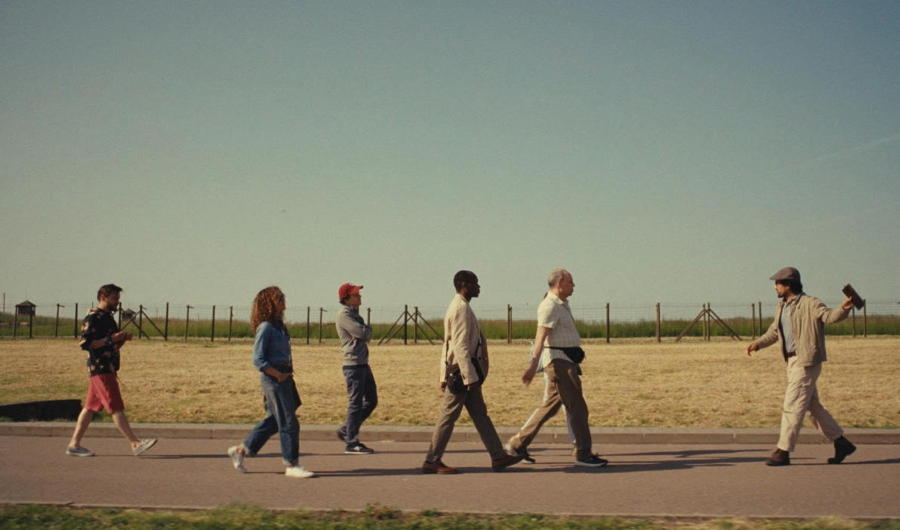
The Holocaust remembrance comes with a visit to a preserved concentration and extermination camp just outside Lublin, now the State Museum of Majdanek, which is shown almost in silence (or so it seemed to me). In addition there are scenes in Lublin’s Jewish quarter and original graveyard and on board a train in which Benji in both cases gets to the point quite directly. The Lublin scenes were the most interesting for me simply because I didn’t know the history of the city and the photography and the locations themselves were fresh to me. The cinematographer is Michal Dymek, a local young man who seems to have progressed rapidly to major shoots. The music in the film is mainly Chopin études, nocturnes, preludes and a waltz and they work very well.

At the end of the film as David rides back to New York from JFK in a cab to be greeted by his wife and child, I was reminded of another migrant story, Past Lives (US-South Korea 2023) which is another migration/diaspora story. For all kinds of reasons – not least American support of Israel in the context of the Gaza War – there is always a good reason for more stories about diaspora cultures in the US, a country developed through migration. A Real Pain has been a commercial success and audiences have largely embraced and celebrated it, in the process learning more about the Holocaust. I’m not going to argue against that – just don’t invite me to watch Kieran Kulkin doing his schtick again, please!
 itp Global Film
having watched the trailer for this at LIFF last year I was strongly tempted to bypass it, but a five-star review in the Guardian and unexpectedly wide access to what I would have thought was a minority film drew me in. Not bad, but not particularly good either. Reminded me of the early-ish Woody Allen where he attempted serious topics with a smattering of awkward jokes. The Kieran Culkin character was well-played and ultimately rather tragic but I would have been happier if some of the ensemble cast got to be more than bystanders, as Benji was by some way too annoying to identify with despite the fact he had some good points to make. Alas poor Jennifer Grey. They really put Baby in the corner.
LikeLike
haven’t seen this but you were not alone in finding Culkin . I decided to catch up with Bob Dylan instead.
LikeLike