
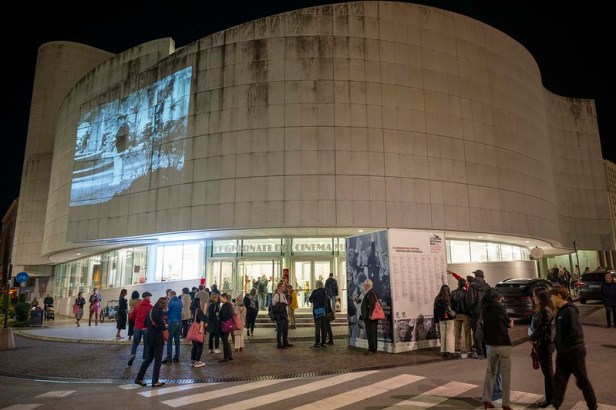
So this year’s Festival of early film ran for eight full days. It was definitely superior to the programme of 2023. But it was also more intensive, both in the timetable of screenings and in the spaces for food and sleep. Like a number of other guests I managed this by missing quite a few screening. This was not easy because substantial parts of the programme were unfamiliar to me. The Festival Catalogue, always well produced and a mine of information and detail, was an essential guide during the week. I intend to write in detail on the most impressive and interesting screenings; here I want to provide an over view of the programme.
The opening Saturday provided two outstanding features, though both were digital transfers rather than 35mm copies of the originals.
The Forty-First / Sorok Pervyi was a Soviet film from 1926, though the source story had appeared in 1924. The film was set during the Civil War when the young revolution had to repel the efforts of pro-czarist forces [Whites] aided by invading troops from Britain, France, Japan and the USA. The setting was the Karakum desert and Apsheron; bleak desolate terrain. A contingent of Soviet troops [Reds] have to break out an encirclement by the Whites. They then cross the desert to the Aral Sea so they can link up with other Soviet forces. The title refers to on member of the battalion, sharp shooter Mariutka (Tatajana the titles – Ada Voitsik); she shoots her fortieth target in the opening battle and is waiting to shoot her forty-first. But she misses a white lieutenant, Govorukha-Otrok, who is captured. Later in the film a storm on the lake maroons the pair alone and together. And the narrative becomes a conflict between desire and duty. The film was directed by Yakov Protazanov and filmed by Piotr Ermoliev. Both the cinematography and the editing are finely done and the plotting is really quite distinctive.
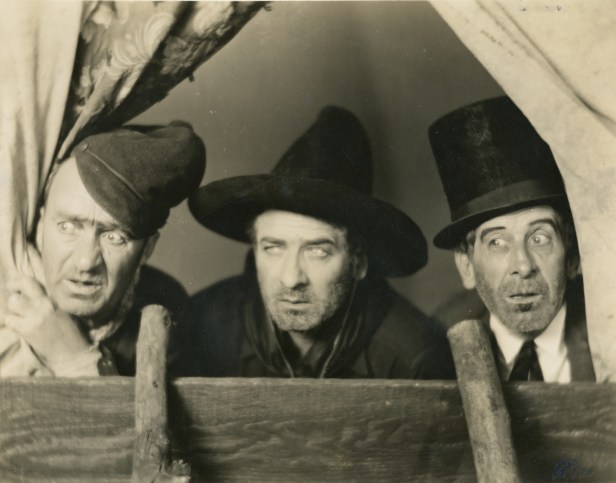
(from left) J. Farrell MacDonald, Tom Santschi, Frank Campeau
3 Bad Men was a fine western by John Ford with a script by John Stone and impressive cinematography by George Schneiderman. It is set in 1877 when an area stolen from the Sioux nation was opened up to settlers and gold prospectors. The titular characters are outlaws with ‘hearts of gold’. “Bull” Stanley (Tom Santschi), is a man searching for his sister, lured away by an adventurer. “Bull” dominate his two companions Layne Hunter (Lou Tellegen) and Mike Costigan (J. Farrel MacDonald). They act as godfathers to orphaned Lee Carleton (Olive Borden) and her beau Dan O’Malley (George O’Brien). In the early stages of the film this is played for the sort stock humour often found in Ford movies. The film really takes off when we reach the race of the settlers to grab part of the land or possible gold mines. This rivals the sequences in the 1925 Tumbleweed of the race for ‘free’ Oklahoma lands, with many parallel plot lines. Here the search of “Bull” comes to a climax. The film enjoyed an accompanying score by Timothy Brock conducting the Orchestra da Camera di Pordenone. This too took off with the dynamic sequences of the settler race.
A week-long programme commencing on the Saturday was The Biograph Project; digital scans of the early films of D. W. Griffith preserved as Paper Prints, (submitted for copyright) held by the Library of Congress. These had been screened as part of the full-length retrospective over several years of Griffith’s entire surviving output. Here we watched 24 one-reel titles, previously only available on 16mm copies. There was certainly better images and detail. Overall there were example as Griffith experimented with new techniques; so The Redman and the Child benefits from fine use of outdoor locations. But these predominately melodramatic tales had fairly basic plots. They did though also present the prejudices of Griffith and his times; with white men at the top: women, often fairly stereotypical, following; and then in increasingly lower order Native Americans (with occasional sacrificial ‘noble savages’), Mexicans and Chinese.
On the Sunday there was one of the screening illustrating the career of Ben Carr. Carr started his film career as a scenic artist in France and was to become one of the pioneering art directors, working through the silent era on into sound and the 1950s. He had an especially successful collaboration with the director Maurice Tourneur, another fine French recruit to Hollywood. Trilby (1915) is one of their early US films, adapted from a novel by George du Maurier. This is a story of artists with a model, Clara Kimball Young, in the title role. Svengali (Wilton Lackaye) comes to dominate the young woman and, despite her being ‘tone-deaf’, succeeds in making her a great singer. The film, screened from a 35mm print, still has some aspects influenced by the successful stage versions. But Carré also designed ingenious sets for filming including excellent facsimiles of Paris. The tragic climax (in the original) is dominated by the portrait of Svengali, still potent even after Trilby has broken free. The re-issue altered to the ending to a happier resolution.

Maurice Tourneur, Mary Pickford
Another title in the Ben Carr programme was The Pride of the Clan, a Mary Pickford vehicle from 1917. The film was directed by Maurice Tourneur. Originally titled ‘The Lass of Killean’, the setting for the film was a small Scottish fishing village. It was shot in Fort Lee, an early centre of US film and on the New England coast. Pickford plays the daughter of a clan leader who has to assume leading the community when her father died. The main plot outlines her relationship with a young fisherman which encounters difficulties when he turns out to be the actual son of a socialite who wishes to take him to the city. Pickford is excellent and Tourneur and Carré create an authentic fishing village with some fine location work. One scene involving an old fishing schooner nearly bought the careers of Pickford and Tourneur to an abrupt end.
Stronger Than Death (1920] is colonial melodrama starring Alla Nazimova. Set in a British encampment in India Nazimova is a famous ballet star suffering from a terminal illness. The plot is bizarre, involving a her dancing by moonlight in a Hindu Temple. The Temple, like the other sets, was designed by Ben Carré; a better piece of work than the script. There is also a brutal slaying of an innocent canine.
There was a screening of La Bohème (1926), directed at M-G-M by King Vidor. This was to celebrate the centenary Giacomo Puccini (who died in 1924). Of course, this silent 35mm print did not include Puccini’s memorable music but Donald Sosin, accompanying at the piano, provided a fine arrangement and improvisation, including the familial themes from the opera.
On the Monday evening there was the standout musical performance of the week. This was the accompaniment to a Germans title from 1928, Saxaphone-Susi / Miss Saxophone, filmed in Berlin and starring the Czech actress Annie Ondra. The drama was fairly formulaic but Annie Ondra was excellent in the title role. The film follows an identity swap between Anni von Aspen (Ondra) and Susi Hiller (Marty Parker). As Susi Anni joins the famous Tiller Girl’s school. This leads to both stage performances and romance. What made the screening compelling was the accompaniment by Neil Brand (piano), Frank Bockius (percussion) and Francesco Bearzatti). The audience responded with great applause to their rendition of the saxophone number in the movie. And for fortunate absentees following Le Giornate stream this was one of the pleasures on offer.
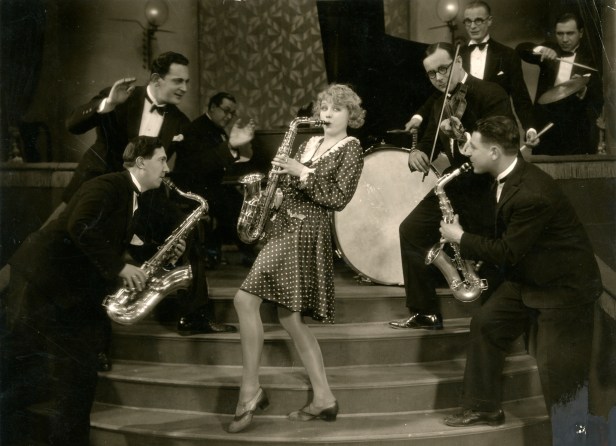
Anny Ondra
The digital version that we saw was some 700 metres shorter than the original release. I noted in the introductory notes to the screening that supplementary images had been added to the DCP in order to match a 35mm running time;[presumably running at 24fps]. There were no further such notes in the Catalogue but it was good to see the admission of what was once called ‘step-printing’; adding additional frames when the print of digital files run at a faster frame rate than the original; a frequent practice but these days rarely acknowledged.
The Land of Promise should have a sub-title ‘Stolen land’. This is a piece of Zionist propaganda released in 1924. Essentially its message is ‘a land without people [or at least civilised people]’ for ‘a people with out land’. The pre-festival press release included this:
As we’ve seen several times in previous editions of the festival, watching images from the past often triggers unexpected connections to the present, and we find surprising analogies between then and now in the themes and stories told in silent cinema. This is certainly the case with the film The Land of Promise from 1924, which inevitably takes us to the tragedy underway in the Middle East.
This is a somewhat dubious justification. In fact at the screening, which I like others boycotted, no one it seems had to face to introduce and explain the screening. At the end one voice called out ‘Free Palestine’, s/he is to be commended.
At least the Catalogue has a commentary by the Festival director which actually sets out the mendacious propaganda of the film and of the Zionist movement of the times. Though the only contemporary ‘analogy’ is ‘to the current horrors of Gaza’; but there is a reference to the 1948 Nakba. This was the week in which the IDF was launching its bombardment coupled with a blockade of northern Gaza.
What is worrying about the Catalogue entry was that it was followed by a disclaimer,
The opinions expressed in this note are the author’s own, and do not necessarily reflect . . . the originating archive or the Festival.
No other set of notes in the Catalogue suffer this disclaimer and I cannot remember seeing one in earlier catalogues. I wondered why people of disclaimed views did not explain their position before the screening. And, of course, what is missing from the event and the print is the voice of the Palestinians. There were Palestinian films in the silent era as there were in Egypt and in some other Arab territories. I cannot recollect seeing them at any earlier Giornate, though we did suffer more Zionist propaganda in 1995 with the bizarre titled ‘Israel before Israel’.
There was also a programme of Swedish nature and ethnographic films. One of these was The Tale of the Last Eagle / Sagan om de sista örnana (1923). This was screened in an attractive tinted 35mm print. The film central section focused on the rearing of young eagles. The director and cinematographer, Bengt Berg, used some quite sophisticated techniques to capture the eagles, both in the nest and in flight over the archipelago.

One of the best titles of the week was Vanina, Germany 1922. This was adapted from the novella by Stendhal by Carl Mayer; the story’s title, Vanina Vanina, was used in the version by Roberto Rossellini in 1961; [there are also two television adaptations]. Mayer turned the story into a kammerspiel [chamber drama] set in only one night in an unnamed C19th city. The first-time director Arthur von Gerlach, together with cinematographers Frederik Fuglsan and Willibald Gaebel, also designer Walter Reiman, created an at time expressionist drama with dynamic editing between a personal drama in the palace of the city Governor and riots and upheavals in the city streets. The leading cast are splendid with Paul Wegener as the Governor: Asta Neilsen as his daughter: and Paul Hartman as her lover but also a leader of the rebellion in the city. Stendhal novella was set in the Italian Risorgimento and the drama combines the excitement of that period with a tragic romance. Only versions made for abroad survive of the original film. So this was a tricky restoration and in particular the dynamic cross-cutting required very careful judgements.
The drama was followed by another strong feature, Song. Die libe eines armen menschenkindes / Show Life, Germany / Britain 1928. This was part of the Anna May Wong programme. Like African-American Paul Robeson Anna May Wong enjoyed better parts and better scripts in Europe than in the USA. And it has taken the revival of Silent cinema for her reputation to achieve the status it deserves; as a really fine actress and very interesting personality. One philanthropic US guest to the Giornate handed round the 2022 quarter graced by Anna’s head.
Song, a waif played by Wong, still suffers from the stereotyping of mainstream cinema. Here she has ‘the devotion of a dog and the soul of a woman’ to European John Houben (Heinrich George) , who has a music hall knife-throwing act. But John is still obsessed with an old flame; ballerina Gloria Lee (Mary Kidd). The plot includes low-life Istanbul: criminality and blindness: Song’s ‘human-target-cum-hula-dancer’ develops to a glamorous dancing star. The last to little avail with a tragic ending. Wong in later life commented, “I left America because I died so often. I was killed in virtually every picture I appeared in. Pathetic dying seemed to be the best thing I did.” (Festival Catalogue).This fate followed her to Europe. But she gives luminous performance and holds the eyes of all the main male characters in the film.

This programme included two of Wong’s minor Hollywood roles: small and stereotypical. And there was another German / British co-production feature; Pavement Butterfly / Großstadtschmetterling: Ballade einer liebe, 1929. In this drama Mah (Wong) progresses from a fairground show’s ‘Princess Butterfly’ to model for Russian painter Kusmin (Fred Louis) to companion of Baron de Neuve (Gaston Jacquet) and finally to a long-shot as she walks away into the darkness. Whilst Wong’s role has similarities to Song, the ending offers a degree of autonomy rare in her film roles. She is both captivating and convincing.
Both films were directed by Richard Eichberg with cinematography by Heinrich Gartner. The mise en scène in both films is excellent and Pavement Butterfly in particular has some fine atmospheric filming. The British and German versions have different endings and it seems that the British version suffered from some censorship. Wong’s film career did not measure up to her talent; happily her features survive for us to enjoy today.
The orientalism apparent in Song received a full-coloured rendition in The Sultaness of Love / La Saltane de l’amour (France 1919). This was a story worked up by a French writer from a portion of a Persian poem. A Princess becomes the object of desire of both tyrannical Sultan and a more virtuous Prince. The film was designed as a repost to the increasing dominance of Hollywood in Europe and was a large scale production filmed in a converted Villa near Nice. In 1922 the film was re-released with tinting and stencil colour. Though successful some critics found the added ‘tones were too vivid and unnatural’. I tended to agree with this of the DCP version we saw and the plot line was rather formulaic.
Three Women, USA 1924 was written and directed by Ernst Lubitsch. Whilst this feature had a number of recognisable Lubitsch tropes, (extensively discussed in the Festival Catalogue), I found it a weak drama-cum-satire. Edmund Lamont (Lew Cody) is a successful wooer of rich women. He manages to succeed with wealthy Mabel Wilton (Pauline Frederick): then with her daughter Jeanne Wilton (May McAvoy): and finally with the less affluent but sexier Harriet (Marie Prevost). In fact his charming but exploitative conquests finally catch up with him. One problem with the original films is that it relies on a view of women as pretty gullible in relation to men; my suspension of disbelief gave up. The film was though liked by many at the Festival.
Girl Shy (1924) stars Harold Lloyd. As the title suggests ‘The Poor Boy’ (Harold) is better at dreaming of romance than actually engaging it. But over the 87 minutes he manages to achieve this with The Rich Girl (Jobyna Ralston). The film, [on 35mm] also features a an attractive canine supporting character. And the climax is the longest ‘ride to the rescue’ that I can remember seeing as Harold uses a chain of vehicles to save his love at the altar. And the film enjoyed a lively accompaniment from the Zerorchestra with a score composed by Daan van den Hurk.
One of the really interesting programmes was a selection of titles from Uzbekistan. Provided by the Uzbekistan Art and Culture Development Foundation they were all digital transfers. Apart from a few earlier fragments the main features were all from when Uzbekistan was a Soviet Socialist Republic, part of the USSR. Several of these were concerned with overcoming the conservative traditions of the region. Arabi (1930) concerns a group of sheep breeders who set up an agricultural association [collective] in order to break free from the dominance of a feudal landowner. Their story was rather like a documentary with mainly non-professional performers and much attention to the actual techniques and labour involved in their sheep farming on the steppes.
The issue of women, frequently restricted by Sharia Law, was a concern in several features. Uning Huquqi / Her Right (1931) centred on a wife who despite he husband’s opposition breaks free by joining her friend in a team going to Moscow to work in a factory. She becomes an icon for women’s liberation and the film has a fascinating finale which seems to be influenced by Dziga Vertov and the Factory of Facts.
The accompaniment for two of the screenings was provided by traditional Uzbekistan musicians.

Raskolnikow (Germany 1923) was an adaptation of Fyodor Dostoyevsky’s ‘Crime and Punishment’, scripted and directed by Robert Wiene. His collaborators were cinematographer Willy Goldberger and designer Andrej Andrejew. The latter, like the cast, was a member of the Moscow Art Theatre company led by Konstantin Stanislavsky, touring in Germany at the time. This was a digital transfer running over two hours, but certainly shorter than the original release. Only foreign language versions of the original film survive. The film was shot as an expressionist drama, full of shadows, fantastic sets and odd angles,
nothing here is based on reality, and the visualisation had to suggest this in an anti-naturalistic way. (Robert Wiene quoted in the Catalogue)
This made for a powerful expressive version of Dostoevsky’s seminal study in psychology, guilt and expiation. However, the ending of the novel is missing, perhaps lost.
Forgotten Faces, USA 1928. This is a ‘gentleman thief’ feature from Paramount starring Clive Brooks as “Heliotrope” Harry Harlow with sidekick Froggy (William Powell). It is based on a short story ‘A Whiff of Heliotrope’ (the flower) which enjoyed three other film adaptations. Brooks and Powell are happily smooth crooks but it is Olga Baclanova as Harry’s wife Lily who turns in the really intense performance. The filing is stylish with excellent cinematography by J. Roy Hunt and smart design by Russell Mathews. It was a popular screening though I did find the idea of the sentimental thief over-familiar.

Vilma Bánky, Ronald Colman, Gary Cooper
The Winning of Barbara Worth (1926) was directed by Henry King with a scenario adapted from a classic novel by Frances Marion. There is great cinematography from a team of craft people, including the young Gregg Toland; and some impressive sets from Carl Oscar Borg. The films dramatises an irrigation project in California using the Colorado River. The climax of the film is a mass rush to escape a flood as the damning of the river collapses. The screening was to be from a 35mm print; but for some unexplained reason we got a DCP. Unfortunately it was not a great set of digital files: the definition was variable and there was even break-up at one point. This was shame as Neil Brand had composed a new score for the screening, that much appreciated by the audience.
The other major programme was America Latina. This presented early films and fragments from Argentina, Brazil, Chile, Columbia, Cuba, Ecuador, Mexico, Peru, Paraguay and Uruguay. Unfortunately very few of the films survived in anything approaching a complete form, and the important title cards lost., So the interesting Luis Pardo (Peru 1927) was a reconstruction compiled from surviving out-takes. The title cards mainly carried the story of a ‘Robin Hood’ style bandit.
Santa from Mexico was a restoration but shorter than the original 1918 release. Santa [played by Elena Sánchez Valenzuela, a major star and later film archivist] falls from ‘Purity’, becomes a fallen woman and dies tragically. The film exposed the moralistic mores of the time with often emphatic title cards such ‘as you are impure … begone, Santa’.
The Cuban La Virgen de la Caridad (1930) was more or less complete. It told the tale of a mother and son whose land is targeted by a corrupt landowner as well as the son’s fiancée. The high point of the feature was when the titular virgin (a picture prayed to by the mother) suddenly appeared to enjoy a miraculous moment; the audience could see that it was merely a domestic accident.
There were many short film and extracts. A programme of these was titled Sine Nomina / Untitled and Unidentified. This included the canine film of the week, When Winter Comes / Als de Winter Komt [a Dutch print likely from 1921], narrated by a young terrier, it recorded his pleasures when his mistress Mary took him on walks and winter treats.

There were the regular Awards with the Jean Mitry prize shared by Bryony Dixon of the British Film Institute and Mark-Paul Meyer of the Eye Museum. There were several lectures with the Jonathan Dennis Memorial Lecture on “Visual Effects in Silent Cinema” delivered by Craig Barron and that on Costume Design and Silent Cinema presented by Priska Morrissey on Early French Costume Design. There were a number of book presentations. Two friends attended that for Geoff Brown’s ‘Silent to Sound British Cinema in Transition’ which they thought excellent.
The Catalogue was, as always a treasury of information and detail. My only reservation is that it no longer includes the aspect ratios for films; this despite there not being a uniformity of ratios in early film. The other omission these days is one that graced the programmes in the old Theatre Verdi; this was the projection of the film-maker or star of major titles on the screen at the end. So on several occasions we had the odd sight of musicians enjoying warm applause pointing up to the screen that they accompanied – now blank. But there are a selection of Photographs by Valerio Greco on Flickr of the Festival and participants.
 itp Global Film