
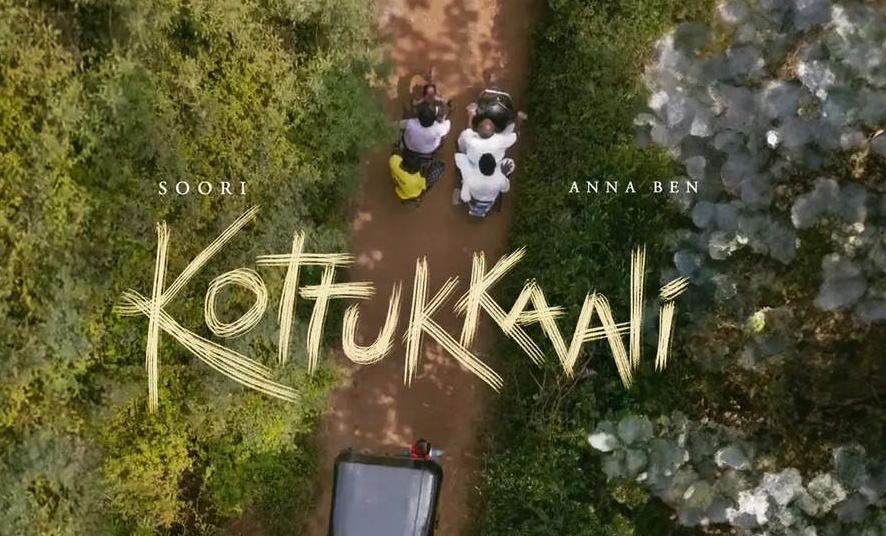
Here’s an example of an Indian Independent film from Tamil Nadu rather than from a filmmaker releasing in Hindi. I have a soft spot for films from Kerala and Tamil Nadu so I was excited to find this on Channel 4. There are 12 days left on catch-up as I post this. It also seems to be available on the Apple TV streamer in the UK and on other streamers in a range of countries. The film premiered at the Berlinale back in February this year, the first Tamil film to do so, although the director’s first film Pebbles was shown at IFFR (International Film Festival Rotterdam) in 2021. The Tamil film industry is one of the biggest language industries in India but perhaps it has not featured on festival programmes around the world as much as it should have done so this is a welcome breakthrough.
‘Kottukkaali’ translates as ‘The Adamant Girl’. Meena (Anna Ben) is a young woman who has reached the age when her family in rural Tamil Nadu expect her to marry. They have found an older man they think is a suitable match and attempted to arrange a marriage. However, Meena is unwilling to marry and the family learns that she has fallen for a lower caste boy she has met in college. Convinced that she has been bewitched by the young man, the families decide to take her to a local seer who they believe will be able to break the spell. Meena is unimpressed and she decides on a strategy of not speaking about anything. As the film narrative begins the two families are together and preparing to leave on a relatively long trip along narrow rural roads to find the village where the seer lives. Meena’s ‘intended’ husband Paandi (Soori) is there and he appears to have a throat condition, the first of several unusual markers of issues about fitness for marriage etc.

This film is about patriarchal attitudes and their impact on lives. In particular how they create problems for both men and women. It also raises questions about the role of religious beliefs in this Hindu community. The men often make fools of themselves because of the expectations of their behaviour. The women learn to accept brutal behaviour from the men, almost as if is ‘natural’. Meena challenges both sets of expectations. Writer-director P.S. Vinothraj doesn’t critique this situation directly, instead allowing the ‘cancers’ to reveal themselves along the way. His plotting brings the two families together and there are actually three generations of males going on the road trip: a small boy I take to be Meena’s nephew is along for the ride (somewhat reluctantly) with his mother as well as Meena’s father, the senior figure in the party. The party travels on three scooters/mopeds/motorbikes carrying two or three men on each and a super-sized tuk-tuk carrying Meena, three other women, the little boy and the rooster (for the sacrifice conducted by the seer) as well as the driver.

Not a lot happens on this road trip but in the gradual accumulation of relatively small incidents and their details we come to learn quite a bit about the society. We visit a small temple site where offerings are made and a couple of food stalls. Two of the party are left behind at one point. The rooster is looking peaky at one point and has to be revived. There are various stops for bodily functions. One member of the group has a tantrum. At another point a bull occupies the centre of the narrow road until it is led away by a young girl from a nearby house – the men of the party look suitably chastened as they were too frightened to approach it. At another point the road is so narrow they need to physically pick up the tuk-tuk and turn it round to get back on the main road.
All of this might sound a little dull but there is an underlying thread of comedy alongside the drama and the director emphasises this by the way he shows the movement of the four vehicles in the convoy. Often the camera is stationary at the eye level of a spectator by the side of the road and we watch each of the vehicles pass left to right, sometimes the camera peers between two trees or through a doorway. At other times we are offered drone shots from above. The landscape is typical for the southern tip of India – lush flat fields of grain or grass, crossings of streams, very narrow roads and mountains often visible in the distance. It’s actually very beautiful in this ‘Scope (2.39:1) presentation. The women are in colourful saris and several of the men wear traditional lungis, the long skirt-like wrap that can shortened for active work or vigorous walking by lifting the skirt and tucking it into the waistband.
But whatever the others are doing, Meena remains calm and says nothing. Anna Ben is a young Malayali actress from Kerala. Working across different industries in the South of India is actually quite common. Though she says little, Ben uses her eyes very well. By contrast Soori as Paandi says, or rather croaks a lot. He’s actually a well-known actor in the Tamil industry. Eventually the group reaches the village of the seer and finds two other groups having family members exorcised by the seer. The director doesn’t offer us a firm resolution to his narrative and we are left wondering what the outcome will be. Will Meena be forced to respond? Will the poor rooster have its head chopped off? Does the seer have any real power or is he a charlatan? I enjoyed the film and I feel like I’ve learned something about contemporary life in the South. This is an independent film that is resolutely ‘modern’ but carries something of the power of the Parallel Cinema films of the 1990s. A major celebration of Indian Parallel Cinema is now underway at the Barbican in London.
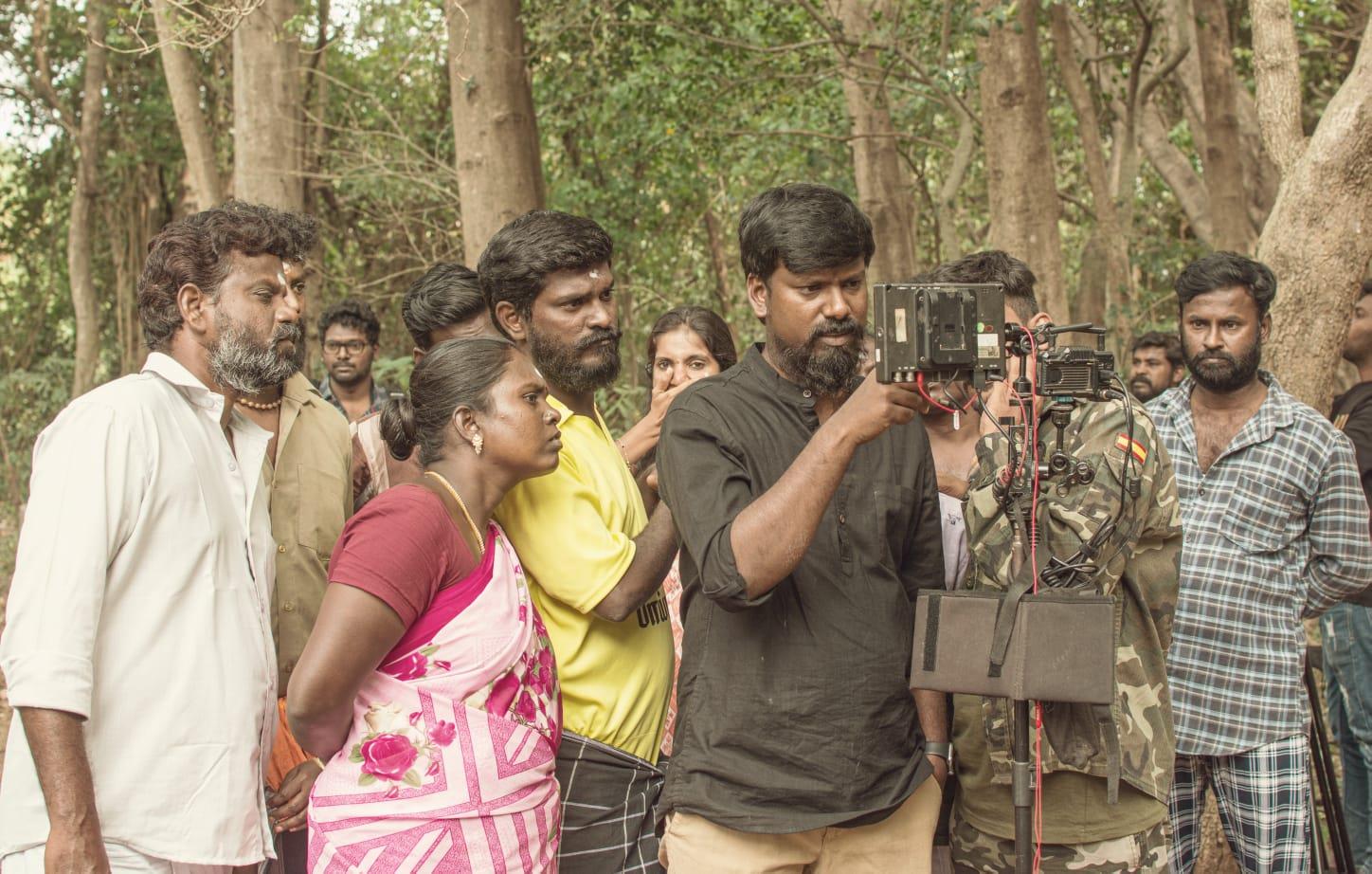
Here is a very brief (25 seconds) clip of how the film looks and sounds on streamer aHa:
 itp Global Film
I managed to catch this and all but two of the C4 South Asian season. I especially enjoyed the tight, slow-burn linear storytelling of most of them, especially Bhagwan Bharose. That was my favourite because of the superb performances of its child actors. I also liked Kamli much more than the director’s celebrated Joyland, because of its unexpected turn in the last act into a different mode that suddenly transformed the story.
Sadly, Kottukaali was the one I enjoyed the least. It was billed in the C4 thumbnail as a film about caste, so I expected something like Mansangada (another powerful slow-burner, which they aired in a previous season), but I agree it was much more about patriarchal attitudes. On reflection, it might well be the most impressive of the films, but I found it such an enraging and distressing watch, I was glad I ran out of time to view it again. Because of the slow-reveal narrative, I spent the first part completely confused by the relationship between Meena and Pandi, though since have read up a lot more on uncle-niece marriages on the Indian subcontinent (more common in South India), by the absence of the lower caste object of Meena’s affections, and by what exactly was wrong with Pandi’s throat. Above all, I could barely detach myself from Meena’s face and plight, especially after Pandi’s violent explosion, to take in any of the director’s artistry.
I must admit I was so angry, I barely registered the comic elements you saw. However, I did even then appreciate the beauty of some of the landscape shots, as well as the slow tenderness and vibrant colours of the rooster revival scene. The animal symbolism was too obvious to miss, and I found some relief and a dim ray or hope for the future in the child characters – Meena’s brother, and especially the little girl who mastered the bull that Pandi couldn’t. It was only afterwards that I began to mentally revisit the clever, ironic way the director used moments like that to play with ideas of power, gender, voice and silence, to suggest that Pandi’s extreme male aggression was actually a sign of his ultimate impotence. Similarly, the scene with the extreme close-ups of the woman’s tongue and his eye. I was initially quite revolted by it and taken aback, especially as I’ve rarely seen shots like that in any Indian cinema. But again, I did on reflection appreciate how it nicely infantilised Pandi, and the idea of the two females using their tongues symbolically to speak for the silenced Meena.
Unfortunately, most of the film consists of the road journey and in the absence of any non-diegetic music, the director forces us to hear the incessant mechanical noise of the rickshaw and motorbikes. A compelling effect, but it left me utterly depressed at the thought of Meena and the rooster trapped on a one-way journey to inevitable slaughter. The exorcism scene again was so dehumanising, I felt zero consolation in the ‘meta’ question in the final frame; it felt like a cheap, inadequate attempt at ambiguity, entertaining the possibility of hope against the crushing weight of evidence up to that point.
Having said all that, I will try to watch Pebbles, and see if I can appreciate it more on a first viewing.
LikeLike
It sounds like you had a tough time watching this Shabanah but you were clearly engaged by the issue and I think you make a reading with real depth.
I recorded Kamli and Bhagwan Bharose and I’ll try and catch up with them later. Coming up at the Leeds Film Festival is a Smita Patil season and I hope to get to at least one screening. I may also have some of her films on earlier recordings I think. I wish Channel 4 would show more South Asian films but it’s good that we get at least eight a year.
LikeLike