
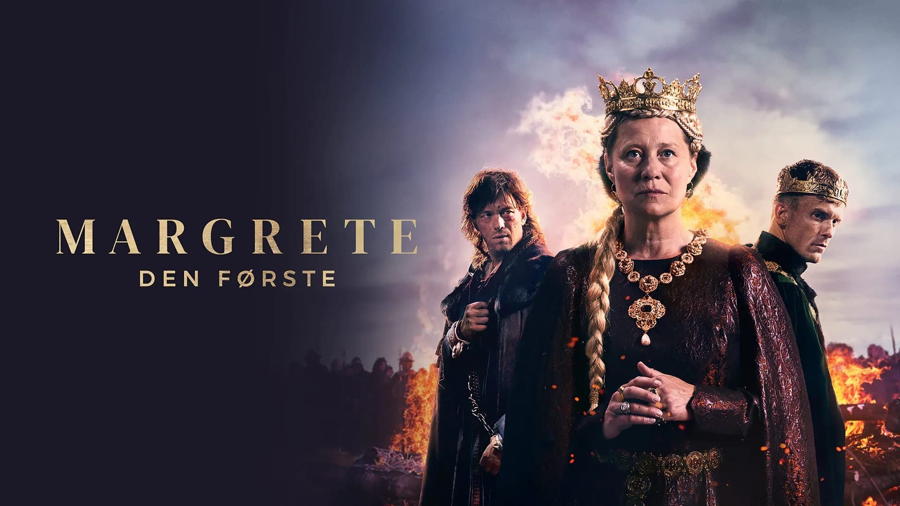
Another major film affected by the COVID lockdown that interrupted shooting and then its distribution, this Nordic historical drama finally appeared on terrestrial TV in the UK on October 5th in the BBC4 transmission slot for ‘foreign drama’. It has been online in the UK for some time. The BBFC lists it as given a 15 certificate for a Signature VOD release in 2022. It never appeared in UK cinemas to my knowledge. An expensive film by Nordic standards, this tells the story of a legendary historical figure, Margrete who was ‘Queen Regnant’ of Denmark, Sweden and Norway from 1387 to her death in 1412. Her great achievement was to create the ‘Kalmar Union’ of 1397 which bound the three separate countries together for over 120 years.
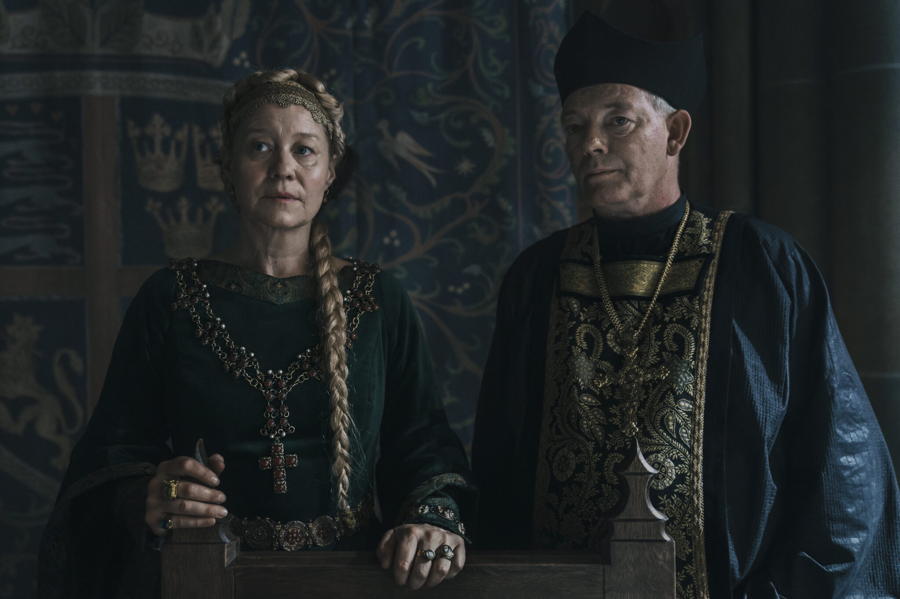
The film narrative is a fictionalised representation of the events that underpin the appearance in 1401 of a man who claims to be Margrete’s biological son Olaf, believed to have died 15 years earlier. This appearance is taken to be a deliberate attempt to undermine the announcement of the marriage between Margrete’s adopted son Erik and Princess Philippa of England. The marriage is intended to create an English alliance with the Nordic states in the face of aggression from German states such as Prussia and the Hanseatic towns which are attempting to control Baltic trade. The narrative actually begins in 1541 when Margrete is a child accompanying her father, the Danish king, who defeated German forces near Visby on the island of Gotland. The Germans had also occupied Stockholm.

The drama hinges on a classic form of court intrigue. Faced with this possible disruption of all her plans by the ‘man who would be king’, Margrete must act quickly but she is faced with an horrendous decision. If she accepts the return of ‘Olaf’ she will anger one part of the alliance which favours Erik. But if she deems the Olaf claimant as bogus she will offend the Norwegians in particular who recognise him as the real Olaf. At the same time, the English envoy sees this as an opportunity to increase his demands in a renegotiation of the wedding settlement. The film is co-written and directed by Charlotte Sieling who was an actor for many years and then began directing TV series in Denmark in 2000, including episodes of many of the highly successful exports such as The Killing, Borgen and The Bridge. She directed only a couple of features before taking on Margrete, including Above the Street and Below the Water (Denmark 2009) with Sidse Babett Knudsen. In Margrete, the director has Trine Dyrholm as her leading player and Søren Malling as the Bishop, her Chief Minister, who she calls ‘Peder’. Trine Dyrholm is one of our favourite Danish stars and she’s very good in this. Søren Malling is in nearly every Danish film/TV series of note – or so it seems. He has perfected the art of saying nothing and looking blank while carefully considering what to do next. Meddlesome priests are of course de rigueur in European court intrigues and his character doesn’t disappoint here. There is a very large supporting cast with some seemingly familiar faces representing various nobles from each of the three states. The English envoy is played by Paul Blackthorne who I was intrigued to discover first appeared on screen as an English officer in the Hindi film Lagaan in 2001. The only performance that seems to have attracted negative comments is that of Morten Hee Andersen as King Erik, but I think this is a problem associated with the role. Erik is the potentially thwarted adopted son who is only twenty-one and might be expected to behave badly in the circumstances. These kinds of characters seem to be the most difficult to present in historical dramas without such accusations.

The film is presented in ‘Scope (2.39:1) by Rasmus Videbæk (who also photographed A Royal Affair (2012) and The Promised Land (2023)). The main locations for the film were in the Czech Republic with some scenes shot in Sweden and Denmark. There is some action outside Kalmar Castle with sweeping aerial shots and the overall effect for me was somewhere between some of the epic Nordic films and some French heritage films (though not in terms of the weather!). Many of the outdoor scenes have the misty grey of Nordic winters. The photography is supported by the music score from Jon Ekstrand and the work of an army of VFX artists and designers. It must look pretty good on a big screen, I think. In terms of export potential the film does face several problems, however. This genre does tend towards long dialogue scenes and inevitably some mainstream audiences are easily ‘bored’. The history is difficult for most audiences outside Northern Europe and, on the obverse, the history buffs will be annoyed by several of the decisions made about how to shape the narrative. I’m certainly no expert on this period of European history and I wondered about the references to ‘Germans’ in the subtitles. Language is another issue. I found that I didn’t notice if the dialogue shifted between Danish, Swedish and Norwegian (which I remember I did in episodes of The Bridge) but it was odd when the appearance of the English envoy saw Margrete speaking perfectly executed 21st century English. I realise that this is a feature of any historical drama but I understand that, presumably in the US, there is an English-dubbed version of the film online. The BBC print I watched was subtitled.

I enjoyed Margrete – Queen of the North very much. I can be a distanced audience for this Nordic film, pursuing an interest in European history. I’m not interested in contemporary ‘royal’ narratives which I find generally irrelevant. It is a conventional narrative but it is presented stylishly with a great central performance by Trine Dyrholm and I applaud the achievement of celebrating an iconic female historical figure. The film is available in the UK on BBC iPlayer for ‘over a year’ and you can compare it to another similar film, Mary Queen of Scots (2017) with Saoirse Ronan as Mary in a film directed by Josie Rourke that is also on iPlayer but only for the next 10 days. Margrete appears to be also available on various national and international platforms but some versions may be dubbed, so do check first.
 itp Global Film