

The initial release of Variety proved controversial with splits between feminist film scholars over a film by Bette Gordon directing a script from Kathy Acker. The film’s ‘American Independent’ New York production was supported by Channel 4 in the UK and ZDF (equivalent to BBC2) in West Germany. In the UK it was distributed by the British Film Institute and covered by a review plus an interview with the director in Monthly Film Bulletin, May 1984. The BBFC website reveals that the film was given an ’18’ Certificate in the UK with warnings about ‘strong sex references, nudity, very strong language’. There is no record of a video release at the time. The film was re-released by an independent distributor in 2023 and gained a DVD release in the UK in 2024. I watched the film on MUBI.
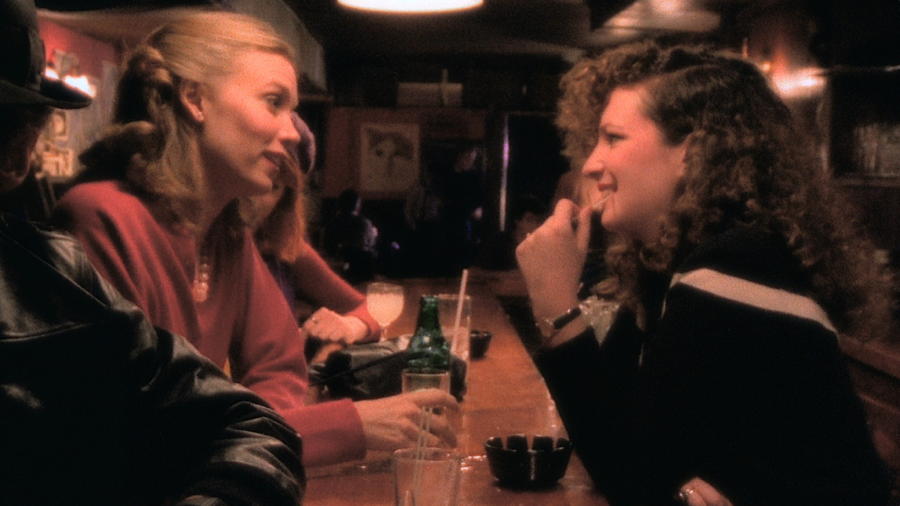
The central character in the film is Christine played by Sandy McLeod who had a relatively short acting career and then moved into filmmaking, first as an assistant to various successful directors such as Jonathan Demme and John Sayles and later into directing herself. Her short Asylum (US 2003) about a Ghanaian woman, was Oscar-nominated. Christine is a young woman from Michigan living in New York in 1983 when the city was renowned for its sleaze and generally dark and dirty demeanour. But Christine keeps herself fit and healthy. At various points we see her swimming in a small pool (in a club?) and later exercising and lifting weights. She is tall and slim with a mane of red-gold hair (although with the lighting it’s difficult to tell) and overall she is an attractive young woman. She complains about the difficulty getting an interesting job in the creative industries and her friend Nan (Nan Goldin, later well-known as a photographer) hesitates but suggests a job in the box office of a movie theatre. Christine takes the job at Variety, a porn theatre and she gradually becomes fascinated/obsessed with pornography.
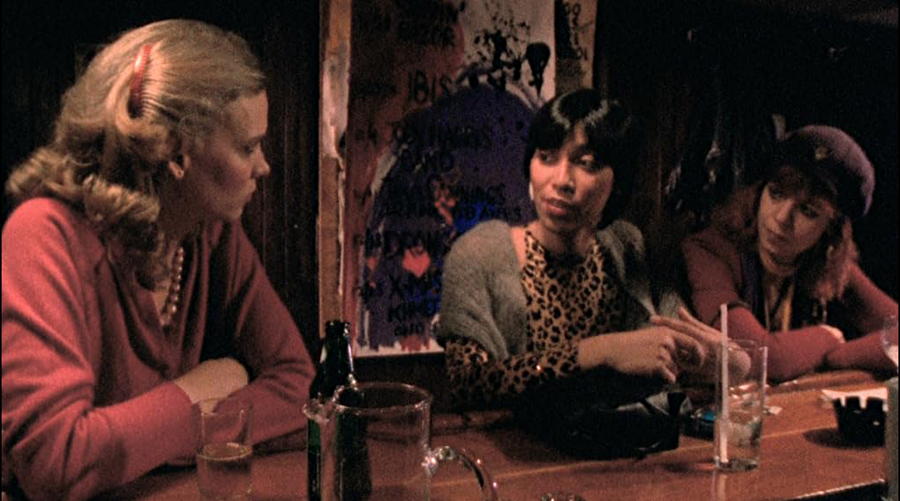

Christine has a boyfriend, Mark (Will Patton), an aspiring investigative reporter. He doesn’t seem to have much time for Christine and disapproves of her job. She has more fun hanging out in the bar worked by Nan, meeting a group of women who are regulars, some of them working as ‘escorts’ – earning good money but running various risks. The young man on the door of the cinema who is in effect her boss is played by the young Luis Guzmán. He’s quite pleasant and looks after her. The key moment in the narrative is when Christine is bought a coke by a suited older man. In her breaks she wanders around the sex shops and peepshows next door and also sneaks looks into the film screening in the cinema. The same older man appears at the ticket booth and invites her out to a ball game. She decides to go and this changes the narrative direction. What was at first an almost documentary-like study of Christine’s daily round threatens to turn into a some kind of crime film. The film is listed as a ‘neo-noir’ in some databases.

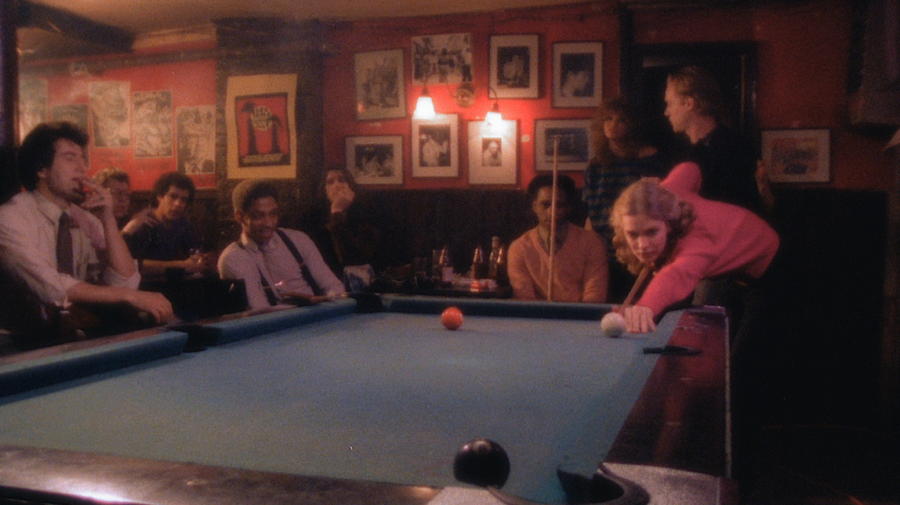
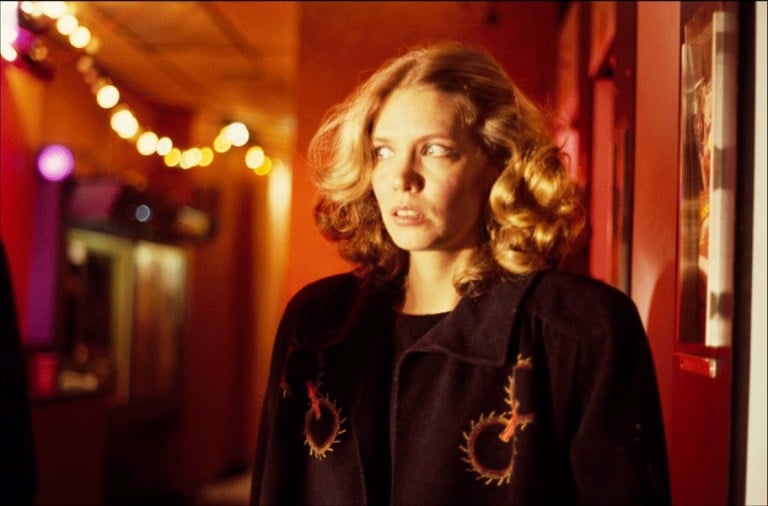
The noir handle is apparent as we move into night-time New York and, shot in 16mm, Manhattan and the adult entertainment district become the shadowy but gaudy environments of a neon-lit underworld. The trip to the ballgame doesn’t proceed as we might expect and Christine begins to investigate her ‘date’, discreetly following him across the city. By this point we have begin to move into more of an arthouse/avant-garde type of narrative. On a basic level Christine becomes something of a voyeur (though there isn’t much to see). More to the point she explores the idea of the male gaze and both adopts the gaze herself and in her room imagines herself as a sexual being. Outside her room she acts with some confidence in male spaces, winning money from the guys in the pool hall.
There are several instances of this ‘play’ with identity and female desire which stand out. On one occasion she listens to her ansaphone messages and one is an unknown caller making a string of lewd suggestions and descriptions addressed to ‘Sally’. She replays part of the message, intrigued rather than disgusted before switching it off. Opposed to this, on three occasions she begins to offer Mark descriptions of first a scene from one of the films showing at Variety then later what appear to be her own fictional stories. (In the opening of the film she tells Nan that though she writes stories, nobody reads them.) One of these stories is told in Mark’s car as he stakes out the fish market where he believes there is racket being organised by gangs and union workers forcing the traders to pay protection money. Christine seems to be making up her story as she speaks. Is it a story based on her own fantasies, told as a rebuff to Mark? It’s a graphic and erotic story. In a third similar scene she ‘s with a guy by a pinball machine (it may be Mark, but I’m not sure) and as he plays she tells another erotic story in quite a heightened way. Through the window we see the New York streets. Increasingly, towards the end of the film Christine seems to be injecting herself into an imaginary story and at one point she appears on the screen at Variety.
In the MFB coverage there is a very good review by Steve Jenkins in which he reads the film in the context of the feminist arguments that were current in 1983. In the interview (by Jane Root), Bette Gordon says she wanted to ask disturbing questions and she was ready for the split in audiences. Jenkins makes the key point that Variety is not a film about women and pornography but a film about stories (about finding work, about unions in the fish market, about working as an escort etc.) and storytelling. He also notes that Variety itself loses its own narrative. It ends with an image that might be the start of another section of the story or perhaps another story altogether. All I can say about my own viewing is that I found Christine/Sandy McLeod to be a fascinating and very attractive figure whatever she was doing. My male gaze was fixed upon her but I also recognised how the camera was both treating her as a female body to be dissected for the image in the opening scene in the swimming pool and then later showing her framed as the investigator. The three ‘sex monologues’ she delivers (written by Kathy Acker) were much derided by some critics but seemed very well pitched to me. As Jenkins suggests, Christine’s fictions show her taking control of women’s stories, her stories. I think the film works as an avant-garde polemic. As a film, the credit goes to Gordon for the story and the direction and to Acker for the adaptation and dialogue. McLeod is very good I think. The cinematography is by Tom Decillo and John Foster and the music by John Lurie (I particularly enjoyed the diegetic use of a 45 played on Christine’s record player – a Neil Sedaka/Howard Greenfield song, ‘The Diary’ performed by Little Anthony and the Imperials.

I can’t find a trailer to show you or images of some characters. This was a very low budget production with the three funders offering only $80,000. It isn’t itself pornography as it is too invested in the humanity of its central character. It’s sometimes quite funny. If you are interested in the history of feminist ideas in the 1980s, I think this is intriguing. In the UK it seems to be available only to subscribers to MUBI or BFI Player which can also be accessed via Apple or Amazon. There is an American Blu-ray but don’t expect a HD image, remember the film was shot on 16mm, mostly at night or in darkened interiors.
 itp Global Film