

Another case of censorship of pro-Palestinian voices in Germany. This is the 70th year of this Festival which started in 1954. Prior to the actual festival their face book page called for support for ‘a rally in Berlin to show solidarity with Israel, organised by the Central Council of Jews in Germany, churches, major political parties, and other institutions.’ The page also included a message from the Festival Director, Lars Henrik Gass.
An interview with Gass on the Web claimed,
“Anti-Semitism is now part of the cultural code,” says Lars Henrik Gass” [Translation].
In reply to a question he stated,
“The massacre on October 7 has affected me very much and kept me busy. A solidarity rally with the Israeli victims was then scheduled in Berlin for October 22, under the patronage of the German Federal President. The tip was shared on social networks – including by us. The post read in essence that we call for participation in the rally, that we condemn the massacre, as well as anti-Semitic incidents in Berlin Neukölln. Co-initiated by the now banned Samidoun association, real celebrations were held in Neukölln at the time.” [Translation]
The Indy Film Library has an article on the issue including this comment;
” [the] reference to Neukölln, a district in Berlin home to a large Palestinian community. The reference was criticised as legitimising a conflation of all vigils and protests against Israel’s actions in the Gaza strip after October 7th, with anti-Semitism.”
It is worth pointing out that the Oberhausen Festival was the location for a now famous Manifesto in 1962 by 26 young German filmmakers who were to be the forebears of the New German Cinema.
“The decline of conventional German cinema has taken away the economic incentive that imposed a method that, to us, goes against the ideology of film. A new style of film gets the chance to come alive.
Short movies by young German screenwriters, directors, and producers have achieved a number of international festival awards in the last few years and have earned respect from the international critics.
Their accomplishment and success has shown that the future of German films are in the hands of people who speak a new language of film. In Germany, as already in other countries, short film has become an educational and experimental field for feature films. We’re announcing our aspiration to create this new style of film.
Film needs to be more independent. Free from all usual conventions by the industry. Free from control of commercial partners. Free from the dictation of stakeholders.
We have detailed spiritual, structural, and economic ideas about the production of new German cinema. Together we’re willing to take any risk. Conventional film is dead. We believe in the new film.”

The ‘new film’ was, among other aspects, to break the silence in German culture on the holocaust perpetrated by the Third Reich. There is a real irony in the Festival now imposing silence on the voices of those defending Palestinians from what the International Court of Justice reckons is likely Genocide and voices attacking the Zionist leaders who now face warrants for arrest from the International Criminal Court.
The Festival this year published a new Code of Conduct which included the following,
“The festival is a place of free thought and respectful discussion, from which no one should feel excluded because of their political views or cultural background. Anti-Semitic, racist and war-glorifying or other misanthropic content and attitudes, groups or organizations are therefore not tolerated here. With regard to anti-Semitism, the festival applies the IHRA definition in the form adopted by the German Federal Government in 2017 as a standard of assessment; this means that attitudes, groups or organizations that call for a boycott of Israel and/or question Israel’s right to exist are also considered anti-Semitic. This also applies to anti-Semitic, racist and right-wing extremist symbols (codes, gestures, signs, clothing, etc.) that are carried, used or disseminated with clear political intent to disturb, discriminate or even threaten people.”
The IHRA definition has become notorious for providing cover for defenders of Zionism; even the original author has voiced reservations about its use. And the definition, like much in the mainstream media and political establishments, fails to identify anti-Semitic attacks on Palestinians, who also speak a language defined as Semitic. The whole debate tends to ignore the dubious derivation of the terms ‘Semitic’ and ‘anti-Semitic’.
The actions at the Oberhausen Festival are clearly influenced by the earlier controversy at the Berlinale. And that also reflect the actions across the German establishments against pro-Palestinian voices and events. Both Festival and the wider German response have been widely criticised. And it has been pointed out that Germany has itself failed to address the colonial genocide against the Herero and Nama peoples in the early C19th. This whole culture war exemplifies the continuance of what has been termed Eurocentrism.
“Eurocentrism (also Eurocentricity or Western-centrism) refers to viewing the West as the center of world events or superior to all other cultures.” [Wikipedia]
And the western states persist in regarding Israel as part of that European / Western culture and alliance. Whereas Israel is clearly a colonial occupation, the underlying basis of Eurocentrism.
If Germany is aggressive example of this neo-colonial stance it is also widespread across Europe and North America. Here in Britain the HOME arts and cinema venues cancelled an event featuring Palestinian writers but then backed down under the weight of criticism. The Barbican in London also cancelled a lecture by Pankaj Mishra addressing these issues. Even after criticism and the withdrawal of art works the Barbican persisted. Ken Loach, who all the contributors to this Blog admire, has been attacked on a number of occasions for his defence of Palestinians.
It is similar in the USA. Jonathan Glazer was attacked after making a critical statement at this year’s Academy Awards. And there are numerous reports of censorship and actions against US artists, writers and students supporting the Palestinian cause.
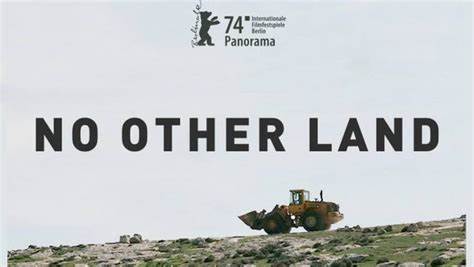
Happily, there are exceptions to all this censorship. DocFest, The Sheffield International Festival of Documentary Film is screening No Other Land, the Palestinian film that sparked much of the controversy at the Berlinale. The screening will be followed by a Conversation which will presumably address these issues, issues that affect a ‘free cinema’, in the words of the Oberhausen pioneers.
 itp Global Film