

This film received a limited UK release from distributor Signature Entertainment in March 2023. It’s now available on All4 and I leapt at the chance to see it for several reasons. It stars the wonderful Virginie Efira and another of my favourites Roschdy Zem. It’s also a seemingly personal film by Rebecca Zlotowski, one of the women trained at La Fémis who emerged as a writer and subsequently a director in 2006. I found her film Grand Central (France, 2013) to be particularly interesting in its references to both French and American classical cinema.
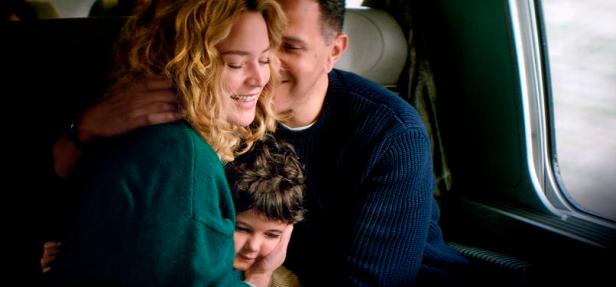
The narrative opens with Rachel (Virginie Efira) as a teacher in a secondary school in Paris. She seems to be showing a film to her class, possibly because it’s a literary adaptation. There may be an in-joke here since Zlotowski initially wanted to adapt a novel by Romain Gary but then decided that the stepmother in the novel perhaps should be the central character in her film. There are many French films featuring settings in schools and they are sometimes about the teachers as much as they are about the students. Rachel’s students don’t seem to understand the film but she tells them they’ve read the book so they should work it out. I confess that I was also quite shocked that Rachel, standing at the back of the classroom, reads texts on her ‘phone while the film is still running. Later in a staff meeting she is still looking at her ‘phone under the table, like a naughty student, during a discussion about finding work placements for students. This behaviour is soon explained – there is a new man in her life and she is meeting him that evening. Ali (Roschdy Zem) is a guy in his forties who Rachel meets in a guitar class. He lives in a beautiful apartment and seems to have a well-paid job as a designer. But the film is about Rachel not Ali. Rachel is forty. She doesn’t have children but Ali is separated from his wife with whom he has a small daughter, Leila (Callie Ferreira-Goncalves). Tonight Leila is with his wife but she does sometimes stay with her father. This is the opening set-up. What happens next is listed as a comedy-drama. It isn’t, as some disgruntled reviewers think, a ‘rom-com’. I’m not sure it is easily categorisable at all, except as a ‘drama’.
In the Press Pack for the film, which screened first at Venice in September 2022, the director talks first about her original intention re the Romain Gary novel. Gary was someone I’d heard of but didn’t know much about. He was born into a Lithuanian-Polish Jewish family in 1914 but eventually found himself in France as a teenager, learning to fly and fighting for the Free French in the Second World War before becoming a renowned novelist. Zlotowski’s intention was to adapt Au-delà de cette limite votre ticket n’est plus valable (1975); translated as Your Ticket Is No Longer Valid (1977). In fact, the film had already been adapted as, at the time in 1981, the most expensive Canadian film. It starred Richard Harris but seems to have been a troubled production and ultimately a dreadful sexist narrative with Harris as a businessman with a young wife who discovers that he is impotent. It seems an unlikely project for Zlotowski but there are vestiges of the original narrative in her film. The crucial difference is that Rachel is the central character in Zlotowski’s story and that her concern is that she has reached forty without having a child and now her doctor (played in a marvellous cameo by the veteran documentarist Frederick Wiseman) tells her that she doesn’t have long before she will be unable to conceive. Rachel’s ‘childlessness’ is not because she never wanted children or doesn’t like the idea of them. It’s simply that she has had a busy life and not got round to it. It seems like Rebecca Zlotowski identified with this situation very strongly and ironically she became pregnant herself during the the production period.

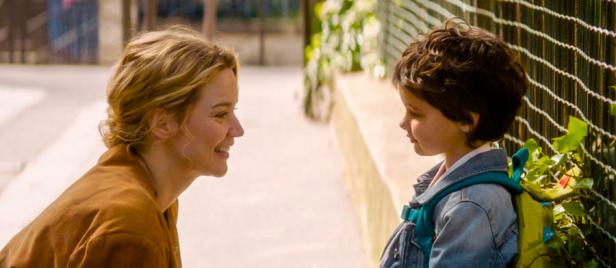
I don’t want to spoil the narrative but there is one other aspect of Zlotowski’s own family situation which is a factor in the story and seems to have confused a couple of reviewers. Rachel is from a Jewish family. She lost her mother as a child but she celebrates various family events with her sister Louanna and her father ,who is played by the director’s own father Michel Zlotowski. Rebecca Zlotowski’s mother is Moroccan. Roschdy Zem was cast as Ali Ben Attia largely because he had starred in the TV mini-series Les sauvages (2019) for which Zlotowski had been the director and one of the writers. Nothing is made of the heritage of Ali’s heritage. His wife Alice is played by Chiara Mastroianni. The crucial dialogue exchange in the film is when Rachel explains that she is the partner who feels ‘trapped’ rather than Ali (who must make decisions that are best for Leila). Rachel is referring to her desire to have a child which has a time constraint. Ali has a child and he is free to have another without worrying about when. This is a drama focusing on Rachel and what becomes the bond that develops between her and Leila. The only two sub-plots in the film involve Rachel with her sister and her wider family and at school with one other teacher and a teenager in her class she tries to help. It isn’t a romcom, though there are comic moments. There are also moments of tragedy and disappointment. Through the whole film the Virginie Efira’s exuberance shines through in a terrific performance. Rebecca Zlotowski refers in the Press Notes to Efira’s ‘erotic brain’ and praises her as the heiress to the Hollywood stars who have played in similar dramas – Jill Clayburgh, Meryl Streep and Diane Keaton.

There is a fair amount of ‘casual nudity’ in the film and I was amused to see Rachel lighting up a beautifully-rolled spliff. Channel 4 dutifully warns audiences about ‘Sex, Nudity and Drug Use’. The latter points to the use of music in the film which is fascinating. At one point in a birthday party Rachel and Ali dance to a version of the Rev. Gary Davis song ‘Cocaine’ (sung by Dave Van Ronk, I think). I mention this since at least one reviewer refers to the ‘big-hearted jazz score’. I didn’t notice this as such but the soundtrack includes a diverse group of pieces – Thelonious Monk, Vivaldi, Shostakovich, and some early Doris Day (‘Again’) and Antonio Carlos Jobim among other tracks. As well as the music, the ‘Scope cinematography by George Lechaptois works well – as does the ‘irising’ in and out of sequences recalling silent cinema but also emphasising the episodic nature of Rachel’s busy life over a year. I also enjoyed the weekend away from Paris in the Camargue. This is a subtle and engaging narrative. Channel 4 introduces it as an ‘affecting drama’ which is pretty accurate. It’s available for around three weeks on All4. Don’t miss it if you get the chance to watch.
 itp Global Film
Grand Central was a very interesting film; I don’t normally post my own reviews on other people’s spaces, but I’m make an exception here; keen to see Other People’s Children, and I really appreciate you pointing out that this film is on All4, I’d never have connected the two otherwise. There’s something about Zlotwoski’s work that’s worth championing, and anything she does is a must-see for me.
https://list.co.uk/news/15745/grand-central
LikeLiked by 1 person
I’m glad you liked Grand Central. I was puzzled by it on a first screening but I investigated its background and bought the DVD later in order to use it in teaching. It’s a many-layered film. I understand now that casting Tahar Rahim points to two things I hadn’t registered about Rebecca Zlotowski – her North African heritage re her mother and her relationship with Jacques Audiard which Wikipedia suggests underpins her desire to make Les enfants des autres. I try to discuss the links to both classical US and classical French cinema in Grand Central in my 2014 blog entry: https://itpworld.online/2014/07/31/grand-central-france-2013/
LikeLike
Excellent drama, interesting commentary. I think the film title screened in the classroom is ‘Les liaisons dangereuses’, 1959 and directed by Roger Vadim. If so, the students have been reading the novel by Choderlos de Laclos. In which case this is an oblique comment on the central relationship.
LikeLike
Yes, I’ve seen that in several sources I think.
LikeLike