

Guillermo del Toro’s film, co-directed by the animation director Mark Gustafson, was made for Netflix on a modest $35 million budget. I hesitate a little quoting that figure because Hollywood blockbuster animations usually cost a lot more. I’ve now rented the Criterion Blu-ray of the film since I don’t subscribe to Netflix. A mystery surrounds the release of this film in UK cinemas (and in most cinemas in other territories). I can find screenings being given a date but no box office returns on the BFI Weekend Box Office chart. Did anyone reading this actually see the film in the cinema? If it was on cinema screens, it would have been in the second half of November 2022.
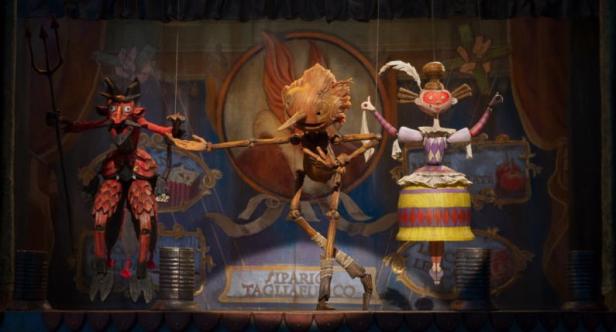
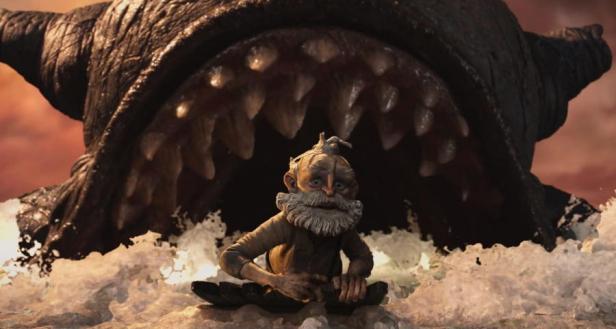
Since reviewers all seem to have Netflix, the chances of finding any audience numbers are slim – i.e. there are no comments about cinema audiences. It’s a long time since I saw an American-produced animation but del Toro’s stop-motion animation seems to me to be in a different league, on the grounds that it is much more like European or Japanese animation, targeting an adult audience or at least including only older children. It’s rated as PG in the UK and US. Original fairy tales in Europe were gruesome and pretty scary up to the 19th century and I remember that the Disney Pinocchio (1940), which I saw as a small child during its 1954 re-release, terrified me in a couple of scenes. The most noticeable aspect of this new version is that del Toro shifts the setting from the original novel from the 1880s in Tuscany to the late 1930s in fascist Italy. Otherwise the changes are less than you might expect. Del Toro, Matthew Robbins and Patrick McHale weave an anti-fascist story carefully around the same characters as the original, albeit with those characters slightly altered.
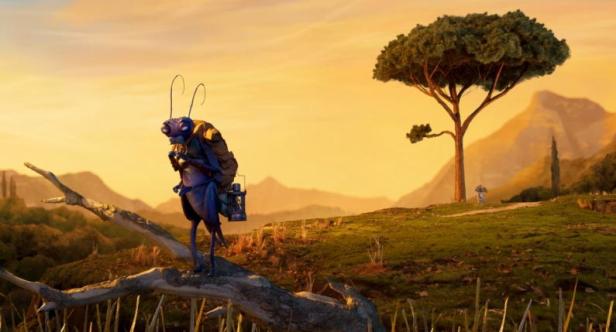
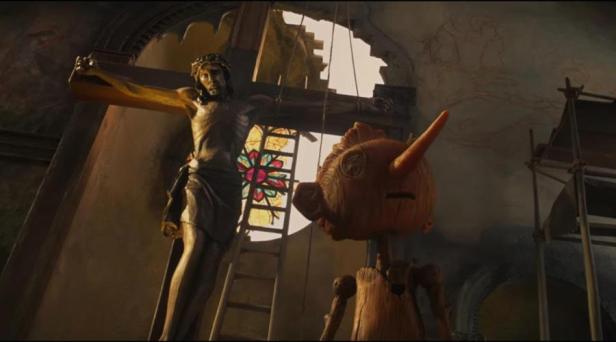
Does the new setting work? Yes, I think so. Del Toro himself has already made several live action films with anti-fascist narratives from The Devil’s Backbone (Spain-Mexico 2001) to Hellboy (US 2004). The world of marionettes was still popular in Italy in the 1940s and a show with a historical/traditional story is being performed in the Naples section of Roberto Rossellini’s Paisan (1946) as American troops move North from Sicily during the Allied advance in 1943. Del Toro does make the actual date of Pinocchio’s adventures a little vague but this is after all a ‘dark fantasy’ akin to Pan’s Labyrinth (Mexico-Spain 2006) rather than a realist story. Del Toro also utilises the Catholic imagery of his youth and makes the connection between the wooden boy/marionette with the wooden Christ, also carved out by Gepetto. There are several other distinctive del Toro touches, not least the fairy sisters, good and bad who govern the crisis moments in the life (lives) of Pinocchio and seem to bear resemblance to the the fantasy characters of Pan’s Labyrinth. The film had been a long-cherished project by del Toro and for me this is a total success with its only flaw being its perplexingly brief stint in cinemas.

Stop-motion works well for me and is certainly preferential to computer-generated animation.The music here is by Alexander Desplat. I didn’t really notice the songs or the voices that much, though I think they will repay further attention and especially the way in which the Cricket’s song is used. The famous names (Ewan McGregor, Cate Blanchett, David Bradley, Christopher Waltz, Tilda Swinton, Ron Perlman etc.) behind character voices are as professional as you would expect and work very well but for me the film might have worked as well, or better, if they had all been in Italian to fit the story. Having searched out the relatively few critical voices arguing against the success of the film, I didn’t find anything convincing. I think a lot of American reviewers (and therefore Anglophone audiences generally) don’t understand that animated films can appeal to adults and can actually be made for adult audiences. Perhaps there are differences about what a ‘family film’ means as well? Del Toro learned about fascism from his grandmother I think. The factual mistakes in several reviews reveal that some of the reviewers are not quite sure what they are watching. Del Toro does his research very carefully. I did wonder whether there was much aerial warfare between Austria-Hungary and Italy in the 1914-18 war. I discovered air raids were made between the two countries and that I still have a lot to learn about the First World War. Most of all though as Cate Blanchett says in an interview on the disc, del Toro makes films about what it is to be human and that’s central to this particular narrative.

There are lots of extras on the Criterion Blu-ray, including interviews with del Toro and his collaborators (working in Mexico, the US and UK and Canada) and lots of background on the animation process. Del Toro argues that stop-motion animation is the ultimate cinematic art form involving all the possibilities of cinema. In this sense the Blu-ray follows in the footsteps of earlier films in which del Toro is eager to show his designs and characterisations. He also tells us that it took him many years to realise this project and how studios kept rejecting him because they didn’t think there was an audience to justify the time and expense of work like this. This story sounds familiar and refers back to films like The Shape of Water (US 2017). But del Toro is a determined character and the film was made. If you have Netflix and haven’t watched this, please do – you won’t regret it. Otherwise please consider buying the disc or renting it.
 itp Global Film