

My second visit to Widescreen Weekend this year proved extremely interesting in presenting a B+W ‘Scope melodrama with a real cutting edge. The film was presented as part of the programme of ‘Queens of the Scope Age’ and the focus was on its star Joanne Woodward who went on to win the 1958 Best Actress Oscar for The Three Faces of Eve – which bizarrely opened just two months before No Down Payment. Woodward was appearing in just her fourth feature after five years appearing in television plays/films. She was still just 27. All her first four films were ‘Scope pictures and several more followed. She was certainly a star of the still relatively new format. Alice Miller’s introduction also outlined Woodward’s background and the importance of her study at the Actors Studio. This meant that she developed skills in relation to ‘method acting’ and found herself among the élite of New York-based acting talent of her generation. Her performance in No Down Payment certainly stands out and naming her as a ‘Queen of the Scope Age’ is fully justified – but it shouldn’t obscure the other facets of this particular film.
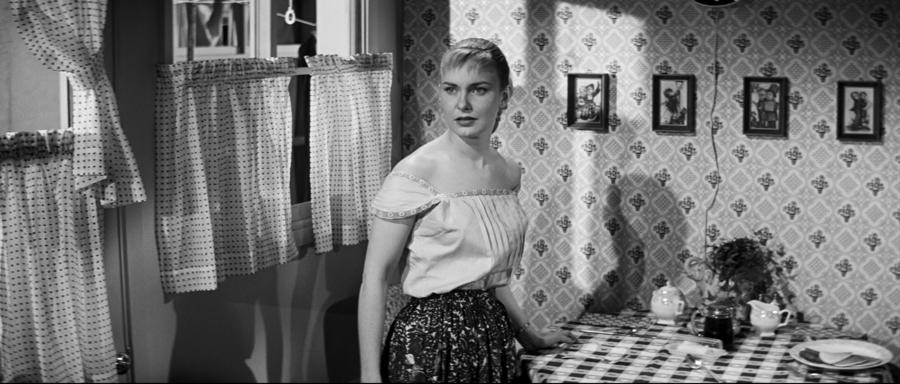
Why did Fox forego colour for the film? When we think of 1950s melodramas it tends to be the widescreen colour films of Douglas Sirk, Nicholas Ray, Otto Preminger or Vincente Minnelli. There are of course examples of melodramas from these directors in B+W around the same time – Sirk’s The Tarnished Angels (also 1957) and Nick Ray’s Bitter Victory (again 1957). Perhaps these films point to the ‘seriousness’ and the critical edge of B+W ‘Scope. Actually, No Down Payment includes two moments that echo scenes in Sirk’s All That Heaven Allows (1955) and Minnelli’s later Home From the Hill (1960), both colour films. But any production that opts for B+W over colour misses out on the possibility of the melodramatic ‘excess’ offered by colour in the mise en scène. That means that the director must search for some other means of finding excess and in No Down Payment this could well be in the casting and the performances.

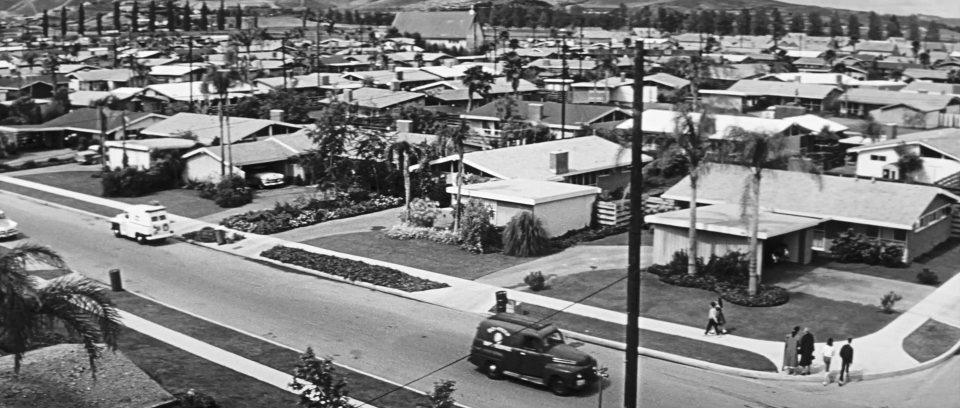
As the title hints, No Down Payment is about the American Dream, specifically of the Eisenhower 1950s, of an affluent future for all young Americans with aspirations. It’s an earlier narrative with similar concerns to the British picture Live Now – Pay Later (1962) but it sees more social ills in the invitation to American couples to acquire a new house in a ‘subdivision’, a new middle-class housing estate in the wide open spaces of Southern California. The billboards by the freeway promise ‘no down payment’, especially for GI Veterans. The original story is from a novel by John McPartland, a pulp writer who produced this single more mainstream novel. Watching the film I caught myself assuming this must have been a stage play since apart from the opening credit sequence of the next young couple to arrive in their new home in ‘Sunrise Hills’, most of the action takes place in four connected houses on a studio set. Having said that, the few long shots of the development do trigger memories of various films over the years in which new American housing developments feature in science fiction and horror narratives like The Truman Show (1998) or Edward Scissorhands (1990) and many others. Suburbia is a disturbing environment in these films.
The conceit in the story (adapted by Philip Yordan, possibly ‘fronting’ the black-listed Ben Maddow) is that four couples as close neighbours carry with them a host of troubles. The new arrivals are David Martin (Jeffrey Hunter) and his wife Jean (Patricia Owens). Hunter I know best as the part-Native American ‘Martin Pawley’, the young man with Ethan Edwards in The Searchers (1956). In this film he is the clean-cut young electronics engineer who spent the war years as a technician-soldier at Los Alamos. Patricia Owens I saw more recently in Island in the Sun (1957) in which she is married to the sugar plantation heir played by James Mason. They are an attractive couple but there is conflict. Jean wants David to move out of engineering and into sales where he could earn more – but he isn’t happy with that idea. Next door are the Kreitzers, Herm (Pat Hingle) and Betty (Barbara Rush). Pat Hingle was a strong supporting player with some 200 credits in film and television. Barbara Rush appeared in many A list features opposite many male stars but never made it to A list ‘leading lady’. Ironically she was married to Jeffrey Hunter in the early 1950s. In this film she has two small children and Herm, a war veteran, is manager of the local hardware store and a member of the local town council. Betty takes the children to church but Herm washes his car on Sunday morning. The importance of ‘Christian values’ will become important later in the plot.
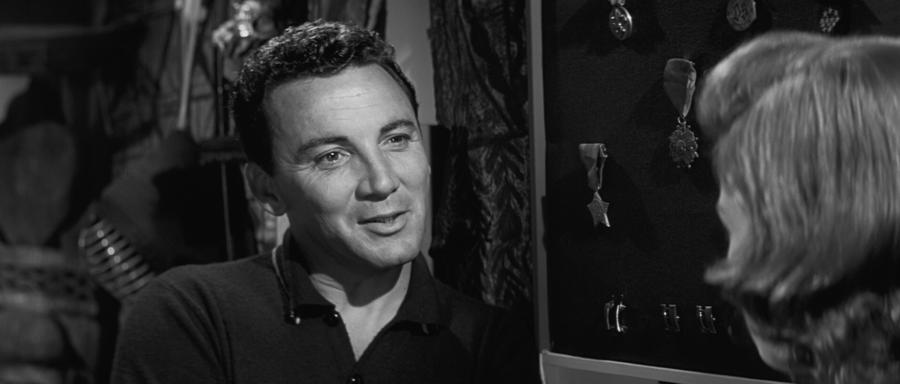
The third couple comprises Troy Boone (Cameron Mitchell) and his wife Leola (Joanne Woodward). They are typecast as migrants from the South, partly signified by their first names. Mitchell had even more film and TV credits than Hingle, but, like Rush, never quite made it to the A List. But he always had ‘presence’ and in this film he’s the ex-Marine sergeant who runs the local petrol station and hopes to become head of the town’s small police force. In his garage he keeps a shrine of all the memorabilia he collected during the Pacific War and the board to which he has pinned all his medals. The marriage has its problems since Leola lost a baby to adoption around the time she met Troy. Was he responsible in any way? The incident seems to to be still harming their relationship. Finally, the Flaggs are the fourth couple with Sheree North as Isabelle and Tony Randall as Jerry. North had been seen as a successor to Marilyn Monroe and at 25 she was the youngest of the eight leads – though her costumes and hairstyle work against that description. She is also the mother of a small boy. Randall was mainly associated with lighter roles, including the lead in Frank Tashlin’s Will Success Spoil Ross Hunter? in 1957. As Jerry Flagg he portrays the real victim of ideology and literally disrupts the equilibrium of the narrative in the first major scene in which all the couples are involved in a barbecue and party organised by Herm. Jerry gets drunk and dances rather too intimately with Jean Martin. He’s a used-car salesman working for commission and Isabelle begs him to get a job with a salary. He has great aspirations to earn more money but drinks too much to disguise his fear that he’ll never make it.
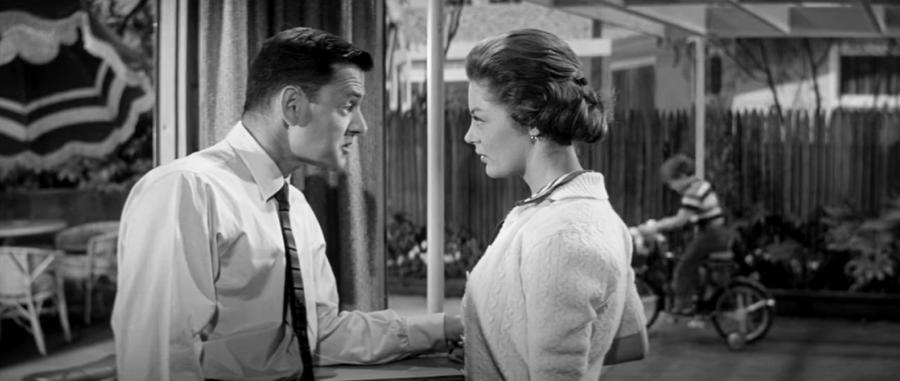
This is an excellent example of ensemble acting. All eight leads are capable actors. Randall, Woodward and Mitchell stand out as the most expressive because of their roles but that only works in narrative terms because of the more restrained performances of the others. I’m not going to spoil the narrative by giving too much away but the script is very cleverly managed so that each of the different conflicts within the marriages actually have effects on each other and all eight of the characters are implicated in the tragedy that ends the narrative and all the other problems that are raised. This film critiques the American Dream in so many ways. The promise of affluence and easy access to goods and services becomes a battle to achieve, to win, to become better off than a neighbour. At the same time the ‘subdivision’ (in the UK a housing estate) is intended to be exclusive and some developers in the US included (illegal) regulations to keep out non-white families. This becomes one of the conflicts in No Down Payment. A second conflict is around social class and also gender roles in each household. None of the wives work outside the home. Betty and Isabelle have childcare responsibilities (when their husbands are at work). Jean and Leola could take jobs. Is there some form of middle-class delusion here? Three of the working men are not middle-class in the terms I understand. Lower middle-class perhaps except for David with his college education and engineering training. But David is not the ‘alpha male’ in the group – that’s Troy or Herm, partly because of their wartime exploits. Alcoholism, babies ‘out of wedlock’, racism, children in front of TV sets all the time (Western series at breakfast time) – these and more ‘ills’ of US society are exposed.
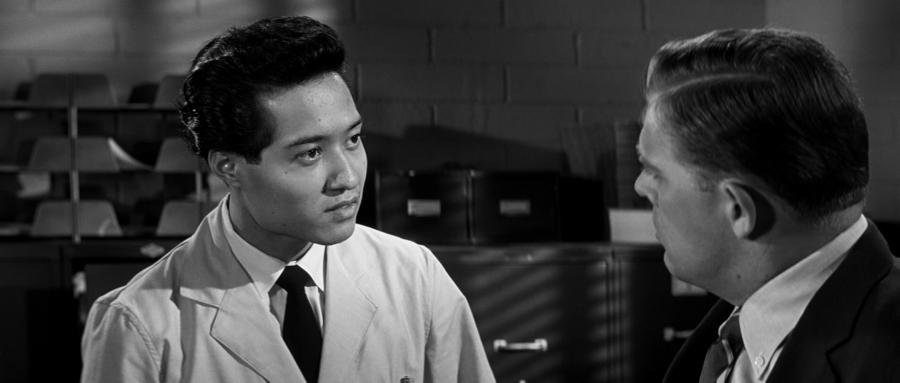
It’s hardly surprising that the film was seen by some commentators as a leftist attack on the Dream and that although critics liked the film it wasn’t the box office success that Fox hoped for. There is one contradiction here. The writer of the original novel McPartland was seen as an ‘anti-communist’ but the adaptor Philip Yordan was seen as a liberal and if he was ‘fronting’ a black-listed writer in Ben Maddow then the film’s stance makes more sense. The director was Martin Ritt, a well-know TV and stage director with a background similar to Joanne Woodward who left TV fearing pressure from anti-communists in the TV industry. He had made just one previous cinema feature, Edge of the City (1957), with Sidney Poitier as a gang boss on the docks who befriends John Cassavetes, a new employee with a past. Ritt made a fine start to his cinema career, working on a subject he understood and with actors who were responsive. He would go on to make a string of films with similar themes, often working with the same actors, including with Woodward and the actor she later married, Paul Newman. How did Ritt get the job at Fox? I don’t know but the producer of No Down Payment was Jerry Wald. Wald came from a Jewish New York family and became one of the top producers in Hollywood from the early 1940s. I don’t know what his politics were but he often worked with Humphrey Bogart at Warner Bros. and in the 1950s he had power as a producer with considerable independence within first RKO, then Columbia and finally Fox. He had been a writer and he understood the business thoroughly. He would have been the person to choose Martin Ritt I think.

I realise that I haven’t made the case for No Down Payment as a melodrama, except in my comments about the social critique and the performances. The score by Leigh Harline is almost anti-melodrama in that for the dramatic final act there is no music at all. Harline won two Oscars for his work Pinocchio in 1940. He was probably best know for Westerns and action pictures rather than ‘social melodramas’ Cinematographer Joseph LaShelle was another experienced industry veteran who won an Oscar for Laura (1944), Otto Preminger’s noir drama. Again he wasn’t associated with melodrama as such, but he was another skilled and talented contributor to the production. The melodrama rests on the mix of so many social issues in the script – excessive certainly – and the performances.
No Payment Down is available online for free on a very good print if you do a quick search. Here’s a brief clip in which Leola seems to be saying she isn’t flirting with David:
 itp Global Film