

This unusually structured film with a remarkably strong cast seems to have failed to excite distributors and festival critics and therefore struggled to achieve any kind of wide release. It failed in its home market and was not released in UK or US cinemas, only later appearing online. It has now appeared on MUBI in the UK. Writer-director Arnaud des Pallières’ only film to receive a wider release appears to be Michael Kohlhaas, featuring Mads Mikkelsen in 2013 which was released in the UK. Is Orpheline really that bad? No, it isn’t but it does offer two rather different challenges to audiences that might have initially frightened distributors.
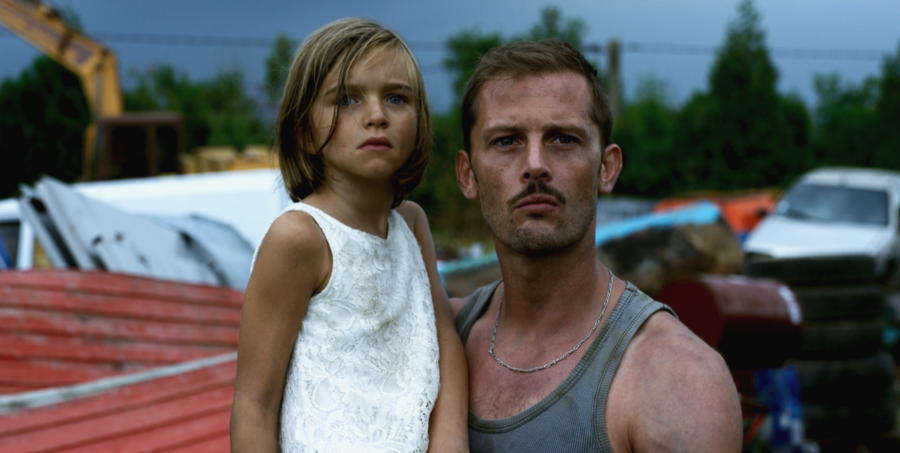
The structural novelty is to have four different actors to play the central character in the narrative at different times of the character’s life. That’s not unusual of course but in this case the narrative is not linear and the character’s name is different for each of the time segments. Add to this that the transition from one time period to another is abrupt and has no accompanying intertitle for the date or location. I had read the blurb on MUBI and I started to watch the film but it was still some time in before I was sure that I was following the story of the central character.

The first actor I recognised in the opening sequence was Gemma Arterton, later revealed as ‘Tara’ being released from a prison cell. There is then immediately a cut to Adèle Haenel in a primary/elementary school where she appears to be the head teacher and named as ‘Renée’. These are two star actors in a European context so I wondered if they were two of the four representations of the central character. I won’t spoil the narrative but it wasn’t until the third star appeared, Adèle Exarchopoulos as ‘Sandra’, a young woman thinking about answering a classified ad in a newspaper, that I guessed that Sandra was a younger version of Renée and that the narrative had entered a flashback. This was confirmed when Sandra met Tara and the two became connected. The narrative then switches further back to ‘Karine’ (Solène Rigot) a younger teenager who appears older than her real years and then finally to ‘Kiki’ (Véga Cuzytek), a small child playing hide and seek with two friends. Eventually the narrative returns to Renée and the final scenes are with her. Along the way there are several other significant characters including ‘Maurice’, a driver who stops to give a lift to Karine and is earlier seen recognising Sandra. He’s played by Sergi Lopez, an instantly recognisable actor for me who links two versions of the central character together. Clearly a French audience might recognise other actors and make other connections. In the Press Pack I found this statement by the director:
The spectator will quickly understand the idea of the film: four actresses playing four periods of a woman’s life.
Really? I’m not sure about ‘quickly’. Thinking back over the narrative, the four versions of the same character are meant to represent key moments when Kiki/Karine/Sandra/Renée is six, thirteen, twenty and twenty-seven. I’m not really arguing against the director’s strategy, simply pointing out that it is a challenge. For a UK viewer, the casting of Gemma Arterton is an extra confusion. She has appeared in French films before starting with Gemma Bovery in 2014, but she is much better known in the UK for her British pictures and it’s natural for a UK viewer to assume at first that she will be more important in the story.


The other other challenge is simply concerned with the change in ideas about representations of gender that have developed from #MeToo and similar campaigns. Here is a film conceived and directed by a man who tells us that he imagined that “I was entering for the first time in a woman’s skin”. To do this he asked his wife Christelle to collaborate with him and put down something of her own biography from her time as a young girl and then a teenager in the countryside and then as a young woman and an adult committed to her work and her partner in the city. Inspired by this material the couple developed a script. (If you want to get Christelle Berthevas’ statement about this process, you can go to the French Press Pack for the film available on the distributor website of Le Pacte. French cinema has included several films about ‘wild’ young women and I did wonder what I was about to see, especially when ‘Sandra’ turned out to be quick to have sex with the man who hired her. ‘Karine’ at first seemed to be very provocative, hiding her age when coming on to a man at a nightclub. But eventually I realised that Karine was rather a frightened young girl and her bravado with strangers was a form of protection. Even so, several reviewers were down on the film for its sexual content and it is worth noting that Adèle Exarchopoulos as Sandra was also caught up in the controversy over Blue Is the Warmest Colour in 2013 and Adèle Haenel as Renée announced her withdrawal from film production in 2022 because of the roles she found herself performing and the sexist, racist, capitalist hegemony across the industry.

I respect Haenel for her decision and the views of those critics who have problems with the film. My practice is, however, to analyse what I see on screen and offer my response and then allow the reader to make whatever they wish from my conclusions. I was surprised that in the end I did enjoy the film. Once I understood what was happening and could follow the linear narrative I was engaged. All the performances are very good, both the established star actors, the two younger actors in lead roles and the supporting characters. The cinematography is by the experienced Yves Cape who has been urged to provide close-ups of the actors, often with minimal make-up and with harsh lighting which exposes flaws in skin. It’s sometimes very revealing and does contribute to the realist aesthetic. It is also a feature of what might be called the ‘candid’ scenes whether these are instances of sexual activity or simply scenes in which characters are washing, sleeping or in one case exploring what pregnancy does to the female body. The director does indeed seem to be exploring his female characters’ skin.
In the trailer below, the distributor, perhaps not surprisingly, appears to have decided to present the narrative in such a way that the director’s intention is undermined and the structure is explained for the viewer rather than challenging them to re-construct the story. I think this is a film worth watching for the performances alone. Perservere for the first fifteen minutes and I think you will really get into the narrative. Some reviewers complain about the ending of the film but it made sense to me.
 itp Global Film