

Ever since Hollywood gained hegemony over all other ‘national cinemas’ in the years after 1918, there have been American films that have attracted international audiences as well as those at home in North America. During the 1920s the nationality of actors was not so important since they didn’t speak on film until 1927/8. One of the biggest stars of the 1920s was Rudolph Valentino (1895-1926) the Italian who became the ultimate ‘Latin lover’. Valentino didn’t speak on film because he died before the ‘talkies’ were established. But Greta Garbo, who arrived in Hollywood from Sweden in 1925 did make the transition to sound. Most Europeans who arrived in America during the 1910s, 20s and 30 decided to stay, learning English and many changing their names, ‘Anglicising them’. Only a few returned to Europe – many couldn’t or wouldn’t return after Hitler came to power and especially when countries like France were occupied. I’m not counting the large number of ‘British Empire’ actors who migrated to Hollywood since language enabled them to move more easily into American film roles (though some did find it difficult).
My concern here is with those European actors who came to prominence in films in the UK, Italy and France in particular in the 1950s and 1960s and who were able to win roles in relatively big budget films made not in Hollywood, but in Europe either for local studios or for Hollywood studios or American independent producers. Sometimes these were seen as ‘runaway productions’ fleeing Hollywood for lower production costs in Europe and sometimes being made by the European subsidiaries of the studios. The UK has long had a film ‘industry’ which is little more than a facilities operation serving the Hollywood majors (starting in the early 1920s). Major European studio facilities included Cinecitta in Rome which eventually became part of ‘Hollywood on the Tiber’. To understand what happened it’s necessary to consider a number of factors.
In the immediate post-war years and into the 1950s the different film industries in Europe experienced different local conditions. In 1946, the UK was the major European film market and also a major producer since British films as well as Hollywood imports were popular. Some of the British films sold in Europe. The British film industry also imported European actors. But Britain also experienced the relatively quick spread of TV broadcasting in the mid-1950s which contributed to a swift decline in cinema audiences in the UK from 1955-6 onwards. The four major West European industries, by contrast, were relatively weak industries and film markets during this period. Spain was isolated because of Franco and censorship issues and West Germany struggled to re-create a film industry when many of the facilities of the pre-war German industry were in the East. In the West, the Occupation forces at first created problems for filmmakers. France had always been an important production centre with both artistic and popular films being made but the French film market was traditionally smaller than the UK or Germany before the war. The revelation of the 1960s was the rise of the Italian film market which would grow to overtake the UK and provide the fuel for the lift off of production during the 1960s and 1970s.
The Italian film industry had three important advantages. First there was an appetite for films that provided a strong base for low-budget domestic productions while Rome became the base for American runaway productions. This home market didn’t necessarily produce high box-office earnings but it was an important factor. Second, Italian producers were enthusiastic in taking up co-production opportunities, especially with French producers and later with German and Spanish companies. Co-production meant a sharing of stars and creative talents and also distribution deals and audiences. European co-productions were also helped by the practice of dubbing that was strongly established in the ‘FIGS’ (France, Italy, Germany and Spain). In all four countries, films in other languages were routinely dubbed into the home language, unless the films were deemed as art films requiring subtitles. In this respect I think the different film industries diverged to some extent. The Italian system was most heavily invested in dubbing with much of the production designed to be dubbed in post-production. Thus it became possible to use anglophone actors alongside the sometimes more bilingual or multilingual Europeans since the whole voice track to the film would be dubbed.
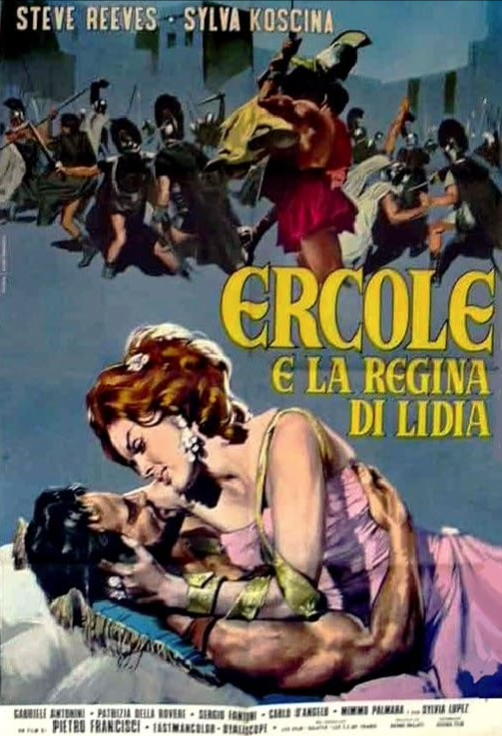
These three factors would eventually lead to a host of European genre films, with stars becoming household names across national boundaries, often in dubbed form. When did this become noticeable? It’s hard to say, but the period around the early 1960s does seem to be the most significant. Italian films dubbed into English gained popularity in the UK and US in 1959-60 with the big box office success of Hercules (1958) and its follow-up Hercules Unchained (1959). These films starred the American body-builder Steve Reeves and the Yugoslavian actress Sylvia Koscina in first an Italian-Spanish co-production and then an Italian-French-Spanish co-production. Both films had the input of an important Italian filmmaker, Mario Bava, who would become better known later as a horror film director. On the Hercules films he was cinematographer and special effects creator. The films were seen across Europe and importantly in ‘circuit cinemas’ in the UK and across the US, courtesy initially of American producer-distributor Joseph E. Levine. They paved the way for the wider acceptance of dubbed genre films and eventually the influence of Italian genre films on supposedly American genres. Hercules was an example of the ‘sword and sandal’ or ‘peplum film’ genre that dominated Italian production in the late 1950s and early 1960s. Its successor was the Italian western, like the peplum film derided by critics but popular with audiences. (Horror films by directors like Mario Bava also began to appear from the late 1950s as co-productions, but although some of then reached the UK and US, they didn’t have the same impact on the mainstream circuits at this time.)

Leone, Eastwood and Volontè
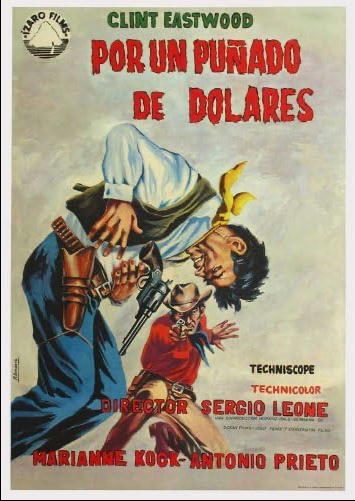
The release of Per un pugno di dollari (A Fistful of Dollars, Italy-West Germany-Spain 1964) was arguably the moment when the the European popular genre film began to make its indelible mark on the international film market. Although famous now, the film took a while to prove its worth with local audiences but the co-production deal guaranteed a release in West Germany (which had a longstanding interest in Westerns) and in Spain (where the film was shot). The German poster here features the two German actors in support roles. Marianne Koch was a lead actor in Germany and did make more European co-productions, Wolfgang Lukschy mainly stayed in Germany. The poster above mentions other Germans but not the Italians, although Sergio Leone is picked out as director. Constantin-Film was producer and distributor in West Germany. In the Spanish poster, the distributor Izaro Films, includes Marianne Koch and finds a Spanish actor Antonio Prieto who plays one of the villains.
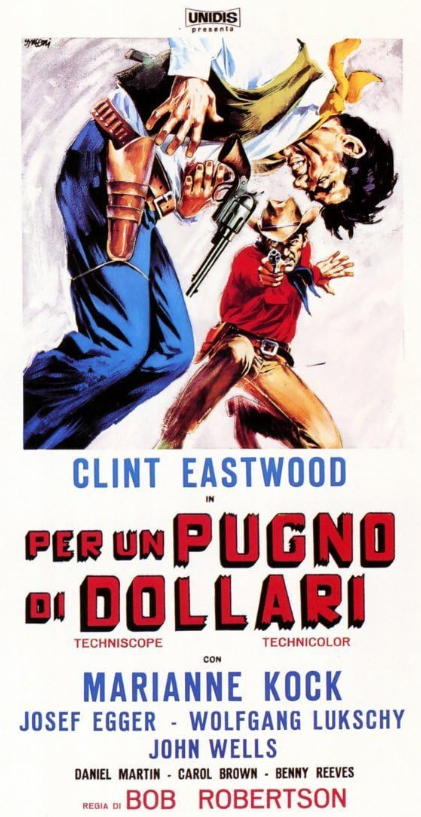
The initial Italian poster from distributor Unidis displays the belief that Italian audiences will be more likely to respond to American-sounding names, so the lead Italian actor Gian Maria Volontè becomes ‘John Wells’ and even the director, Sergio Leone becomes ‘Bob Robertson’. This was quite a common practice and certain actors retained their new ‘American’ names for later productions, e.g. ‘Terence Hill’ (real name Mario Girotti), one of the best-known stars of Italian genre movies.
When the film began to take off, the Italian presentation for the film was modified. Clint Eastwood was the star of the film and Marianne Koch was a recognised name in Germany but Sergio Leone, the actor Gian Maria Volontè and the music composer Ennio Morricone were now becoming more widely known.

The first two films in the ‘Dollars Trilogy’ have been written about at length and I don’t intend to repeat familiar material here. It took over two years before ‘Fistful’ got its release in the US and then the UK and when it did, the second film For a Few Dollars More (Italy-West Germany-Spain 1965) followed soon afterwards, so both films appeared in 1967, dubbed into English. The second film was longer (over 2 hours) and Lee Van Cleef, a Western support player since the 1950s joined Eastwood. Eastwood himself, mainly known in the US/UK as ‘Rowdy’ Yates in the TV series Rawhide (1959-1965), developed a new persona as the ‘Man With No Name’ and in 1968 began his new career as a leading man in Hollywood. Van Cleef, by contrast, was able to build a new career in European productions from the mid-1960s. But the other actor who appeared in both of the Dollar films was Gian Maria Volontè. Born in 1933, he was university-educated and had appeared in several films and TV dramas mainly in small parts but sometimes as a lead in the early 1960s. It seems odd that the Italian distributor would disguise his name as he was known in the industry as one of the best young actors in Italy. He made his mark in ‘Fistful’ as the most dynamic of the villains up against Eastwood and in the second film his role was expanded to become what was in effect the third main character in the narrative, ‘El Indio’, the bandit chief who gets nearly as much time on screen as the two American leads.

Volontè had a powerful screen image and real ‘presence’. He would go onto make at least one other major Italian Western, but mainly he appeared in a number of major films by Italian auteurs, as well as further co-productions. His international presence grew on the art cinema circuit and we have already discussed some of his better known roles in Francesco Rosi’s The Mattei Affair (Italy 1972) and Jean-Pierre Melville’s polar Le cercle rouge (France-Italy 1970). Over the next few weeks I hope to feature two or three more of Volontè’s roles in 1970s features. His filmography will also lead us into thinking about some of the other major European stars who made an impact internationally in the 1970s. He himself won several international acting awards, including from Cannes and Berlin festival juries.
 itp Global Film
On the subject of Italian actors in spaghetti westerns with anglicised names and fading Hollywood stars as guest actors, honourable mention should be made of spoof western ‘They Call Me Trinity’, and follow-up ‘Trinity Is Still My Name’, featuring ‘Terence Hill’ and ‘Bud Spencer’ and the real Farley Granger. Both the former Italians went on to some B movie success in the States although I am not sure if Farley Granger ever did much else. Carroll Baker also spent much of her latter days propping up the lower end of the Italian cinema, as my visits to the Plaza Cinema in the early seventies will attest.
As an aside, I guess a number of cinema-goers of my generation will possibly only know Marianne Koch as the almost mute victim in ‘A Fistful Of Dollars’. I saw her recently as an alcoholic vengeful wife in something on Talking Pictures and was almost taken aback.
LikeLike
I did mention ‘Terence Hill’ but I should perhaps have included ‘Bud Spencer’.
The flow of Americans and Brits to Italy is the obverse of the appearance of Italian, French and German stars in UK and Hollywood films. I’ll get round to it at some point.
Perhaps you should write up your memories of early 1970s cinemagoing John? I’d certainly be interested.
LikeLike