

Un beau matin is a very fine film. As with most of the films from Mia Hansen-Løve, her new film has links to her experiences with parents, relatives and colleagues. In this case the narrative draws on Hansen-Løve’s experience of her father’s decline through the onset of the neurodegenerative disease Benson’s syndrome. Her father was a philosophy teacher and this film is linked to Things to Come (2016) in which Isabelle Huppert is a philosophy teacher in a role informed by Hansen-Løve’s mother’s experiences. This is a beautifully presented drama and very moving but a word of warning – if you are an older person considering what might happen in your later years or a younger relative of someone diagnosed with dementia, you may find the film upsetting.

The narrative structure of the film is relatively simple. Sandra Kienzler (Léa Seydoux) is a young widow with an 8 year-old daughter Linn (Camille Leban Martins). We first see her on her way to visit her father, Georg (Pascal Greggory). His condition has deteriorated and he has difficulty opening the door to her. Benson’s syndrome is a form of dementia which reduces vision and makes it difficult to process visual information. Soon, Sandra finds herself in discussion with her sister Elodie (Sarah Le Picard), her mother Françoise, Georg’s ex-wife (Nicole Garcia), and Georg’s current partner Leila (Fejria Deliba) about Georg’s future care now that he is unable to look after himself. Over the rest of the narrative Georg will be moved four times – to two different hospitals and then to two different care homes. The last move does meet the family’s requirements. The search for affordable social care seems as much a problem in Paris as it is in the UK.

In the meantime, Sandra has her job as a translator working on various conferences and public events. She is close to her young daughter and one day when the pair are in a park, Sandra meets a slightly older man who she recognises as one of her husband’s friends. This is Clément (Melvil Poupaud). There is an obvious attraction between Sandra and Clément. He is a ‘cosmo-chemist’ who travels widely to find extra-terrestrial materials which have landed on earth from meteorites etc., bringing them back to analyse in Paris. He is also married with a son. An affair is almost inevitable as we watch a vulnerable Sandra responding to Clément’s opening remarks.

This is a film with what seems like more dialogue than some of Hansen-Løve’s other films. Some critics have compared the film to those of Eric Rohmer, perhaps because both Melvil Poupaud and Pascal Greggory featured in Rohmer films during their long careers and the French distributor of Hansen-Løve’s recent films has been Les films du losange, the company founded by Rohmer and Barbet Schroder. I’m not sure there is a particularly strong connection but it is certainly the case that Un beau matin is very well written and although there isn’t much in the way of ‘plot’, we are offered a detailed study of the central character Sandra at a difficult time in her life when she is having to ‘let go’ of her father and both enjoy and suffer the emotions of a possible new life with Clément. The film is quite long (112 minutes) but the time is well spent. I was always engaged and grateful to have time to think about what was happening to the characters.
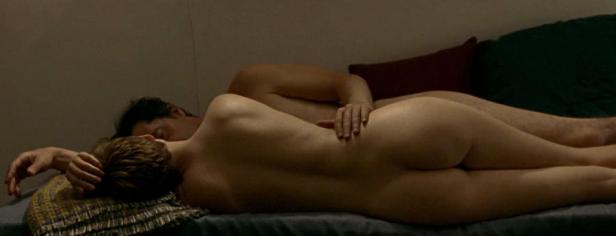
The director says that she had Léa Seydoux in mind for the lead role from the start but that she also wanted to ‘de-glamourise’ a star performer in order to create Sandra. There is a discussion of the change to Seydoux’s appearance in several reviews. One reviewer refers to her ‘dowdy’ costumes. I don’t think that is a useful description. They are perhaps utilitarian and appropriate for the things she has to do. I was more taken by the impact of her short hair. I think I would describe it as a ‘Joan of Arc hairstyle’ and I was reminded of the strong images of Renée Jeanne Falconetti as Joan in Carl Dreyer’s 1928 film La Passion de Jeanne d’Arc. (Later in the film we see Sandra at work seemingly providing a commentary in French for a German silent film starring Brigitte Helm in The Wonderful Lies of Nina Petrovna. I haven’t yet worked out the significance of this.) Léa Seydoux has strong facial features, usually framed by long hair and these features stand out much more with short hair. Sometimes it appears as a more masculine face but Hansen-Løve also emphasises Seydoux’s beautiful female shape in a shot reminiscent of classical nudes as Sandra has her back to us on the edge of the divan that she shares with Clément. The cinematography by Denis Lenoir, who has shot the director’s last three films, is excellent throughout. The director chose to use 35mm film to shoot her picture, feeling it gave warmth to the images, but also ‘distance’.

The centre point of the film is the sequence in which Sandra explains the importance of her father’s books to her daughter Linn. Sandra tells her that when she visits her father, she does not find him present in the body that is failing him, but he is there in the books – that’s where his soul resides. “But he didn’t write the books”, Linn says. “No but he chose them and through these books his personality expresses itself” says Sandra. This is followed by a similar scene relating to Georg’s love of certain kinds of music. These scenes seem to me very ‘real’ – almost painfully so. Music is important to the director as she tells us in the Press Pack:
‘Liksom en herdinna’, is a piece by Jan Johansson, a Swedish composer. When I prepare a film, I am always accompanied by one or more pieces. For One fine morning, it was this one. What makes it special is that I discovered it in a Bergman film, The Touch, which talks about an adulterous passion between two characters played by Bibi Anderson and Eliott Gould . . .
. . . I used Jan Johansson’s theme, because I identified with his melody where you find a melancholy as well as a speed, which goes with walking, which is recurrent in the film.
I think that the general audience is sometimes a little suspicious of Mia Hansen-Løve, possibly because she makes so many references to other films, but this is a reason why so many cinephiles love her films. In this case the story is so universal, not precisely but in the meeting of the emotions of new love and of parting. In addition there is Sandra’s job which places her with the responsibility of translating/interpreting speech between individuals using different languages.
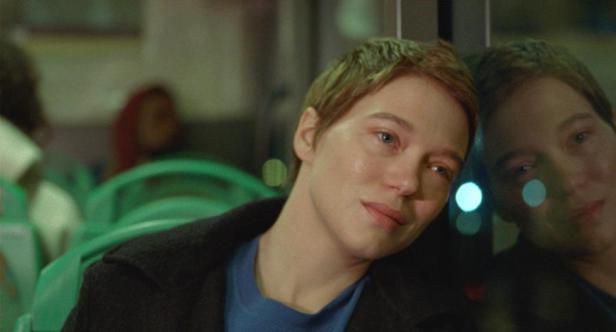
Being a carer changes when a loved one enters a care home. But a different responsibility then arises – regular visits. Sandra finds herself with many journeys to make each day, to her translation jobs, to Linn’s school and to the care home. It’s a marvellous performance by Léa Seydoux and indeed all of the cast. I highly recommend Un beau matin, an intelligent and immensely affective film. It’s available to stream on MUBI in the UK and via Amazon.
 itp Global Film
I couldn’t quite bring myself to see this, not just because of the father but because the affair with the older man seems such a cliche of French cinema. But I do think Things to Come one of the best films of recent years.
LikeLike
I take your point but I should note that the affair is viewed mainly from Sandra’s perspective. Is Clément that much older? I do tend to think of Léa Seydoux as a young woman but actually she’s in her late thirties (born 1985). Melvil Popaud was born in 1973. The characters’ ages aren’t mentioned in the film. The only salient point is that Sandra knew Clément before as her husband’s friend. I think Hansen-Løve presents the characters as closer in age than the actors playing them.
LikeLike