
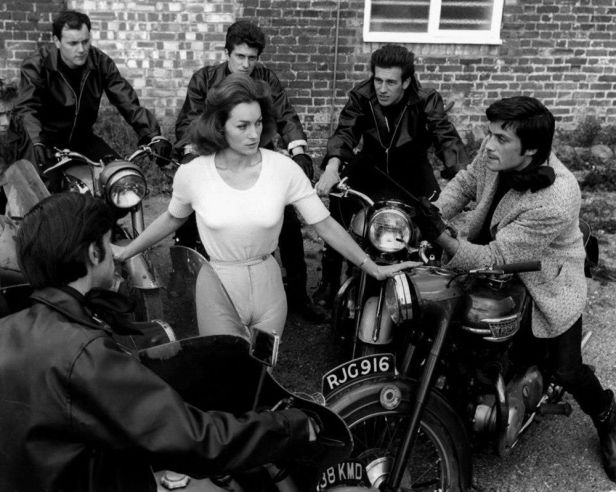
Director Joseph Losey is sometimes lauded as Brechtian, he drew attention to the artifice of film in order to estrange the audience and get them thinking. However, the fractured (and somewhat estranging) narrative of The Damned comes from the messy way it was scripted. Losey didn’t like the original script, an adaptation of The Children of Light by H.L. Lawrence, and he brought in Evan Jones to rewrite, with Losey, which went on throughout the production. So it’s not surprising the film’s narratively disjointed. The children, who are being experimented upon by the British government and so are the centre of the narrative, don’t appear until around half way through. The first part of the narrative focuses on Teddy Boys terrorising Weymouth with Oliver Reed relishing the role of the deranged delinquent not unlike Malcolm Mcdowell’s Alex in A Clockwork Orange (UK-US, 1971) a decade later.
A rather insipid Macdonald Carey plays a middle aged American living out a mid-life crisis before being entrapped by an unlikely femme fatale (Shirley Ann Field), sister of Reed’s thug. Swedish actor Viveca Lindfors plays the free-spirited (she’s foreign) sculptor in contrast to Alexander Knox’s deranged civil servant who’s administering the tests on the children.
It is a strange film but that’s perfect for the world at the time when nuclear war seemed, to some, inevitable. It’s certainly worth watching for Reed’s turn alone and I’m surprised it took so long for him to become a leading man after it but that probably reflects the lack of box office success of the film.
In America it was marketed as These Are the Damned and the poster is a compete misrepresentation of the children; the tagline more describes the British civil servant played by Knox. The uncompromising ending is excellent.
 itp Global Film
Whilst there are some problems with the script overall I think this is an outstanding film and one of the best that Losey made in Britain. The cinematography and editing are excellent and the final overhead tracking shot of the couple is, like the title, ‘damned’.
Reed is good whereas Carey is miscast, the problem of importing US minor actors into British productions; though this is at the ‘fag end’ of that tactic. But Alexander Knox is excellent and not deranged. Rather recalling his Nazi perpetrator in ‘None Shall Escape’ {1944). I think Nick’s comment regarding Freya is interesting. The film plays with representations in terms of identity in a way that Losey returns to in his later and better-known films.
As for Brecht; ‘estranged’ does not really give the sense of his concept, ‘distance’ is better. And Losey and his team do this in a number of ways, especially in self-conscious non-realist tropes such as Reed’s mocking take on Englishness. I do think that ‘Brechtian’ is not quite the right term for such cinematic devices. Brecht worked in theatre and the cinema works in different ways. However, the aim in works by such as Losey do share an approach to engagement in audiences.
LikeLike