
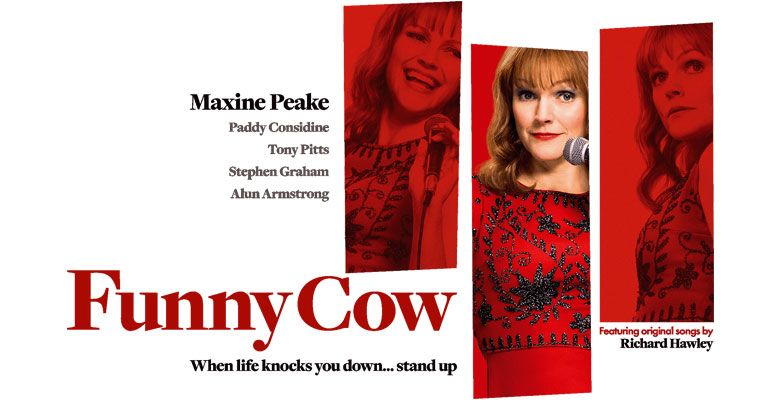
Funny Cow is a difficult film to write about. Maxine Peake is the star of the film and its executive producer and my admiration for her commitment to her craft and to working-class socialist politics is boundless. Add to that the filming in Saltaire and elsewhere in Bradford and Leeds and I’m certainly compromised. In some ways, I think that the most interesting aspect of the film, apart from Maxine Peake’s wonderful performance, is the range of positions adopted by various critics and commentators about the film and its depictions of Northern working-class life from the 1950s through to the 1980s.
Funny Cow is a fictional biopic of a female stand-up comedian, presented almost as a kind of arthouse ‘essay film’ about working-class life. The narrative jumps backwards and forwards during the life of the unnamed central character who is shown as a child (‘Funny Calf’) in the 1950s (played by Macy Shackleton), (very) briefly as a young wife in the 1960s (Hebe Beardsall) and finally as ‘Funny Cow’ in the 1970s and 1980s. At times, the fourth wall is broken and Maxine as Funny Cow talks to the camera. At other times she visits her old haunts and meets her younger self. Individual sequences are introduced with inter-titles. Throughout the narrative, Funny Calf/Cow wears bright shades of red, culminating in a red Triumph Stag car as her chariot – thus subverting the chauvinistic symbolic identity of the car (second only to the E-type in signifying macho posturing?). ‘Funny Cow’ is never given a first name. I assume that the nickname is meant to signify that process by which in the North of England (and other communities, I guess) derogatory names are given to best friends, almost as endearments – “stop it, you daft bugger!” etc.

The genesis of the project appears to have come from the meeting of the writer Tony Pitts and the actors Maxine Peake and Paddy Considine on the production of Red Riding: 1980, the second in the trilogy of TV films from 2009 based on the books by David Peace. All three were actors then and Pitts wrote Funny Cow, presumably with Peake in mind. I heard Peake discussing the production on radio and I think she said that convincing Considine to act in Funny Cow made it viable for financiers because he has a ‘known’ profile in the cinema. Much as I really like Paddy Considine, he is decidedly miscast in Funny Cow. Or perhaps it’s just a badly-written part? Either way it is a shame, because I thought his scenes were the only ones that just didn’t work. I couldn’t believe that under a wig and behind a pair of glasses was a great actor. I couldn’t believe in his character at all. He’s supposed to be an effete ‘intellectual’ running an enormous bookshop (without any discernible customers or staff) and living in a mansion decorated with artworks. Funny Cow starts a relationship with him, seemingly to get away from her abusive husband – or possibly hoping for an Educating Rita scenario? I did also wonder if this was a conscious role-reversal of the relationship between Joe Lampton and the industrialist’s daughter in Room at the Top (1958). It’s interesting that each scene in Funny Cow conjures up these memories. I think it’s a function of the episodic narrative.
Among the other familiar faces for UK audiences Alun Armstrong excels as a stand-up comedian in the pubs and clubs coming to the end of his career. It’s painful to watch but utterly convincing. He finds himself acting as Funny Cow’s mentor, not necessarily by choice. Other well-known names and faces appear in bit parts throughout the film.
Apart from a miscast Considine, the other weaknesses in the film hinge on the difficulty of representing the North of England of the 1950s-80s in 2018. It’s ironic that the streets of back-to-back houses depicted in the film are actually located in the World Heritage site of Saltaire – artisan’s dwellings in the model town built by Titus Salt. In at least one shot you can see Baildon Moor on the other side of the Aire Valley. They certainly confused Mary Beard on the BBC2’s ‘Front Row Late’ who thought that the National Trust had ‘sanitised’ them in Manchester. But she’s got a point. It’s impossible to recreate the Ripper Years of the late 1970s in Bradford and Leeds (although Red Riding made a valiant attempt). Everywhere is now a lot cleaner, partly because there are few dirty industries left and partly because many of the terraces have been replaced by modern housing. The other problem, for historical dramas is that representations of the working-class North of England in the 1970s (or 1960s) have become reified (i.e. made concrete, permanent) by a relatively limited number of successful films. Films like East is East (1999) for 1970s Salford/Bradford or Billy Elliot (2000) for 1980s Co. Durham, Saturday Night and Sunday Morning (1960) for Nottingham in the late 1950s or A Taste of Honey (1961) for Salford in the late 1950s and Charlie Bubbles (1969) for the devastation of old housing torn down in Manchester. TV has never really had the same problem since TV drama has very often been made in the North – in fact I’d argue that it is as familiar as London as a location.
But if we step away from the location issues, the real question is, “What is the film about?” or “What is it for?”. It isn’t simply a comedy. And it isn’t a faux biopic about a real female comedy performer (though Marti Caine has been widely touted as an inspiration for Peake’s character). If anything, the film is a satire on male chauvinism which has a terrible ending in which Funny Cow finally succeeds by adopting the homophobic racist gags of the Bernard Manning type of performer in order to put down an oafish, sexist man in the audience. I hated myself for laughing at what was an undoubtedly funny but ultimately degrading scene. This is where I fail. I never went to a ‘working man’s club’. As a lower middle-class grammar school boy in a town without heavy industry those clubs were very exotic for me in the 1960s and 1970s. I did watch the Wheeltappers and Shunters Social Club on Granada as well as The Comedians in the 1970s. These shows were certainly sexist and racist but on TV comedians couldn’t be ‘blue’. I watched some of the shows again on YouTube and there is enough humanity in them to mean that they are still funny to me despite my winces at the social attitudes. Is the kind of performance in Funny Cow with its prolific use of the ‘c’ word more ‘authentic’? Is it somehow empowering for a female performer? I don’t know.
A few weeks before I saw Funny Cow I watched a biopic of the Irish comedian Dave Allen on BBC2. The final section of Funny Cow, which depicts a successful comedian being interviewed on TV, reminded me very much of the Dave Allen bio. Partly it was the incessant smoking but also the melancholy. Part of that melancholy is the situation in which Funny Cow finds herself abandoned in different ways by her brother (Stephen Graham, who also plays her father in the 1950s) and her mother (Lindsey Coulson). I wish I could remember what Funny Cow actually says in those later scenes, but I don’t think she comes over as a woman who has succeeded. Perhaps in the end Funny Cow is a kind of salutary lesson about what women had to endure in Northern working-class communities? I haven’t read any commentaries on the film that fully make sense of it and I’m still struggling. In the ‘Front Row Late’ discussion referenced above, the three critics generally disagreed about what they’d seen in the film. Paul Morley argued strongly for the film as illustrating the thesis that it was difficult to extricate yourself from your roots in Northern working-class communities without then being corrupted and compromised when you join the middle-classes. The only response is to turn back. But this too is impossible. This was the basis for the Albert Finney film Charlie Bubbles back in 1969 – that feeling that you are caught between two different social classes and that you don’t really belong in either.
Maxine Peake is magnifique in Funny Cow, but I think I’d rather have seen a film based on her play about Beryl Burton.
 itp Global Film
I was under- awed by ‘Funny Cow’ but musn’t grumble, as they say, having seen it at a free preview weeks back at the museum. I did marvel at the promotional budget that this film attracted, being seen on the reverse cover of various Sunday newspaper magazines, given that it was to me a very forgettable film full of working class cliches and a few guest celebs (Kevin Rowland as a disgruntled customer at the pub made me look twice).
Paddy Considine’s Angus in his remarkable bookshop that somehow financed his opulent lifestyle, obviously pre-Amazon, was a particular bugbear as he obviously found the part as comical as the writer had. I believe Tony Pitts had some experience in running a comedy club and contacts gathered from this line of work therefore the unexpected guest appearances came via that route rather than any desire to be associated with a fairly unoriginal film.
LikeLike
I enjoyed this much more than I thought I was going to and was impressed overall, especially by Maxine Peake. I agree very much about her work on and off screen, and about Angus (Paddy Considine). He was a caricature of a middle class person – from his fantasy bookshop that was more like a Hollywood set designer’s idea of a classic English library to his absurd pronunciation of ‘the-aytre’ and clichéd choice of classical music. Most of all I didn’t believe that ‘Funny Cow’ would ever fall for him in the first place. I too kept thinking of the much more rounded character of Frank in ‘Educating Rita’ and the more complex relationship between those two leads. Tony Pitts’ script almost seemed to be nodding knowingly to the way that narrative plays out through Funny Cow’s objections to Angus turning her into Eliza Doolittle. I was also unconvinced by young Funny Calf’s chirpy, rubber ball reactions to her father’s brutality and initially felt we were being set up for a feel-good tale of survival.
But in the end there’s no false pay off in this film as there is for individuals or a select few as in ‘Billy Elliot’ or ‘The Full Monty’, neither of which offer any wider solutions to the problems of industrial decline – they can’t all become ballet dancers and Chippendales…. I thought ‘Funny Cow’ was much more honest in a darkly funny way about the price paid by anyone trying to escape from their roots. I loved the fact that it pulled no punches about the violence, misogyny and un-PC humour. I laughed out loud at many of the jokes because they were true to that time: the problem was precisely that they were funny, but that’s all we knew then. (I even remember laughing at ‘Mind Your Language’, because at least there were brown people like me in it). I was also struck by the grim humour of the older comic’s final failure, one particular detail reminding me strongly of an unsettling TV ad from the time featuring a sad middle-aged man with a comb-over, ‘Happiness is a cigar called Hamlet’. After watching the film I found out that Adrian Shergold also directed ‘Pierrepoint’ …. say no more.
I think what lies at the heart of the divergent reactions to the film are people’s attitudes to class: so the film is too grimly Northern, not grim enough, too working class, not working class enough…. As Maxine Peake put it in a BFI interview: as a RADA trained actor (“Really? How did you get in?”) who feels she should be able to play both Hamlet and Beryl Burton, she’s never quite the ‘real deal’, as if there’s only one way of being authentically working class, northern and female. Actors like her and films like this just can’t win. As if acting isn’t enough of a challenge, anyone not middle-class, male or white has the added burden of having to represent their tribe too. I felt the film was about someone, like Peake herself, who doesn’t quite belong anywhere, trying to find her own identity: she might not know who she is or could be yet, but she knows it’s not Funny Cow, Eliza Doolittle, or any other limiting label put upon her, and dares to want something better – that’s the crime for which her husband punishes her, not for seeing another man. I think the deliberate ambivalence of the script also explains the bitter-sweet nostalgic tone of the film (and the choice of Richard Hawley’s lovely retro music): Funny Cow’s ‘interviews’ show her painfully caught between two classes, but preferring the paralysis of splendid isolation to being ghettoised and defined by others.
That sense of a past fondly remembered but irrevocably lost is also the story of so many working class artists from Alan Bennett to Tony Harrison to the writers of the Royle family (are they laughing with the family, or at them, or both? And remember the Oasis signature tune ‘Half the World Away’): they find a way of turning that tension between past and present into something new and creative. So for me the ambiguity was the whole point – a truthful expression of Maxine Peake and Tony Pitts’ real, lived personal experience. Interesting that on Radio 4’s Film Programme, the two described the film’s creative team as a small ‘family’ of working class people like them who now move in different circles. They admit to wanting to be made to feel they belong but refusing to belong, and not really fitting anywhere now, except perhaps just with each other. As someone with similar roots, I could completely relate to that.
LikeLike
I agree with almost everything here. But you are much more confident in your reading – perhaps you should have written the original post? It is of course true that people feel differently about social class. I think though that there is more to it than that – it’s also about other forms of identity, including gender and ethnicity but also regional identity and age. Your “sad middle-aged man” in the Hamlet ad was actually Gregor Fisher the Scottish comic actor (then in his late 30s I think) who became well-known as ‘Rab C. Nesbitt’ and ‘The Baldy Man’ in the 1990s. I never found the ad unsettling, but then I did once smoke cigars and I liked the Jacques Loussier Trio playing jazz Bach. Different tastes, different cultural readings?
LikeLike
Roy’s comments are accurate. I think the drama that this needs to be compared with is Trevor Griffith’s Comedians (1975) which was a theatrical play and then performed on television. Griffith demonstrates the form that is most appropriate when trying to dramatise authentic but reactionary discourses.
It has not be performed for a long time but there is a DVD of the television version which, I believe, is still available.
LikeLike
Of course – Rab C Nesbitt! Can see it now – thanks. I only felt confident about the central theme of identity – and my point is the film is ambiguous enough for us to take from it whatever chimes with us personally – there’s probably no definitive take on it.
As for the depiction of northern working classlife, I wasn’t at all sure, despite having had one version of it myself, as I’ve never been in working men’s clubs….In some ways I agree with those who found it overly grim (the drunken mother) and yet stylised in its depiction of working class life (Tony Pitts has talked of wanting to capture the ‘faded glamour’ of working men’s clubs) but also with those who find it broadly realistic ( the cultural obstacles FC faces). I also didn’t fully understand exactly why FC’s brother and wife shunned her when she visited – envy of her success didn’t seem enough to explain some of their odd behaviour, and a friend of mine agreed it wasn’t entirely clear what wasn’t going on in that scene.
Incidentally, I can’t speak for all women but I didn’t have a problem with FC’s use of the C word and didn’t judge her for it – or for that matter racial insults like the P or the N word. However, I certainly would object to them outside of this fictional, historical context. I don’t think targets of hate words can ever really reclaim them by using those words themselves. Besides, too often it just gives licence to outsiders with nothing at stake to make a fetish of them eg Tarantino and the N word…
LikeLike
Yes, thanks – I’ve seen the comparisons with Trevor Griffiths’ play and saw a recording of that production in the 90s – sadly too long ago to remember much except that it was about class, comedy and power. Will try to track it down again.
LikeLike