

Martin Scorsese’s adaptation of the novel Silence by Japanese Christian (and Roman Catholic) Endō Shūsaku (1923-1996) follows a Japanese film adaptation, Chinmoku directed by Shinoda Masahiro in 1971. There was also a Portuguese film in 1996, Os Olhos da Ásia, which featured similar historical events. Scorsese thus finds himself in the same position as with his previous remakes, Cape Fear and The Departed – what can he add? I need to see the Japanese version of Silence to judge whether his close personal interest has been a bonus or a burden in interpreting the narrative. My verdict on The Departed was that he didn’t match the Hong Kong original. At the moment I’m ambivalent as to whether or not his most recent remake works.
The background to the narrative is the attempt by both traders and missionaries to ‘open up’ Japan to the West (i.e. the maritime nations of Spain, Portugal, The Netherlands and England) in the 16th and 17th centuries. These European incursions coincided with the period of civil wars in Japan, the final triumph of the Tokugawa clan and the beginning of the long Shogunate which would only finally succumb to American trade (and military power) in the 1850s. Silence begins in 1640 when the Shogunate has banned Christian missions and forced up to 300,000 converts to deny their Christian beliefs. Two young Portuguese Jesuits set off from Macau (the Portuguese colony on the Chinese coast) to find Father Ferreira (Liam Neeson) one of their teachers/mentors who is rumoured to have renounced his faith and who is now living as a Japanese. The two young men, Fr. Rodrigues (Andrew Garfield) and Fr. Garrpe (Adam Driver) land secretly in Japan and are hidden by Christian villagers on the coast near Nagasaki (the port where Dutch traders eventually negotiated sole trading rights for the next 200 years). The two Jesuits face an almost impossible mission. They wish to prove that Fr. Ferreira couldn’t/wouldn’t commit apostasy but very quickly they see that the local governor acting as ‘inquisitor’ is willing to adopt various strategies involving torture to force renunciation. Both Jesuits are eventually captured. How will they withstand torture, mainly in the form of watching the villagers die, if the Jesuits refuse to renounce their faith?
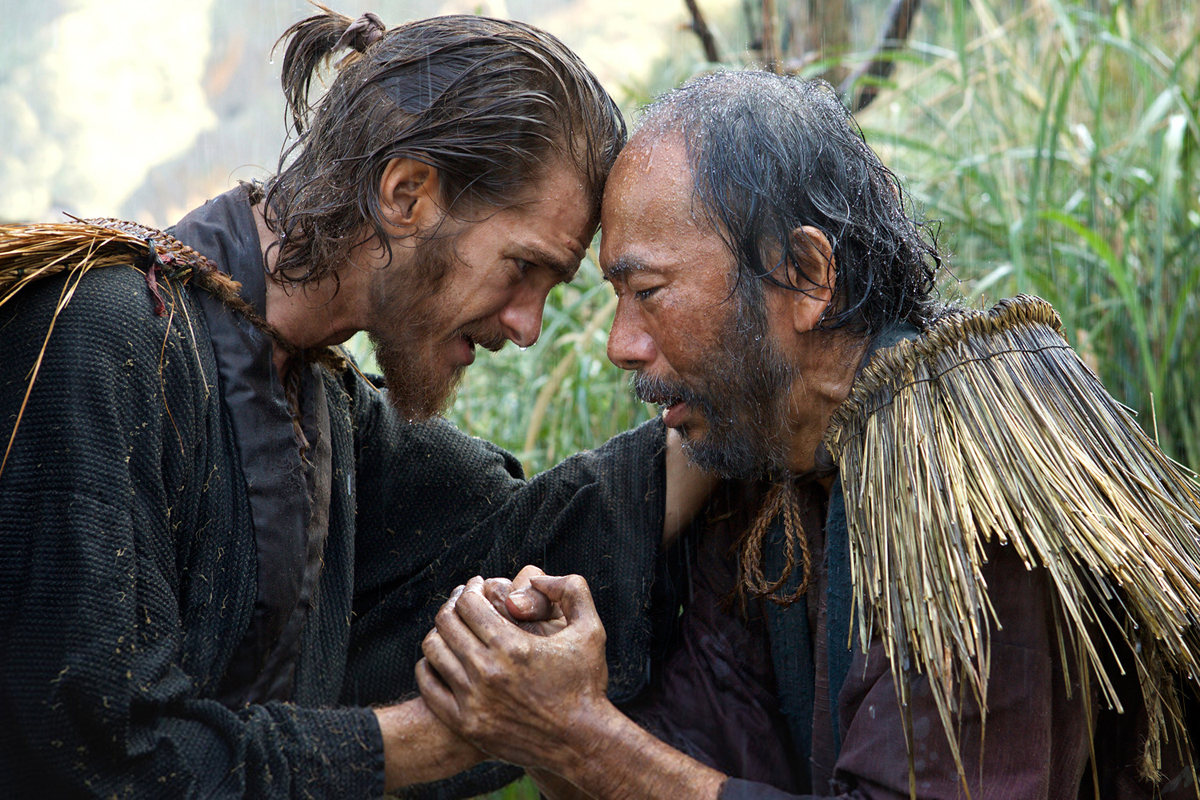
This is a very long film (161 minutes) and there isn’t as much ‘action’ as I expected. I confess that my attention lapsed at times. I thought I had stayed with the narrative all through but watching the trailer and some of the clips available online, I’m beginning to think I missed some moments. The film is beautifully photographed by Rodrigo Prieto, edited by Thelma Schoonmaker and designed by Dante Ferretti – so it looks great. This is especially true of the scenes in the mists that shroud the priests’ journeys by small boat or through the mountains – classical Japanese cinema (especially Mizoguchi) comes to mind. Much of the film was actually shot in Taiwan, though I noted from the credits that some work was based in Kyoto, the home of Japanese historical drama. But no matter how great the film looks, I have problems with the narrative.
This is really Andrew Garfield’s film – Adam Driver (looking almost skeletal) becomes almost a secondary character. Garfield is presented as almost a Christ-like figure (i.e. like the conventional 17th century images of Christ in Europe) and indeed this seems to be the central narrative theme. Is Fr. Rodrigues too concerned with seeing himself as the image of Christ and therefore unable to see the wider picture? As a non-believer I can be reasonably objective about this tendency, but because I find the Japanese history so fascinating and because I see the missionaries as part of mercantilist/capitalist attempts to colonise, my sympathies are generally with the Japanese characters. This should be one of the strengths of the film. The two most engaging characters for me are the interpreter (the wonderful Asano Tadanobu, last seen by me in Harmonium (Japan-France 2016)) and Ogata Issei as the governor/inquisitor. Ogata is remarkable and I perked up whenever he appeared. Yes, he is responsible for torture and death, but at least there is a reason behind his actions, which he explains in a tale about a daimyo (feudal lord) and his four concubines – a clear allegory about the four foreign powers squabbling among themselves and causing unrest in Japan. By contrast, what do the Jesuits offer in a country that already has both Buddhism (imported via China) and Shinto? Why do they need another religion? It’s not as if these Christians have liberated Europeans from feudal rule. I’m intrigued as to how the Japanese version by Shinoda handles this. Scorsese’s script (with Jay Cocks) has the Japanese inquisitor argue that Japan is a ‘swamp’ in which Christianity can’t put down roots. ‘Swamp’ as a description seems to come from the novel, but to me sounds rather demeaning. The suggestion is that Japanese converts simply grasped the hope of this new religion to assuage the misery of their lives in a feudal state without ever understanding it. Christians have always believed in the universality of their beliefs and the righteousness of the gospel teachings. But from the perspectives of other cultures, as the interpreter comments, this looks like arrogance.
During the screening, I did wonder why the Catholic Church successfully grew a large community of adherents across Latin America but had relatively little success in Asia. I note that some reviewers refer to The Mission (UK-US 1986) with Jeremy Irons and Robert De Niro as a comparison film for The Silence. I haven’t seen that film, but I understand that the Spanish missionary priest and his lay companion positively help the local people in their fight against Portuguese slave traders. Perhaps Catholicism is not necessarily ‘universal’? Is faith universal? Must it always be contextualised in relation to different cultures? It’s often said that the Catholicism of filmmakers like Hitchcock and Scorsese helps to explain their fascination with guilt, self-doubt etc. I can see that I should have been open to these questions in watching Silence, but the film didn’t move me as I hoped. I can see though that if you believe in a supreme God, the ‘silence of God’ in the face of the suffering must be hard to accept. The narrative provides a ‘way in’ to understanding this by offering us a Judas-like figure, Kichijiro (Kubozuka Yôsuke) who is present throughout, ‘testing’ Fr. Rodrigues.
The Silence is presented with most of the lead characters speaking English and with subtitles for the Japanese speech. The Japanese speak English with accents that reveal the class distinctions between peasants and nobility. I suppose this makes sense but I do wonder why, when non-Anglophone directors can make films in English, Americans (and Brits) won’t use the appropriate languages for the characters in their films. Portuguese-speaking Japanese actors in 2016 is a bit of a stretch (though there are many Japanese-Brazilians) but the principle remains sound. Silence is an impressive film and Catholic audiences may find the questions of faith more riveting than I did, but some kinds of personal projects are always likely to be problematic. It would be good if Marty returned to a neglected genre that he has conquered before. How about a decent female-centred melodrama?
 itp Global Film
Thanks, that was really helpful – explains why the film got such mixed reviews. I so agree with your point about Scorsese (and this is a counter-intuitive truth about many artists) probably producing better work when not writing from his own experience. Too much wrestling with with personal demons can get in the way of the critical detachment necessary for great art. Besides, I feel Scorsese is at his best when not doing films about obvious gangsters or villains eg ‘Goodfellas’ and ‘Gangs of New York’ (too operatic and self-indulgent) but when forced to work with restraint eg representing the tribal violence below the surface of New York high society in ‘Age of Innocence’. Adapting a novel for the screen with a clear, subtly ironic authorial voice that isn’t his own made that violence all the more powerful, and choosing to keep the narrative voice (Joanne Woodward as Edith Wharton) was perhaps key to this. You might find it interesting listening to some wildly divergent responses to the film on last week’s Saturday Review (31st Dec):
http://www.bbc.co.uk/programmes/b08558zv
Shabanah Fazal
LikeLike
Thank you for this. Since I wrote the blog, Sight and Sound‘s ‘Scorsese Special’ issue has arrived and I’m pleased to see that Marty discusses his own fascination with Mizoguchi/Kurosawa/Ozu/Naruse etc. My problem with Naomi Alderman’s outburst on Saturday Review is that she doesn’t demonstrate any knowledge of the Japanese context – though I agree with her thoughts about the ‘Inquisition’ in Spain and Portugal.
I think that you slightly misconstrue my comments (which may well be my fault for not expressing myself clearly) about Scorsese’s ‘personal project’. Some of his best work is informed by his own biography (e.g. Mean Streets). I was more concerned to suggest that if you spend 28 years trying to get a project off the ground it can sometimes become messed up in the process because it’s difficult to maintain objective control over it. I agree with you about Age of Innocence – but don’t forget Alice Doesn’t Live Here Anymore (1974).
LikeLike
Ok…..so now I’ve finally seen it and I too was pretty certain I was going to hate it as Catholic propaganda or the kind of pornographic display of suffering we had in Mel Gibson’s ‘The Passion’. However, although I fiercely resisted it for as long as I could, to my complete astonishment, I ended the film in a trance, feeling like I’d had a rare, unexpectedly moving and almost transcendent experience. I want say before I go any further that I’m perfectly able to watch films and take them apart politically and ideologically: ‘Billy Elliot’, ‘The Full Monty’, ‘East is East’ and ‘The Reader’ all stirred my inner Marxist to a raging fury. So of course we should ask political and ideological questions of this and any film, and yes, the imperialist background to the story needs sharp interrogation, but I now realise that isn’t the best lens through which to fully appreciate this particular film’s power.
Firstly, the Japanese were – for all their cruelty – portrayed as much more counter-intuitively wise – and even dare I say it ‘good’? – than I expected, like the darkly comic Inquisitor, who in many ways had some of the most sobering and unsettling lines; sadly, I’ve not been able to remember them or track down the script to quote them here. Mainly though, for me, the film is best appreciated not as theology but as a metaphysical work in which, if you open yourself up imaginatively to it, Scorsese takes you on a slow burn epic ‘spiritual’ journey. It’s a kind of Pilgrim’s Progress for our secular age, for anyone with a God-shaped hole who’s ever seriously grappled with why on earth we should get up every morning and keep going. Graham Greene and his whiskey priest in ‘The Power and the Glory’ are also better reference points for understanding where this film can take you, if you’re willing to let it. As a literature lover, I can’t help but bring that sensibility to bear on it too – film purists can filter that out if they don’t like it. The statement “You cling to an illusion- and call it faith” summed up how the film is largely about the psychology of belief – the sustaining power of illusions and the paradox that to find faith, a person must first lose it – and kill the ego that needs it. I think Scorsese is suggesting that if we stop asking questions and looking for meaning but instead, give up and listen more carefully, we can hear our God – whoever or whatever that is – in the silence of nature and in the suffering of other humans.
It certainly is a flawed film: at the film’s most profound moment, when to save his fellow creatures, Father Rodrigues has to step on Christ, and forsake his silent God, Scorsese loses his nerve and makes the divine speak; he should have trusted us to ‘hear’ the voice that speaks powerfully in that moment of silence – I could. Mercifully though he doesn’t go the full Mel Gibson and give us anything as bad as God’s giant tear-drop falling from on high onto the head of Christ on the cross . . . Anyway, I am so glad I saw on the big screen, in the dark, and had the full immersive experience. The sound of the waves we hear on the final credits (I stood in an empty cinema till the very last one had vanished), is the paradoxical sound of silence, the illusory but powerful voice we so want to hear. It put me in mind of Matthew Arnold’s ‘Dover Beach’ and the sound of the sea of faith receding down the ‘naked shingles and vast edges drear’ of post-Darwinian Victorian England. With a few reservations, I came out feeling the film was something very special, Scorsese’s best film and – if we define it as finding ‘God’ in the here and now – perhaps his most (small c) christian work ever. Will it stand up to close scrutiny on a second viewing? I look forward to finding out one day.
LikeLike
I agree/feel the same about many of the things you discuss. Your references to the natural world and feeling ‘spiritual’ makes me think of the different feeling for landscape and the natural world in Japanese culture – and of (the very little) knowledge I have of Shinto as a Japanese religion. I can’t deny the way in which christianity has influenced the way I think about the world but I do find Japanese films make me think differently. On the other hand, the best of them are ‘humanist’ and therefore potentially universal.
LikeLike
My response was similar to Roy’s. As an atheist I found 161 minutes on the most noxious ‘opium of the masses’, Catholicism, hard work. But the film did get more interesting when major Japanese characters appeared. It is beautifully done. In fact it is that rare beast, a DCP distributed in 4K. Watch it in that format if you can.
One writer suggests the film’s central concern is with ‘apostasy’, which figures. Does that crop up in Hitchcock?
Also, I thought that Ferreira (Liam Neeson) introduced the notion of Japan as a ‘swamp’? It certainly is demeaning.
And the puzzle is why all those Japanese got hooked by a Catholicism: at least the Protestant forms were ant-hierarchical.
And Roy – you have never seen ‘The Mission’? Cracking movie and the priests do help the Indians resits the colonialists.
LikeLike