

In a recent screening at Picturehouse at the National Media Museum I enjoyed a trailer for a re-issue of the UK classic The Long Good Friday (1980). This re-issue is to mark the 35th anniversary of the film’s release. I thought the trailer was pretty well done. If you have seen the film before then the clips reminded one of some of the great action and dramatic sequences in the film. However if you have not seen this film before then I thought that the film did not pre-empt viewings in the unfortunate way that so many contemporary trailers do.
But the final onscreen title in the trailer spoilt my pleasure
‘exclusive 2K restoration’.
We have an increasing number of venues in the UK that advertise 4K projection, though they are not always as informative about whether films come in a 4K DCP. And we have enjoyed an increasing number of classic films restored using 4K technology [or even higher]. 4K cameras are becoming increasingly common in film production – I was fortunate have a cinematographer show me such a camera during a filming out our own Hyde Park Picture House.
Despite all of this the cheapskates in the UK distribution sector persists in using 2K technology. I would be interested to hear from film buffs in other countries as to what the standards are there. Certainly whilst there are still quite few cinemas in the UK which only have 2K projection the technology allows them to source from 4K DCPs.
I remember in the early days of digital projection frequently hearing exhibitors and distributors claiming that digital
‘looked better than film’.
Given that the vast majority of film then originated on 35mm this was an oxymoron – there is a contradiction between the use of ‘better’ and different formats that are incommensurable. One image is composed of silver halide grain the other of pixels. I am always annoyed by reviews that claim that a film is ‘better’ than the original literary work. The critic may find the film more enjoyable, and some viewers may prefer the characteristics of digital; that is not the same thing.
The more recent items of rhetoric from exhibitors and distributors are
‘the screen is not large enough for 4K or the viewing angles in the auditorium are insufficient for 4K’.
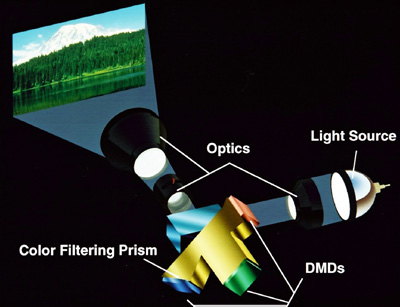
I have yet to hear an convincing explanation for these claims. Certainly Torkell Saetervadet, in the FIAF Digital Projection Guide, takes this and a several accompanying arguments to task,.
‘The numbers [set out in a diagram] indicate, though, that the 4K format is much closer to the ideal cinema than 2K ..’
Another claim is that audiences ‘don’t notice’. There may be some truth in this but the claim is difficult to determine. For a start mainstream film nearly always privileges action and character over technique: the invisible style. And prior to the arrival of video the comparisons were between different celluloid formats or between nitrate and safety film stock. Now the comparisons may be between analogue video, DVD, Blu-Ray, other formats and DCPs. Of course, the DCP technology is a form of video itself. But the standards are higher than other forms, and the effectiveness of the format is constantly developing. indeed one of the developments is from 2K to 4K to 6K, and soon 7 or 8K.
Further there is a larger problem with Digital standards. I have noticed recently that there frequently appears to be variation in aspect ratios, even when they are supposed to be in New Academy. And this does not seem to be just a projection problem. It is worth noting that the Arriflex Alexa has a range of settings for aspects ratios, but that the standard one seems to be 16:9, not even a cinematic ratio.
There also seem to be problems with digital sound, an area where the technology has bought undoubted improvement. But I find that modern soundtracks often lacks balance: the prime example would be Interstellar (2014), where the director publically defended its disparities.
Clearly it is not feasible to press for a return to uniform celluloid projection. However, the distributors could be more effective in making 35mm available, at least to a degree. But there need to be higher standards in the digital sphere. The standards were initially set down by the Hollywood Academy. The failings of the original standardisation are apparent from the question of frame rates – initially including 24fps, 25 fps, and 48 fps. The extension of these frame rates mean that now 2K has a wider variation available than 4K. So the standards included the facility of video playback but not proper digital playback of early film. FIAF has now addressed this point with specifications for rates from 16 to 24 fps. But hardly anywhere in the UK can one find digital versions played at the frame rate of the original early film. This despite a projectionist explaining to me that the conversions were relatively simple.
Finally there is the question of archiving. There is no convincing evidence about the life span for digital: and changing formats are also increasingly a problem. Yet it seems that some distributors and stores are only retaining digital copies even when the original was celluloid. The prospects for future generations appear problematic. Archivists reckon that only a third of early film, shot on nitrate, survives. The explanation was the absence of an archival process in those years. We may well arrive at a situation where the same is true of sound nitrate and safety stock films.
 itp Global Film
I don’t feel that I know enough to argue for or against 2K or 4K, except to point out that the designation only tells us about the amount of data in an image – there are many other factors that govern what we actually see on a cinema screen.
I think you make a strong argument about the frame speed of digitally-projected films from the era before frame speeds were standardised and an equally strong case for looking at the appropriate technology for archives.
But what actually happens on cinema screens is much more murky.
Yesterday I watched two films on a very large screen. They were both projected using the cinema’s Sony 4K system. The first was a 1975 Hollywood film projected from a Blu-ray, the second was a new release from outside Hollywood, shot (by a leading cinematographer) using digital camera technology (an Arri Alexa-Plus) and projected from a DCP.
The 1975 film looked absolutely fine, but the new film had some flaws visible from my position in Row 3. I suspect that further back in the auditorium I wouldn’t have noticed anything.
LikeLike
Roy is right about the number of factors involved. However, there are several drawbacks to DCP, especially at 2K level. I had had this from a cinematographer and in the FIAF volume: the dynamic contrast is lower than for 35mm and the colour range is not exactly the same. My personal observation is that 2K transfers from celluloid do not have the same definition as 35mm, especially in long shots, I rather suspect that deep focus is also more difficult.
Re Roy’s viewing, the FIAF book reckons that pixels when visible, they are likely to be so except in the farthest rows from the screen.
Of course, part of the problem is comparison. Unless one views the films close together and in similar viewing situations this is tricky. However, to give one example, I have watched the BFI restorations of the early Hitchcock films on both DCP and 35mm. And there are problems both with step printing but also image quality. And I have had similar comments from colleagues as well, some of whom are archivists.
The mainstream industry has never paid that much attention to the quality of image or sound. You only have to look at how film was treated at times of technological change: e.g. the arrival of sound or the introduction of widescreen.
I also remember the multi-screens that were around before multiplexes. I went to see Mandingo at a venue in Birmingham. I watched the whole film because it was my only opportunity. But I did complain about the quality afterwards. I discovered it was a video using rear projection!
The point is that only audience pressure will lead to some improvements. I asked a colleague I saw at the Festival what he had seen that was good at the cinema. He had not been for ages, and his local is the Showroom in Sheffield. His rationale was that he had Blu-Ray and a 55 inch TV at home, with surround sound.
I dread the day this may befall me: in fact I think at that point I shall return to an earlier love – theatre.
LikeLike