
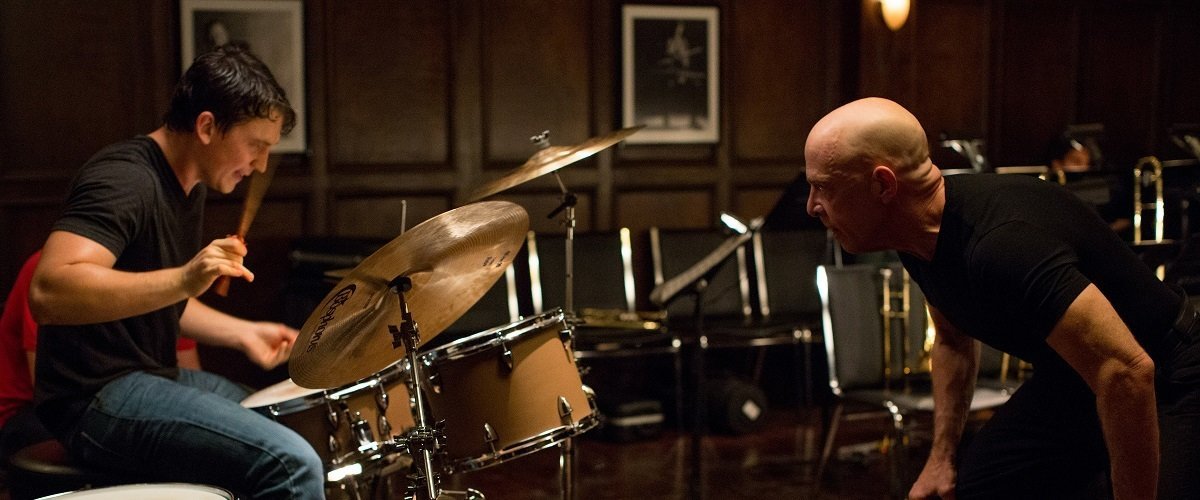
The film centres on the relationship between music student Andrew Neyman (Miles Teller) and conductor/teacher Terence Fletcher (J. K. Simmons). Andrew is a would-be drummer studying at the prodigious Shaffer Conservatory. He is recruited to the star Studio Band run by Fletcher. We follow their stormy relationship through a series of student competitions and concluding at a New York jazz festival.
The Studio Band play big band jazz: Duke Ellington’s ‘Caravan’ features in the repertoire. And in attempting to fuel Andrew’s drumming drive Fletcher twice recounts a story, supposedly about an early performance by Charlie Parker. Andrew himself is driven by the example of Buddy Rich, whose music is clearly an influence on the soundtrack. However, this is not a jazz film – it is a variation on the long running Svengali tale. The S&S review included a comment on performance – “that (in keeping with the jazz theme) risks sounding one-note”. Clearly the reviewer has never listened to Charlie Parker or Duke Ellington. Ironically, whilst Fletcher talks about Charlie Parker, the control that he exercises over the Studio Band would inhibit even a talent equivalent to that of Parker’s. And Andrew’s ambitions are about being the ‘best’: his drumming style a far cry from the master of percussion, (who also gets a mention) Philly Jo Jones.
The Svengali myth appears to be a story of masculine control: frequently but not always about controlling women. I could not think of a variation where a woman controls a male tyro: the closest might be The Graduate (1969). Andrew does have a relationship with a young woman, Nicole (Melissa Benoist), but she appears mainly as a device in the plot and a reflector for Andrew. There are also a couple of female players in the Studio Band, but the focus is resolutely masculine.
The competitive drive at the centre of the film is [only to a degree] inflected by class. There is a dinner party at home with friends of Andrew’s father. It is full of self-promotion and ‘putting down’. One can see where Andrews’s unhealthy preoccupations come from.
I found the film entertaining but implausible. It is also often funny, not always deliberately. The acting is strong and holds the attention. The production values are excellent. The director Damien Chazelle and his cinematographer Sharone Meir do an excellent job in depicting the musical performances, especially the drumming. This relies on fairly fast editing and large close-up, which adds to the sometime frenetic feel of the film. The script, also by Damien Chazelle, is less developed: S&S suggested that the writer would have benefitted from a Fletcher-type mentor peering over the shoulder.
Note, my friend and fellow film buff Jake has pointed out that we also have an absent mother! Another factor in Andrew’s flawed upbringing.
 itp Global Film
I saw “Whiplash” a few weeks back and its been in and out of my mind ever since.I thought the acting was very strong and I left the cinema with the music drumming about in my head.
I agree with your reference to Svengali and of course the film has been compared to “Full Metal Jacket” (1987) and “Raging Bull” (1980) and infact at times, Andrew does have the appearance of a boxer about him!
However, for me “Whiplash” is a film about relationships.The main one is between Andrew and Fletcher and starts off as a kind of sado-masochist relationship ,but develops into a symbiotic one.Andrew needs Fletcher,to become the best drummer he can be.Fletcher needs Andrew,if he is to fulfill his dream of creating a musical genius of his own (his Charlie Parker).
All of Andrews other relationships,come second to his need for Fletcher.His short lived affair with Nichole,is an impotent one.The father and son relationship is like a marriage.We see them sat around the TV having a meal and going to the cinema together.However,like his mother,Andrew leaves his father (as Fletcher calls him a failed Eugene O’Neill) for another man.Leaving both Andrew and Fletcher to reach the climax of the film, “in tempo” with each other!
LikeLike