
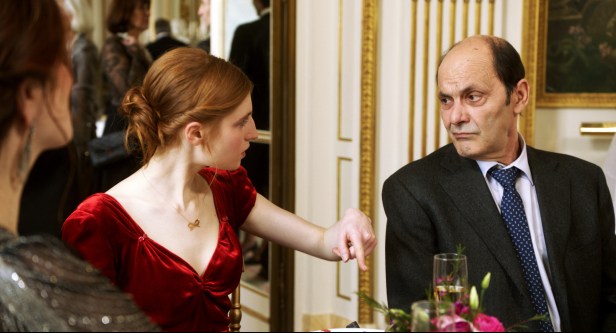
Released without fanfare by Artificial Eye in the UK, the latest film from Agnès Jaoui and Jean-Pierre Bacri deserves a much bigger audience than it is getting in UK cinemas. The couple’s scripts are directed by Jaoui and both are also actors in an ensemble cast. Like their previous films Au bout du conte centres on the ‘cultural’ sector of the French bourgeoisie. The difference here is that Jaoui has decided to incorporate a discourse about fairytales into the familiar network of shifting relationships. The couple’s films are invariably witty takes on relationships informed by previous collaborations with Alain Resnais and Cédric Klapisch (both Jaoui and Bacri also work as actors on separate projects). Here, the starting point is Stephen Sondheim’s Into the Woods and fairytale films like Jacques Demy’s Donkey Skin and Cocteau’s Beauty and the Beast. The English title of the film is not helpful and a better, more helpful translation might be ‘Happily Ever After’, (the end of the fairytale).
In some ways, the central idea here is most similar to the couple’s 2004 film Comme une image (Look at Me, France-Italy). In that film Jean-Pierre Bacri plays a cold-blooded and rather egotistical celebrity author with a daughter who is attempting to become a classical singer. In this new film, he is again a rather grouchy figure (owner of a local driving school) with an estranged son who is a budding composer of ‘contemporary music’. The son is Sandro (Arthur Dupont), the ‘Prince Charming’ of the story, but also in a neat inversion, its Cinderella as well. At a party Sandro meets Laura (Agathe Bonitzer) – and loses his shoe when he rushes off early to pick up his mother who is closing her late night bar. Agathe is the ‘Princess’, the daughter of a wealthy industrialist, but she is also Little Red Riding Hood on her way to her aunt’s house in the woods and prey to the ‘big bad wolf’ who lives next door. The aunt, a hippyish school teacher is played by Jaoui herself. The aunt is also separated from her husband and she takes driving lessons from Bacri’s character. This spiralling of relationships is a common feature of the scripts by Jaoui-Bacri. The scripts are meticulously written with dialogue being Bacri’s specialism.
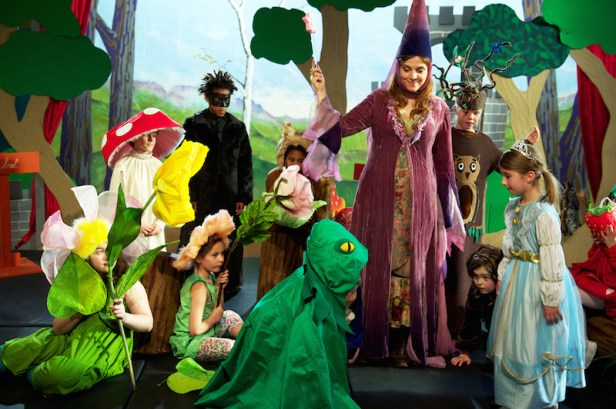
The difference this time is the fairytale discourse. This is presented – and commented on – in a number of ways. At the straightforward iconic level, Jaoui’s character Marianne is attempting to persuade a class of primary children to perform a play based on traditional fairytales. She also lives in a house that resembles a house in the woods in Hansel and Gretel. This visual impression is re-inforced by CGI rendering for a dream sequence and there are references to several forms of mysticism ranging from Marianne’s young daughter’s sudden interest in Jesus via clairvoyants and alternative therapies to modern psychoanalysis. More subtle is the cinematography by the Bulgarian Lubomir Bakchev. In the film’s press notes Jaoui tells us that she and Bakchev shared an interest in Russian films they both saw in Paris years ago. He has come up with a very fluid style for the film which emphasises the ‘swirl’ of relationships and an overall motif of ‘circling’. There are one or two clever devices to create the impression of ‘otherworldliness’. In one scene a teddy bear dances on a window sill as we look through at Pierre. Later we realise it is a wind-up toy but for a moment it looks ‘real’. Much of this effect is about sound and in the press notes Jaoui also discusses her increased confidence in manipulating sound as well as making more use of music. I can’t comment on the ‘contemporary’ score written by Sandro but there is good use of a Gil Scott-Heron song for the sequence in which the ‘Princess’ is ‘lost’. At the end of the film, which doesn’t quite see everyone living ‘happily ever after’, I nevertheless felt better, having enjoyed myself – and laughed out loud several times.
As well as Comme une image, see earlier postings on this blog of Let’s Talk About the Rain (2008) and Looking for Hortense (2012) (which stars Bacri and is directed by Pascale Bonitzer, Agathe’s father).
A short teaser trailer:
 itp Global Film
I’m glad you liked this Roy. I saw it in Berlin in 2013 and really enjoyed the playfulness of the film. I’ve admired their work for some time and looked forward to seeing it and I wasn’t disappointed. I was disappointed by the sniffy attitude of the critics. Even more by the long delay in it reaching the UK and then being dropped into the throwaway time of the World Cup and Wimbledon. I don’t know what Artificial Eye thought they were acquiring, or if it was just part of a package they bought, but they have shown little interest in finding an audience for it. And like you say, it deserves a better audience, so many people would actually enjoy it! How rare to find a film these days that is genuinely enjoyable, and plays with film with a surprising freshness. Maybe ‘grownup’ critics and programmers don’t know how to relate to fairy tales, dismissing them as some childhood trivia, while really they contain all the fears, anxieties and hopes of adults.
LikeLike