
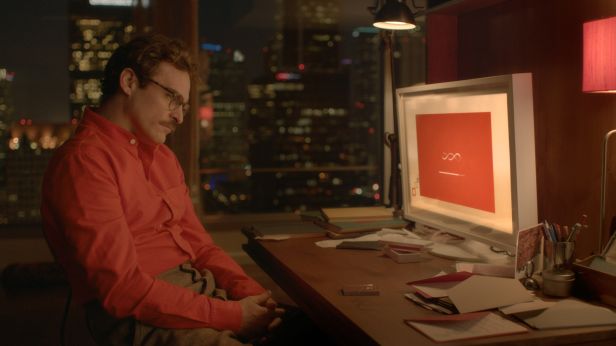
A few years ago Her might have been called a ‘smart film’ – made for and appreciated by a specific niche audience (of well-educated, arthouse patrons). In 2013-4 it has taken $23 million at the box office in North America and I’ll be intrigued to see how it does in the UK. It already has an IMDB score of 8.4 and 94% on Rotten Tomatoes. I found it an ‘interesting film’, well worth seeing but not completely satisfying. It’s been described as a romcom which I don’t think is helpful. I would say that it is a hard science fiction film utilising comedy. I realise that this won’t be a common reaction, but I can argue a case.
I find it very difficult not to see most SF films coming out of the US as anything other than Dickian narratives – i.e. inspired in some way by the ideas of Phil K. Dick. Possibly I haven’t read enough or I became obsessed by Dick at a particular moment in my cultural education and I can’t throw him off. Still, I can imagine this as one of Phil’s short stories. Set in the ‘near future’, Her focuses on Theodore (itself a Dickian name, referring to ‘God’s gift’). He’s in early middle age, recently separated from his wife and working as a writer of emotionally-charged letters for customers who are themselves less than emotionally literate. His social life is as he indicates a non-choice between internet porn and videogames. One day he buys a new Operating System, ‘OS1’, for his phone/computer and promptly falls into a relationship with the artificial intelligence who voices the software and calls ‘herself’ Samantha. I don’t want to give away any more than that (though in contemporary cinema, blogs and promo material tend to tell you everything).
The film looks beautiful. It is shot in LA and Shanghai which provides cityscapes and, I suspect, the High Speed train that takes Theo on holiday. The photography by Hoyte van Hoytema who has worked in Sweden, UK and North America and the costume design with its distinctive (but hideous) high-waisted pants for men combine to create a world of warmed-up pastels and bland environments. The music, mostly by the Canadian band Arcade Fire, surprised me by sounding a little twee for my taste but it worked in terms of the narrative. Joaquin Phoenix as Theo and Amy Adams as his close friend give good performances and Rooney Mara copes well with the difficult role of Theo’s wife. The problem is that as a film the narrative poses problems for writer-director Spike Jonze. Many scenes consist of shots of Joaquin Phoenix talking to Samantha (voiced by Scarlett Johansson) via his smartphone’s integrated microphone. I confess that people who talk on their mobiles in public via earphone/mike combinations drive me almost to murder so I was aggravated by these long sequences. OK, perhaps that is an extreme reaction, but these sequences are not cinematic. The Amy Adams character is trying to construct a documentary film about sleeping. This – and the reactions to it from Theo and Amy’s husband – make for an interesting commentary on the overall narrative of the film.
There is a great deal of talk about relationships – and about sex. There is little sexual activity on screen though I did find one scene strangely arousing. I’m not sure that there is much ‘romance’ and for me not much emotion. More important, I think is the satire on social relations in this future world. And what a sanitised world it is – seemingly ‘cleansed’ of old people, poor people, black people, disabled people etc. I was reminded at various points of Charlie Kaufman’s script for Eternal Sunshine of the Spotless Mind. I don’t think Her is as good.
I am intrigued by the discovery that Samantha Morton is the Executive Producer on the film and that she was initially the voice of the OS. It seems that her voice was replaced for production reasons. I’m a huge Samantha Morton fan and I do wonder what her voice would have contributed. Johansson does a good job, but it would have been a different element in the mix as voiced by Morton.
Her did make me laugh at various times, not because of the romance but more because of the recognition of human frailties in the face of artificial intelligence. I think the film could lose 30 minutes and it might have benefited from more, not less, ‘plot’. I don’t regret 126 mins in the cinema and I enjoyed the overall experience, but as with American Hustle, if this is one of the Oscar choices, American cinema is in trouble. The film is in some ways ‘global’ but its sensibility seems to be the wan emotionless world of Southern California.
 itp Global Film
Just about right Roy.
I had problems with the concepts in the film. Like what do they think ‘consciousness’ is? Samantha can understand and speak English – other languages? She can see and understand video of the world, when her little camera eye is open. And she has night vision. This still begs several questions.
Apart from the gender she reminded me of Hal in 2001.
Gender is another issue. The Op. System voice is male. But then the personalised ops. are female – in both cases?
LikeLike
I can see that you haven’t encountered Siri, Keith. All of the features you question are part of current operating systems in a cloud computing world. If your computer is on and linked to the internet it can receive data from anywhere in the world, in any language. The real ‘sf’ question is about how it interprets that data as an artificial intelligence.
LikeLike
I think you missed the point I am making. I don’t know Siri, but it may be able to read, speak and view – are you saying also that Siri has some sort of intelligence and consciousness?
I don’t think the film is clear on this re the Op. System or Samantha. It is sort of assumed: that ine one reason it reminds me of Hal. One would expect ‘hard SF’ to do more with this.
LikeLike
The sf element here is a ‘personalised’ OS. Samantha is an OS. I was simply pointing out that ‘she’ isn’t a computer as such, so she isn’t like HAL or other earlier sf uses of a computer. She is constructed as software that exists in the Cloud. Yes, it is about artificial intelligence and ‘consciousness’ but, like all sf it is about ‘us’, ‘now’ and how we are interacting, via our computers and software or face to face with other humans.
LikeLike
Noted, but that seems to be a different point. My coment was about consciousness, or are you arguing that that is possible in software but not in a computer? Clearly Samantha appears to be more complex than Hal – but it was that sort of complexity that the film did not seem to address.
LikeLike
I think we are probably at cross purposes. You seem interested in the philosophical questions about ‘consciousness’ – which are certainly interesting and which I agree with you are not really explored in the film. I think I’m interested in the paradigm shift from a computer we ‘go to’ to do something and a software ‘identity’ that is always with us via the Cloud – until it decides to abandon us. The implications for human social activity and ‘dependence’ are considerable – and I don’t think that the film explores these fully either.
LikeLike
Two counts down then.
LikeLike