
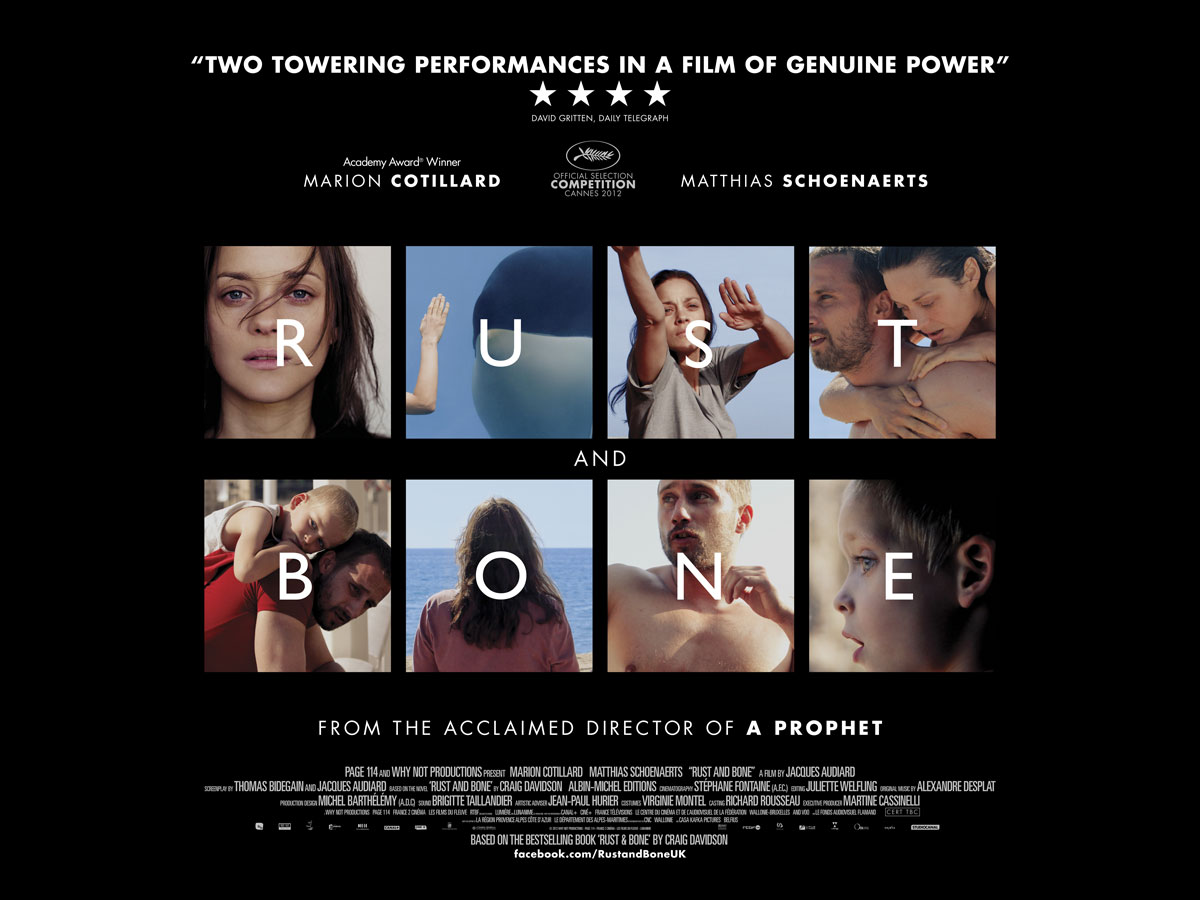
This was the opening film at the 26th Leeds International Film Festival. A winner at this year’s Cannes Film Festival, the screening was a late addition to the programme. This probably explains why the Town Hall venue was less than half-full for a new film by one of France’s most talented and interesting filmmakers. There was also a slight delay whilst the staff set up the digital projector and sound system – time well spent because I found the acoustics better that I remembered from previous years.
Essentially this is relatively typical Audiard fare (thoughtfully dedicated to another fine French filmmaker) – the lives of people set at the margins of society. However, it is rather unlike his recent successes such as The Beat That My Heart Skipped (De battre mon coeur s’est arrèté, 2005) and A Prophet (Un prophète, 2009). Whilst a damaged hero, Ali (Matthias Schoenaerts), is at the centre of the story, romance is a much more noticeable strand. Indeed the female protagonist Stéphanie (Marion Cotillard) is arguably the emotional centre of the film. Both actors give fine, sensitive performances, which are among the most effective aspects of the film.
The production values are equally good. The anamorphic cinematography by Stéphane Fontaine is impressive, with some very fine montages of light on sea (as with the opening shot), foliage and even the less aesthetic facades of urban life. The film was shot on Red digital camera, presumably with 4k facility. As in earlier films the editing, down to Juliete Welfling, works both to position characters and events but also places them in a believable but also evocative enrolment. A good touch is the cut from Marineland where Stéphanie works to Ali jogging as ambulances race pass. Alexander Desplat’s score is sometimes very noticeable, but effective and there is a great mixture of popular songs on the soundtrack. Audiard’s direction of his talented team shows how the auteur depends on the creativity of a larger group.
However there is no doubt that his films do offer a ‘personal vision’. And what makes his films so interesting is his ability to fashion (partly as a co-scriptwriter) film stories that address personal and social issues in a very distinctive fashion. From this point of view Rust and Bone is his weakest film for some time. One is conscious of the contrivance of the plot for both melodramatic and emotional moments. Thus is a key relationship in the film between Ali and his son Sam (Armand Verdure). So at a climatic moment in the film there is a serious accident, which requires a frenzied almost masochistic rescue by the father. I was conscious at this point that there was a simpler method available, but one that was less dramatic.
Another development in the story is an accident that leads to an amputation and the later the fitting of artificial limbs. This is done fairly impressively in the film, including frequent shots of the amputated limbs. I am not sure how this was done technically, presumably through some digital technique? But it was so well done that I actually found the perfection distracting.
But the film is never less than absorbing, and at times powerfully emotional. It also includes scene of disturbing violence: another frequent strand in Audiard’s films. In this case it is bare-knuckle fighting: visiting the strata of the lumpen-proletariat, another frequent Audiard depiction. It is out the travails of the fight arena, and of the major accidents in the film, that the protagonist’s relationship develops. And it is in the developments within the central relationships, including with the son Sam, which the film works its way to a resolution and redemption.
The resolution does feel a little pat but it is worth noting that it includes a dry, detached voice-over that provides the sort of ambiguity to the resolution that is also present in earlier Audiard films.
In an interview in Sight & Sound (November 2012) Audiard referred to his pleasure in older Hollywood films by Tod Browning, including The Unknown, 1927) starring Lon Chaney. “They made a sort of expressionist cinema that speaks about the Great Depression of the 1920s and 1930s (and the films often featured physical disabilities). I wanted to try and find a form of melodrama that could talk about today’s economic crisis, in which the setting of a Marineland (where Stéphanie works in the film) would be like a circus.”
This is a revealing comment on the film, and is interesting when one reflects on his other recent films. In fact my memory of The Unknown is that it was implausible but packed an immense emotional kick. I think Audiard’s new film achieves something similar.
I should finally note that the screening was followed by the Gala Opening of the Festival: the film, the USA feature Argo. This apparently sees Ben Affleck rescuing ‘stranded Americans in Iran’. Whilst I was happy to see Audiard symbolically revisit the 1920s, the prospect of Yanks revisiting and rewriting the 1980s was a little too much.
 itp Global Film
(This comment includes SPOILERS!)
Just back from a screening and agree with Keith. It’s a pretty impressive film. I learned from an interview with Audiard that the title (taken from a very loose adaptation of a book of short stories by the Canadian writer Craig Davidson) refers to the flavour of being punched in the face. Quite a good metaphor actually and of course the audience gets a few punches along the way as well as the two main characters.
I admit to feeling anxiety at the prospect of seeing the film as I was aware that the viewer would be spared little in viewing close shots of the bloody stumps of severed limbs. (Keith refers to the Todd Browning film The Unknown but I thought of another one by Browning, Freaks, which gave me the willies, – “One of us! One of us!) In fact I found those shots uncomfortable but not too much so, and completely necessary and easier to view each time we see them. Likewise the sex scenes with Stephanie’s severed limbs displayed prominently. Not exploitative but humane. (And while we’re onto intertextual allusions, I must admit that, in penultimate sequence when Ali’s son falls under the ice, my thoughts were to Richard Donner’s 1976 horror, The Omen!)
There were a couple of scenes that stood out for me. Stephanie going down to the Antibes beach (without the beautiful people) and, despite her self-consciousness, she asks Ali to carry her into the water where she swims joyfully with a strong sense of release with the water gleaming on her shoulders. Then there is Stéphanie reconnecting with a whale for the first time after her accident which could have been a mess but was handled very sensitively.
Keith mentioned the soundtrack but what surprised me was the extract from the punk, Mancunian poet, John Cooper Clarke whom I hadn’t heard of for decades. As for the technicalities of Cotillard’s amputated legs and artificial limbs, I think it’s to do with her wearing stockings (green?) which can be digitally replaced. As for camera, I’m familiar with the Red camera but what does “with 4k facility” mean, Keith?
The material could have been handled as a freakshow or as some life-affirming TV movie about overcoming adversity but Audiard, I think, got it right.
LikeLike
Hoping to see the film today. ‘4k’ refers to the resolution of the digital image. The major multiplex chains in the UK have re-equipped with 4k digital projectors but the international standard for digital prints is still, I think, 2k. Much the same issue as filming in 65mm and projecting a 35mm print.
LikeLike
Hi Des,
I noted the green stockings you mention, but in some scenes of sex she is not wearing them? And that is when I noticed the impressive achievements re the limbs.
Note, re the ‘red camera’, I think having 4K [which is twice the quality, more or less, or current digital projection] is a first among cameras in use for filming.
Whilst some Multiplexes like Vue are installing 4k projectors, very few of the digital packages are of that standard. I think they probably need it for 3D.
I have seen several 4k projections, Tinker, Tailor … was one.
And I believe the forthcoming releases of the restored Tess and Lawrence of Arabia should be available in 4k. Bradford Pictureville has this standard.
LikeLike
I enjoyed the film but I think a period of reflection is necessary before considering it alongside Audiard’s other films and deciding which is weakest/strongest. I agree that he presents himself as an auteur and that it is legitimate to think about his films as a coherent body of work. I think Rust and Bone links to each of the earlier films in different ways. The prominence of the female lead links this film to Read My Lips in which the ‘rough’ man is promoted by the intelligent woman with a disability (hearing impairment). On the other hand, the North American source material and the theme of aggressive male behaviour links the film more directly to The Beat That My Heart Skipped.
In four of Audiard’s films there is a central relationship between a central male character and his real or surrogate father. That possibility is briefly here in the latest film before the putative surrogate (the ‘gypsy’/gitane) disappears. Instead of that relationship, we have the central character, Ali, as the father with a small son. I guess the chief question for me is whether this is a polar – a French crime film. It’s been suggested to me that in structure the film is a family melodrama – which is undoubtedly true – but I’m also struck by the thought that the polar is often about the French interest in Hollywood and American culture. Rust and Bone feels like the most American of Audiard’s films. On the other hand, I’m not quite sure about the family in the film which seems to be mixed race and to involve Maghrebis. I’m not sure if this links the film to the less American-influenced polar that is A Prophet.
For me the strongest parts of the film all involved Marion Cotillard. Hers is a remarkable performance and worth the price of a ticket alone.
I think we need a posting specifically on Audiard and also one on digital developments – I’m a little worried about some of Keith’s comments on 4k as I think the whole situation is very confused and complex. We now have 5k systems as well (and 4k compatible cameras are available from several manufacturers).
LikeLike
I am uncertain why Roy finds my comments on 4K worrying? In fact, I thought the reference to the difference between 35mm and 65mm was a bit of a misnomer.
I have spoken to projectionists and 4K packages are rare, though it seems that Skyfall will screen at Bradford in 4K.
Roy is however right about the complexities of digital projection, though I am referring here to the theatrical situation – DVD and Blu-Ray, are not theatrical formats.
Note, FIAF are publishing further specifications aimed at Archives, but I think they will be generally helpful.
http://www.fiafnet.org/uk/
LikeLike