
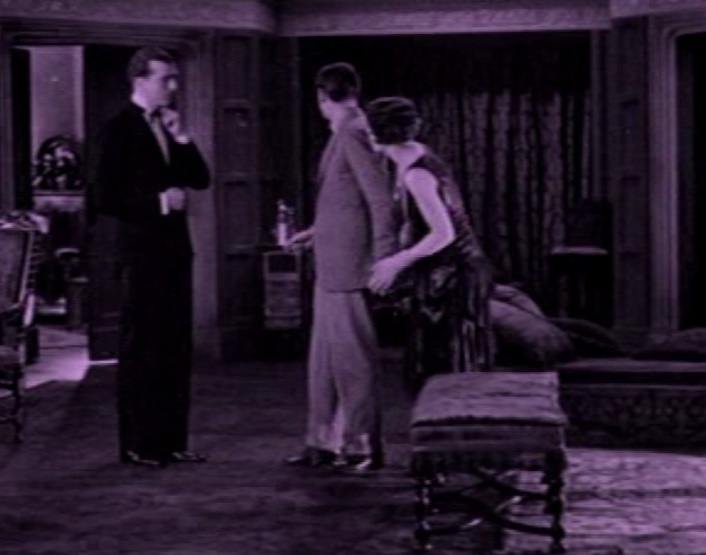
This British silent film from 1928 was re-discovered and restored by the British Film Institute. The film is a subtle and witty parable on married life and the bourgeois mores of the period. It adds to the re-evaluation of British silent film in recent years, joining a growing list of productions that are both intelligently scripted and made with a distinctive style and noticeable technical quality.
The film is also interesting because it benefits from the talents of a number of extremely able filmmakers. The film was produced for Gainsborough under the auspices of Michael Balcon. He is a producer whose impact over decades on British film is equal too or greater than many of the valued auteurs who usually garner the most attention. The film was designed by W. C. Arnold, whose distinctive sets gave such impact to an earlier Gainsborough film, The Rat (1925). And the film stars Miles Mander and Madeleine Carroll.
The film was directed also by Miles Mander, less well known for directing than for acting. He was a character actor whose typical role was as ‘a moustachioed cad’: he plays a bigamist in Hitchcock’s early silent The Pleasure Garden (1925). However, Mander had some experience in theatre, as an actor-director. He had also worked with the Swedish film director Gustaf Molander. Both The First Born and later directorial outings show a continental influence in the use of the camera and in editing practices.
Mander adapted the film from his own stage play Those Common People. In some ways his fellow-scenarist in the adaptation is the most interesting, Alma Reville, usually listed as the wife of Alfred Hitchcock. Hitchcock is generally regarded as the auteur par excellence. In fact, as with many other noted filmmakers, his work relies to a great degree on the talent of his collaborators. His British films benefited from the scriptwriting talent of Charles Bennett. He worked with notable cameramen, designers, editors and gifted actors like Peter Lorre, Robert Donat and indeed Madeleine Carroll. Michael Balcon was his mentor. Quite possibly though Alma was his most important muse. She was already established in the industry when Hitchcock entered it as young man. She worked for a time as a scriptwriter, but her career was subordinated to that of her husband: very much the norm in the industry of that time. Hitchcock always acknowledged that he discussed his films daily with his wife. So there is a tantalising question mark over the status of Alma Reville.
 Some light will be shed on this by the introductory talk before a screening of the film at the National Media Museum (April 25th). The talk is by Nathalie Morris from the British Film Institute. She has written on ‘The Early Career of Alma Reville’ (in the Hitchcock Annuals, 1 to 15, 2009). This should bring an added dimension to the film, as will the live music performed by Darius Battiwalla. He has already established a high standard of accompaniment at earlier Bradford screenings such as The Rat and Cottage on Dartmoor (1930). The film screens as part of the Bradford International Film Festival.


The film was very well-received at the festival, letting the audience enjoy a melodrama in the truest sense of the word with the live, improvised accompaniment. The film has a number of surprises for modern audiences where certain assumptions about films of this era might linger. As well as the dramatic content, there were some beautifully constructed shots using artistry to intensify the emotion still further. As the central character waits to hear news of someone close to her, we witness the police officer advancing as a harbinger of terrible tragedy framed in the mirror at her side. The relationships were affectingly and subtlely played – with a pre-39 Steps Madeleine Carroll alongside Manders as the female lead. Dr Nathalie Morris’s introduction outlined many of the aspects the film’s original production and restoration. If you would like to know more about this and about women’s contribution in the silent era, please go to Dr Morris’s blog co-authored with Clare Watson: Women and Silent British Cinema at: http://womenandsilentbritishcinema.wordpress.com/. Additionally, the Women’s Film and Television History Network is newly-established, global network engaged in furthering research that disseminates knowledge of women’s contribution to film historically and now, in order to establish greater understanding, awareness and participation of women in the media industries going forward. Their website can be found at: http://womensfilmandtelevisionhistory.wordpress.com/
LikeLike
I am a big fan of classics.
LikeLike