
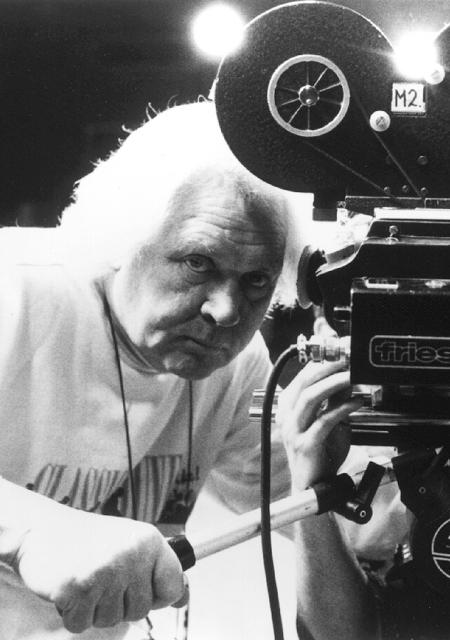
The British film director died in 2011, and the critical re-appraisal has begun. Linda Ruth Williams and Mark Kermode (the duo with an expertise on cinematic sexuality and violence) have a piece in February’s Sight & Sound, ‘Mythomania Ken Russell 1927 – 1911’. Williams had an earlier article, ‘Sweet Smell of Excess’, in S & S July 2008. She commented: “It may seem sacrilegious to compare Russell whom some now consider an unbankable joke to the canonised Michael Powell, but Powell’s visual energy and sense of fun and fantasy were also once sensed as an affront to British cinematic proprietary . . .”. Both directors loved to explore the world of imagination and provided a stark contrast to the far less exotic works of British realism.
In an accompanying article in that issue David Thompson discussed Russell’s television Portraits of artists. He commented on the boss at Monitor, Huw Wheldon, “The crucial and often fractious relationship between obsessive director and rule-book-wielding producer still lives on in television, but Russell was lucky to find a mentor who both tamed and nurtured him.” Another parallel with Powell, though Emeric Pressburger was a different character and his impact on Powell also of a different character.
Two masterworks from these days were screened recently on BBC, 100 Elgar (1962) and Song of Summer (Delius, 1968). Unfortunately the BBC totally failed to publicise the screenings properly: I only caught the Elgar at the last minute. Their sloppy and almost Philistine approach was exemplified with the screening of the feature The Boy Friend (1971) in an aspect ration of 1.37:1 despite its Panavision format! It appears that they had not viewed their own earlier Profile, where extracts from this film were shown in the correct letterbox.
Of course Russell frequently played fast and loose with his subjects, but he was never cavalier. The films were almost poetic and musical visions. Thus as Williams points out ones most vivid memories are particular sequences: the final montage of the Elgar: looking and sounding as if it could have been filmed by Humphrey Jennings. Elton John, in his vast shoes, pounding rhythmically as Roger Daltry ‘plays a mean pinball’ (Tommy, 1975). An image of Ann-Margaret swims into view every time I see a tin of baked beans. And there are the memorable passages in Mahler (1974) accompanying the fantasies of the composer.
Memorable images also abound of another: less mentor, more ‘partner in crime’, Oliver Reed. There are numerous tales of their doings in Russell’s idiosyncratic autobiography A British Picture (Revised edition 2008). Both had exceptional talent but also appeared to find great difficulty in holding it in check. Yet Reed is magnificently played and presented in several Russell’s film, notably, of course, The Devils (1970). This is extremely strong viewing even today, but it also generates great power and emotion.
Russell’s cinema is undoubtedly one of excess, which created problems with the BBFC, The Festival of Light and the Hollywood Studios. At times there is a definite kitsch tone: he can tend towards pastiche but is usually saved by the over-the-top treatment.
His work also depends on frequent collaborators. His first wife Shirley was Costume Designer on his best and best-looking films (her other work includes Yanks (1979) and Enigma (2001)). He was especially well served by Billy Williams on Women in Love (1969) and David Watkin on The Devils. The latter film also benefited from the designs of Derek Jarman, getting a start in British film. And there is Russell’s long-time editor and friend Michael Bradsell.
What is also acknowledged in the appraisals is how important and influential Russell has been in British Cinema and Television. The shock tactics of the 1970s films clearly made an impression, not just on the Mary Whitehouse circle, but on the Censors, other filmmakers and audiences. But right back in his early work for television, Russell was trail blazing. It is difficult to realise now how innovative were the programmes he made for Monitor, because the style and approach has been so copied since. Russell was also, for a period, immensely successful. He had a number of major box office successes in the 1970s: all the more impressive as this was a low decade for British film and filmgoing.
Unfortunately it is quite difficult to see Russell’s best work, or to see it as it was made. The BFI are bringing out a DVD with the UK cut of The Devils in March. 35mm prints of this and other masterworks seem in short supply. The fine Savage Messiah (1972) did receive a restoration and new print last year.
Bradford’s National Media Museum is screening Women in Love in 35mm on Saturday February 11th, and offering a study day to accompany this.
 itp Global Film
I hope that the new DVD will be available here in the US (on Amazon, my main worry would be making sure I get the right one, as so many edits have been cut).
LikeLike
I will post on the issue when it appears, I assume it will be accessible on the Internet. Unfortunately, there does not appear to be a 35mm print of the film available.
LikeLike