
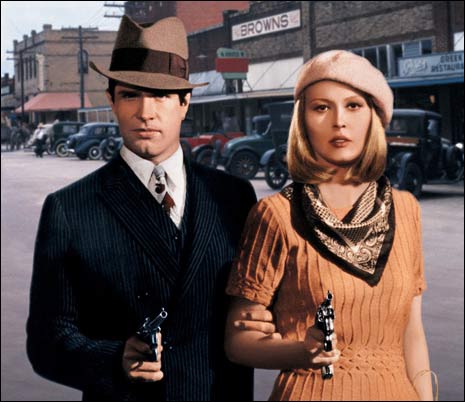
Bonnie and Clyde broke the mould of Hollywood product and was probably the film that lay the seeds for the New Hollywood cinema of the early ’70s as it’s doubtful that Columbia would have made Easy Rider (1969) if this film hadn’t been a success. The script (by David Newman and Robert Benton) was a conscious attempt to mimic the French nouvelle vague and was offered to both Jean-Luc Godard and François Truffaut. They declined, and it was not until Warren Beatty got attached to the script that Warner Bros. decided to finance the film. Indeed Beatty did not simply star in the movie, he also produced it, and was instrumental in getting the film re-released after its disastrous first run.
Bonnie and Clyde was unconventional in a number of ways. It was not simply because the central characters were anti-heroes or outlaws, as Warner Bros.’s gangster movies had celebrated villains in the 1930s; Clyde’s bisexuality (played by pin-up Beatty) was groundbreaking, and the film’s narrative focuses as much on the domestic squabbles of the Barrow gang as it does on the robberies and shootouts familiar in the genre. In addition, the ‘heroes’ meet their demise in an incredibly violent hail of bullets at once intensified, and aestheticised, by the use of slow motion; a precursor to The Wild Bunch‘s finale (1969).
The film was also heavily influenced formally by the nouvelle vague, including the liberal use of jump cuts. The critics’ reception of the film was as varied and violent as the stresses tearing at American society, which was embroiled in the Vietnam War as well as the civil and women’s rights movements. Bonnie and Clyde was a belated box office hit appealing to the burgeoning counter culture. In the same year The Graduate, featuring Dustin Hoffman as a youth rebelling against middle-class materialism, grossed over $100 million in North America to make it one of the top five films of the decade.
Adapted from Introduction to Film (Palgrave Macmillan, 2005)
 itp Global Film
THE RELL BONNIE AND CLYDE
LikeLike