
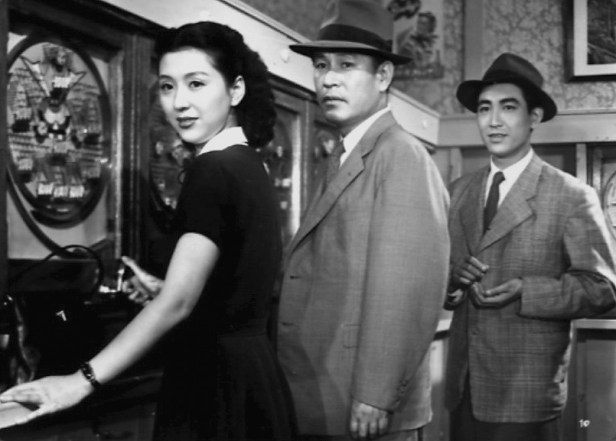
The more I see of the films of Ozu Yasujiro, the more I enjoy them and the more differentiated they become. This film, made just before Tokyo Story and scripted by Ozu with his usual writing partner Noda Kôgo, has the usual focus on family arrangements and personal relationships, but its tone is unusual. For long periods it seems quite bitchy and cynical and then becomes quite sweet and sentimental. The train trip is here, the bar and the visit to a spa, but also other aspects of the leisure time of the middle classes – dress shops, baseball, cycle-racing, kabuki, pachinko parlours and even Tokyo Airport and a tracking shot of a couple walking through the streets. There is more sense of the social life of a Japanese city in this film than in all the other Ozu films that I have seen.
The family is middle-class. The wife, Taeko, is very definitely ‘leisured’ and has at least two maids. She lives in a large Tokyo house with two floors (though Ozu carefully avoids actually showing us stairs – I’m not sure why). Her husband, Mokichi, who she thinks of as ‘Dull-san’ or a ‘relaxed turtle’, is from a lower middle-class background. He was a corporal in the Imperial Army and has done well in his (office) job at an engineering company. A sudden trip to Uruguay becomes a plot point in the last third of the film. Taeko is bored and constantly lies to her husband in order to spend time with her girlfriends at the club or going away to a spa. The lying is pointless, since she is a very bad liar and anyhow, Mokichi would probably raise no objection if she told him straight.
Both husband and wife are acting as mentors. Taeko takes her niece Setsuko under her wing and Mokichi agrees to be a guarantor for a young man, Non-chan who is seeking employment. The two younger characters represent the rapidly modernising Japan and Taeko is taken aback to discover that her niece has no intention of agreeing to an arranged marriage (which of course she went through – and ended up with Mokichi). The young man meanwhile is tempting Mokichi into spending time in pachinko parlours and baseball.
Taeko and her girlfriends gossip much like suburban wives in a 1950s Hollywood comedy-melodrama. The tone then changes a little with the resistance shown by Setsuko to an arranged date. An intriguing sequence this, set in a kabuki theatre – we never see the stage, but hear the actors – as we watch Taeko and her friends searching for Setsuko who has ‘escaped’. She ends up with her uncle and Non-Chan. Mokichi is quite sensible and when he realises that she simply won’t accept the arrangement, he leaves her slurping noodles with Non-Chan. I won’t spoil what happens in the end, but it’s an interesting resolution to the narrative.
The film’s title refers to the kind of meal that Mokichi really enjoys – poor people’s food, simple but subtle with the clash of flavours producing something pleasing. It becomes an important plot point and Mokichi suggests it’s a metaphor for marriage with the different flavours of men and women. Taeko comments on the smell of pickles on her hands which Mokichi refers to as the smell of a ‘working woman’s hands’.
Great movie!
 itp Global Film
“Ozu carefully avoids actually showing us stairs”
Ozu probably hated stairs. They would have upset his attitude to composition within the frame, and my guess is that he elided them mainly for this reason. There’s a very unusual sense of 3D space in Ozu homes generally. I can’t remember any stairs in his films, though if there are I’m guess they’ll be in the early ones.
Naruse, of course, loved stairs, especially with women on them.
Incidentally according to Donald Richie, Ozu himself disliked the ending to The Flavour… I think I can see what he means, in the sense that it’s not very Ozu-like.
LikeLike
Yes, but in Naruse’s Flowing I think that the main house is two-storey, but he also avoids showing the stairs. In Kurosawa’s Ikuru, however, I’m fairly sure they appear. I agree with you though – actually showing characters going up or coming down stairs would probably have offended Ozu’s sense of composition.
I thought about the ending and as I wrote, overall, I thought the shifting tone unusual, but possibly the feeling of ‘having it both ways’ (i.e. the traditional and the modern) is perhaps similar to the later Ohayo!
LikeLike
Are they living in bungalows in Ohayo? I was never really sure. That one in particular has a very carefree attitude to ‘explaining’ space, I think. The housing development in that film is fairly odd as well – I don’t remember any sense that they’re in or near a town, no shops or communal spaces, just houses and, some distance away, school. It’s like that in I Was Born, But… as well, though that one has a more classical attitude to space.
What do you make of Agfa colour? You don’t see that much…
LikeLike
I love this movie too. I was happy to have this impression. Thank you.
LikeLike