
(These notes were written for a screening of the film on a course on the Cinema of Central Europe.)
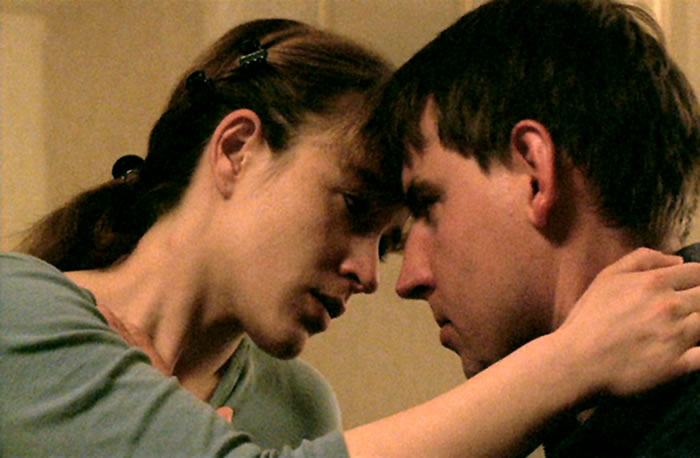
Sehnsucht tells the story of an ordinary man, in ordinary circumstances, who through a chance meeting propels himself, his wife and another woman towards tragic circumstances. The story is distinctive – not in the content, because it is a tale that we could feel is familiar, almost banal. However, the combination of what is being told with the way it is being told demonstrates several features that are unusual. The story is often told through juxtapositions, there is little exposition of character through extended scenes of dialogue. Markus, our protagonist, is quiet, unassuming and inexpressive of the internal drives that force him to act as he does. There is an implication that Markus little comprehends why he does what he does. In fact, the episodic style of the film and the refusal to explain, make this grown up filmmaking for grown-up film audiences.
Writer-director Valeska Grisebach’s work has been identified as being part of a New Wave of German cinema, in particular part of a ‘Berliner Schüle’. In fact, to be exact, she has been talked of as part of ‘the next generation’ of this new group, following on from the likes of Christian Petzold and sharing a platform with Christoph Hochäusler and Maria Speth (Madonnas (2006)). To outsiders, the variety of work being produced is striking and a sense of a joined-up movement is not obvious. However, there is much discussion of a move away from macro-politics to the micro-politics of the family, and there is evidence in the coverage given to these filmmakers of their impact in Germany and abroad, albeit on the festival circuit more than in the multiplexes. Grisebach’s work has featured on the festival circuit: Sehnsucht was included in competition at 2006 Berlinale (under Dieter Kosslick’s positive curation) and won the Special Jury Award in Buenos Aires.
Grisebach, like Petzold, made her first big impact with her graduation film Mein Stern (2000), in which she established a working style we can see perpetuated in Sehnsucht. Her casting procedure was painstakingly to interview potential actors, as part of the casting process but also as a way of collating experiences to include in the film. Both films used amateur actors, to achieve a naturalism that would convince audiences further about the drama being played out. Grisebach says of Sehnsucht, that using unknowns enhances the belief that any person has the potential to be a ‘melodramatic hero’. Her preparatory interviews asked people about their hopes for themselves as children, and how far they believed that these hopes had been realised. Grisebach comments that her research demonstrated that much of people’s hopes and longings centred around romantic, love stories, that it was there that we could become a “dramatic character, showing one’s true face”. I think it is possible to see this at play in Markus, of having the chance to be a new character in a new set of scenes that dramatise his banal existence and make his behaviour become addictive and irrational. The reserved cinematography commentates on his self-delusion, and the impossibility of escaping banality in either situation, an interpretation that is reinforced by the coda and its unusual style that creates a detachment from the story. Called Bressonian by some (after Robert Bresson), this reminds us that these choices of cinematography can have a political or moral undertone. Do we need, always, the commentary of editing, music and performance to be able to read the melodrama that exists in the most ordinary people’s lives?
Grisebach is one of the directors who has established an association of her work with Berlin and the state of Brandenburg, not least because it has the collision of Old West and Old East that she finds exciting. Place seems vital to these new German directors, many operating out of Berlin, who have been dubbed the ‘Nouvelle Vague Allemande’, even whilst it does not features in the films in the same way as, for example, the Berlin of Wenders’ Wings of Desire. However, the films do share something of the intention of Wenders’ contemplative piece about the state of Berlin. Grisebach is aware of examining a world altering post unification, with Brandenburg returning to a more mystic place “a fairy-tale forest” as the people disappear from its small villages through migration. Her comment on Berlin as having a ‘gruff quality’ but also a ‘damaged psyche’, could equally apply to these smaller places her characters inhabit and the emptiness that pervades their lives.
When watching the film, it’s easy to be reminded of Dogme and the style of these new directors can produce an alienation from the characters and the story that is quite deliberate. The landscapes are drawn from a real, post heavy-industrial landscape that have led to comparisons with the work of the Dardennes brothers in Belgium. However, Grisebach’s people are not born in marginalised, and therefore dramatic circumstances. Interestingly, despite her specific inspiration from her home city and its surroundings, her dramas have a universality since they come from within, born out of those disappointments and frustrations that are universally shared. However, unlike the earlier existential dramas of New German Cinema, there is no existential angst (in their own dialogue at least) for people who act rather than contemplate.
Grisebach cites a true story, told to her as an anecdote, as forming a particular inspiration for Sehnsucht. The central character became, for her, a romantic hero, through his experience very much like Markus’s. One interesting question to follow up may be to consider how this turn to the personal and this idea of heroism sits with the other films dealing with the macro-politics of Central Europe.
Full credits and a synopsis (with spoiler) is available here.
 itp Global Film