
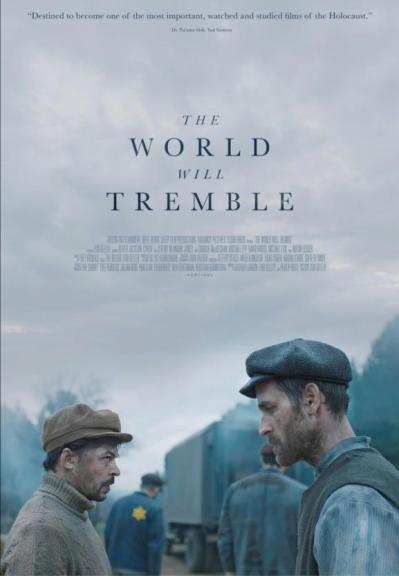
I stumbled across this film on BBC iPlayer where it appears to be available for a year. I’d never heard of it and didn’t know what to expect. The opening titles reveal a distributor and production companies that weren’t familiar and I was intrigued by the Bulgarian and Israeli references. Further titles then remind us that Germany annexed Western Poland in 1939 and that Jews were deported to ‘the East’. The narrative proper starts in January 1942 near the small town of Chełmno in the Northern part of Poland. This was the location of the first Nazi extermination camp and we meet the members of a Sonderkommando group – young Jewish men forced to act as the labour force in the killing of men, women and children, including their own families. This is a true story and has been argued to be the story that broke the silence about the camps for the first time. The first section of the narrative gradually reveals the method the Nazis were using to kill around 6 to 9 truckloads of Jews each day. There is a detailed description of the process on the Wikipedia page for Chełmno extermination camp. The narrative follows three of the forced labourers in particular who seem to be plotting an escape and an opportunity to tell the world what is happening – though the local Poles might not believe what they hear or may simply want to pretend they haven’t heard. (The unreliability of the local Polish population is mentioned by the men in their brief exchanges.)
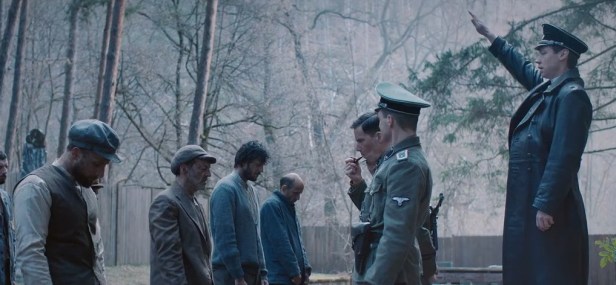
The first odd aspect of the production that I noticed was that the Wehrmacht soldiers tend to speak English to the forced labour prisoners but sometimes speak German to each other which is (mostly) subtitled. The Jews when they arrive speak another language – Polish or Yiddish? IMDb is not very helpful but it does list a group of actors who dub German over the English dialogue so I presume dubbed prints were released in Germany. My lack of knowledge about contemporary younger actors means I didn’t recognise any of them and this did make it more difficult to remember who was who. Eventually it became apparent to me that Solomon (Oliver Jackson-Cohen) and Michael (Jeremy Neumark Jones) are the two main characters. They are both British actors and in fact the rest of the cast seems to be either British or German including the one actor I did recognise, the veteran British player Anton Lesser who plays a rabbi. The performances are generally very good, although the Wehrmacht officers do tend to be rather overplayed – but perhaps this is meant to emphasise the combination of sadism and boredom necessary to perform their hideous operations. Later, Solomon and Michael during their escape will meet a Wehrmacht officer who seems to represent the more respectful Prussian stereotype. The escapees are wearing the uniforms of Polish railway workers.
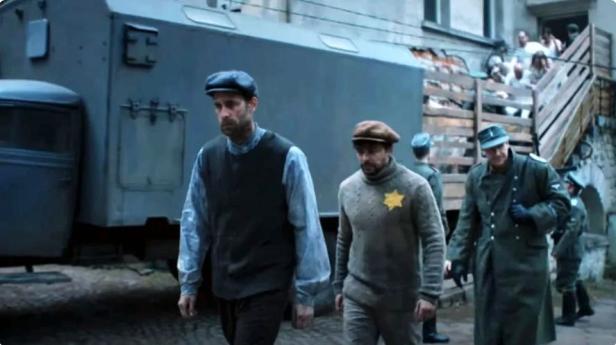
The film does not look like a typical Hollywood Holocaust drama, the final section of the film covers the escape of the two leads which is well put together and exciting. Inevitably the ‘chase’ is more conventional in presentation but the final still images carry more text that explains how the story of the early months of the extermination of Polish Jews is exposed and what happened to the real people involved. The film is an example of the Israeli drive to tell the full story of the Holocaust and to make sure that younger audiences in particular are presented with new Holocaust narratives designed to engage them. The production began with the work of the Israeli-American writer-director Lior Geller who was a prizewinner for his short films before moving into features. This is his second feature and it came about through a consortium of rather disparate production elements. Lorton Entertainment is a UK company now branching out in features after a successful run making sports and music bio-documentaries (including Asif Kapadia’s Diego Maradonna, UK 2019). The American company UFO Films has a background in exploitation films for TV and Radiancy, the other US company, seems to have been involved in its first feature. The film was shot in Bulgaria with support from the Bulgarian National Film Centre and the crew seemed to me to be mainly Bulgarian based on their names. Several Israeli agencies, including the Israel Film Council and Black Sheep Films were also involved. The film was distributed worldwide by the US independent Vertical. IMDb lists the date for UK distribution as 14 March 2025 but I can’t find the film in the BFI data for a release around that date. However the film’s Wikipedia page tells me that: “Since the film’s US theatrical release it has become an international streaming sensation reaching the global Netflix top ten and securing the number one spot in multiple countries”.
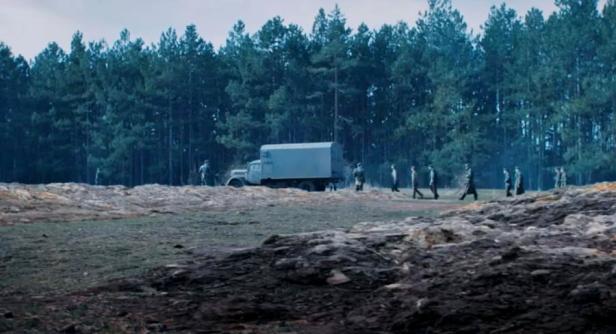
I found the film interesting and engaging and parts of it are very moving. I didn’t know about the Chełmno camp but I’ve seen enough Holocaust films to be prepared for the horrors. But then, I don’t think I’m in the target audience for this film. I have read that Lior Geller did a lot of research to get as many details as possible right. The film is presented in the ‘Scope aspect ratio and it uses a predominantly grey-green-blue palette throughout apart from the last scenes in the Rabbi’s house. It’s good to see a relatively unknown Holocaust story on a screen and perhaps this film might work best on television. I recommend it for most age-groups but it carries a 15 Cerificate in the UK and a 12 in Germany. It should be available on Netflix worldwide.
 itp Global Film