
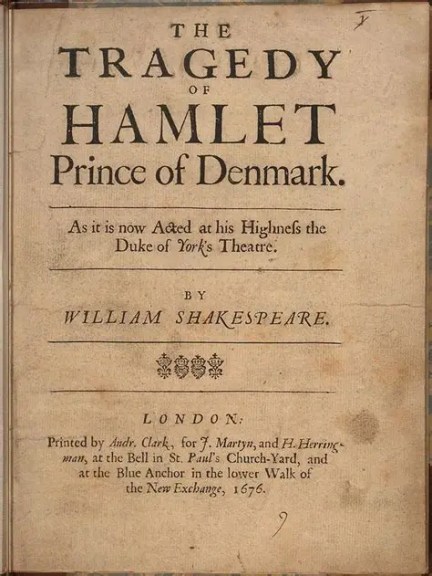
“The names Hamnet and Hamlet were considered interchangeable in Elizabethan England.” Quote in novel and film adaptation.
These two recent releases were both exhibiting around the same time: and, as the titles suggest, they both relate to one of the masterworks of playwright William Shakespeare. Hamnet is an adaptation of a novel by Maggie O’Farrell; Hamlet is an adaptation of the actual play.
Hamnet, Focus Features and Universal Pictures, 2025
The original novel, Hamnet & Judith (2020), traces the wooing and marriage of William Shakespeare and Agnes/Anne Hathaway. She bears him three children; a daughter Susanna and twins Hamnet and Judith. Frustrated and restricted in his father’s household and glove business Shakespeare goes to seek wider horizons in London, leaving Agnes and the children in Stratford. Shakespeare become involved in the Elizabethan theatre and his career is history. The novel concentrates on domestic life and the tragic death of Hamnet by plague. The novel essays how this can be read into the themes and characters of Shakespeare’s famous play, written several years later. The novel has a non-linear narrative, is poetic and reticence in relating family life to the play. This film adaptation is linear, literal and heavy-handed in placing Hamnet in the play Hamlet.I found the dialogue ‘muddy’, lacking clarity, a common issue in modern films. However, one critic referred to a scene of Shakespeare’s early attempts at writing whilst still in Stratford as part of Romeo and Juliet. This is long before his move to London and encounter with Elizabethan Theatre. Then in a scene by London’s Thames he recites ‘To Be or Not to Be’, heard again later in the actual staging of the play; the novel spared us this.
When we reach that production the stage set has painted flats representing greenery and a hidden cave; this is meant as a reference to the early part of the movie where Agnes, a herbalist, frequents local woods and a mysterious cave. The Elizabethan audience might have wondered where was Elsinore Castle?
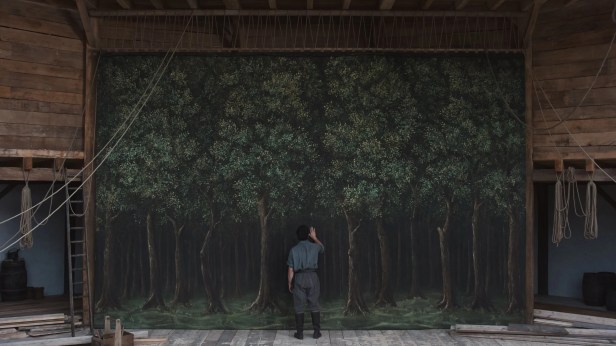
Wikipedia notes that the director Chloe Zhao and production designer Fiona Crombie felt that London’s actual Globe Theatre was too ornate to use. It is a shame they were not as particular about the staging of the play in the movie.
“Maggie O’Farrell discussed with Script her inspiration for writing Hamnet, emphasizes the importance of research during the writing phase, her collaborative process with co-writer and director Chloé Zhao, and highlights the challenges of adapting her book to a screenplay, the necessity of making interior emotions exterior, and the impact of Chloé’s unique film-making style.” (Scriptmag. com).
I rather wonder at the ‘necessity ‘ of making the interior exterior, both verbal and visual; surely literature does this but in words rather than in images. If you consider fine adaptations of Shakespeare’s plays they manage to effect the interior visually.
It is fair game to imagine the missing aspects of Shakespeare’s life, a large amount. I thought that Shakespeare in Love (1998) did that with intelligence and wit;: as did the earlier stage production of Rosencrantz and Guildenstern (1966) to his play: both down to Tom Stoppard. The family life in Hamnet did retain some of the book’s engagement but this rather lapsed when we reached the theatre.
Hamlet, Focus Features through Universal Pictures 2025
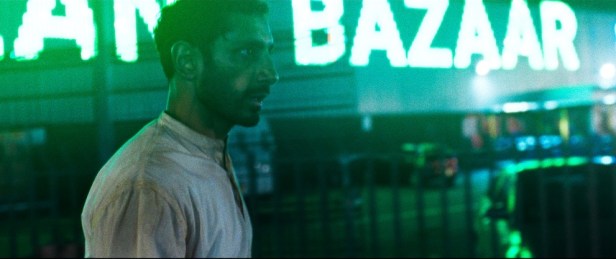
This was a relief to turn to, a modern adaptation of the play set among a British/Hindu entrepreneurial family based in London. The drama only runs half of the length of the original, but captures much of the character and interaction that make Shakespeare’s original so powerful. The movie uses a combination of the original dialogue and contemporary dialogue. Some characters are combined and both actions and scenes are in some cases moved: the movie opens with Hindu obsequies: one inspired change has the family property business opposed by a cooperative of homeless people, called Fortinbras. But the essential trajectory of Hamlet (Riz Ahmed) agonising on how to respond to his father’s death is maintained. One of the pleasures is the clarity of the dialogue, both Shakespeare and added; though on occasions it is voiced a little too quickly. And there are ambitious changes that do not quite work; Hamlet delivering ‘To Be or Not To Be’ whilst racing in a car around East End streets. But the film does present the interior without making it literally exterior; so the famous last line of the play is visualised rather than spoken.
When I read O’Farrell’s original novel I was not completely convinced by the premise of the book, but it still made me think again about Shakespeare’s great masterpiece. I have seen a complete stage production of the play, very finely done. And I have seen innumerable adaptations, both on the screen and the television. Hamnet added nothing to those memories. But Hamlet (2025) made me think again about some of those, especially the films.


I can’t bring myself to see Hamnet, not having liked the book. I really enjoyed Riz Ahmed’s version
LikeLike