
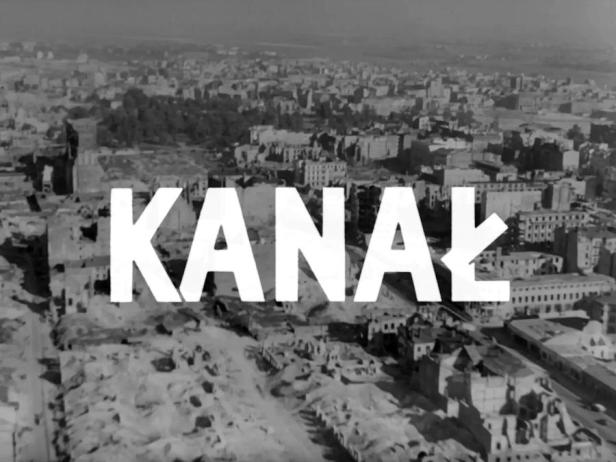
In the year of the centenary of Andrzej Wajda’s birth it seems appropriate to explore his early work focusing on the Warsaw uprising of 1944. It was actually his second feature and the middle film in his loose trilogy about the fight against the Nazi Occupation of Poland and its immediate aftermath. Wajda died aged 90 in 2016 and its sad to think that his final years saw another threat to his homeland with the first move by Putin to attack Ukraine in 2014 and the subsequent fears that Poland might face war again if Russian aggression grows.
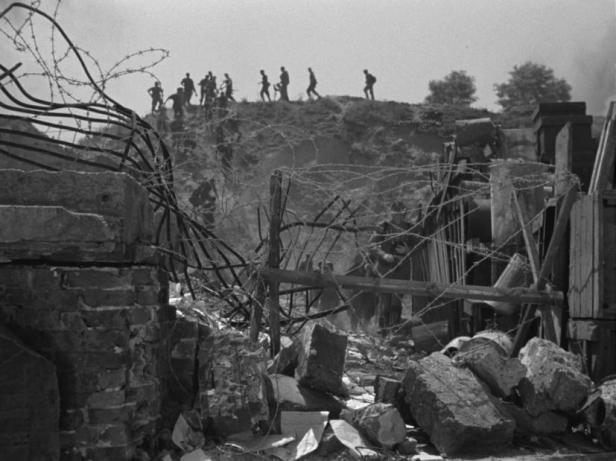
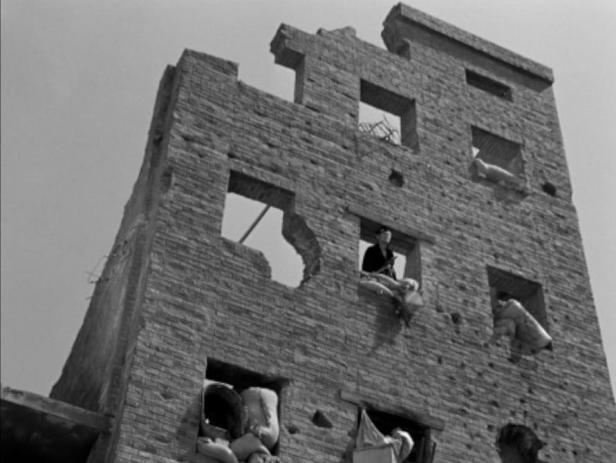
The story of Kanał, written by Jerzy Stefan Stawinski, follows a company of Home Army soldiers, part of the Warsaw Uprising which began on August 1st 1944 and lasted until the final surrender on October 2nd. The aim of the uprising was to liberate Warsaw and to create the possibility of Polish forces aiding the Allied fight against the Nazis. It was supported by the Polish high command in exile in London who wanted to see Warsaw as a pro-capitalist liberated city to prevent Soviet domination of Poland after the German defeat. It is generally agreed that the Red Army halted its advance from the East on the grounds that the Germans would inflict significant casualties on the Home Army, enabling the pro-Russian ‘People’s Army’ to be in a stronger position when the Red Army finally took control of the city. Andrzej Wajda’s earlier film A Generation (1955) focused on the People’s Army but here he attempted to record the bravery and tenacity of the traditional Polish military, a controversial move in 1957 when Poland was still part of the Soviet Eastern Bloc.
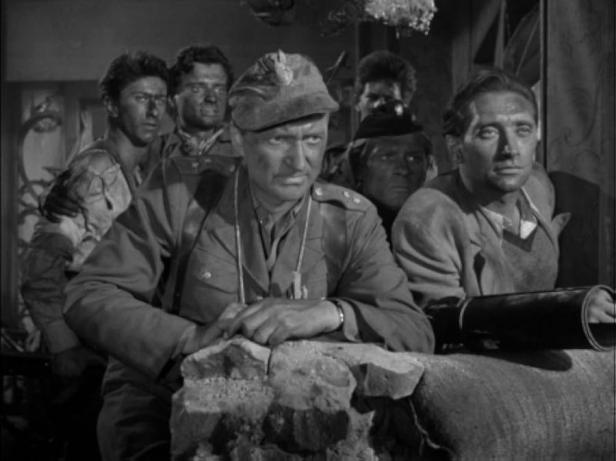
During the opening credits we see the German occupiers using flame-throwers on the on the buildings of a central district in Warsaw. The narrative proper begins with a company of men, women and youths in an array of military uniforms and with assorted weapons moving into an outer district of the city, expecting that the Germans will soon mount another attack. A voiceover commentary tells us it is late September and this company, once 70 strong is down to 43. They are relieving another Home Army group which has been attacked by dive bombers. When the next German attack comes the company leader Lieutenant ‘Zadra’ receive orders to return to the city centre via the sewage network beneath the city streets – thus the title of the film. The company, which will be whittled down to a much smaller group as the fighting intensifies, includes a variety of characters. Some are professional soldiers such as the Lieutenant, some are civilians such as the music composer Michal. There are two significant women in the group and most characters appear to have nicknames rather than given names. They have weapons such as machine guns, anti-tank guns, grenades and rifles but are ill-equipped to resist the Germans with their tanks and armoured vehicles. The voiceover picks out some of the soldiers and whereas the opening shots cover the whole company, as their numbers are reduced during the German attack we begin to focus on individuals and small groups.
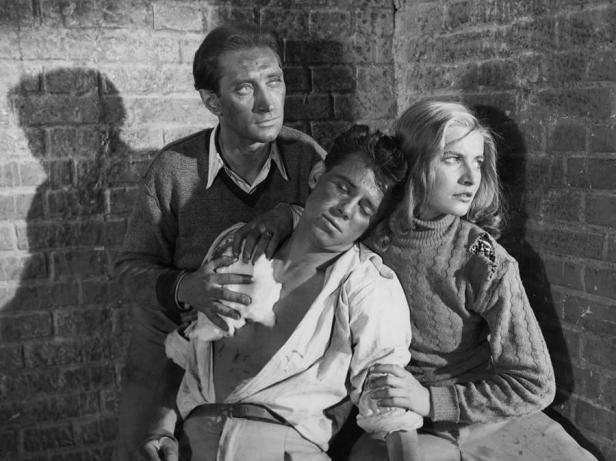
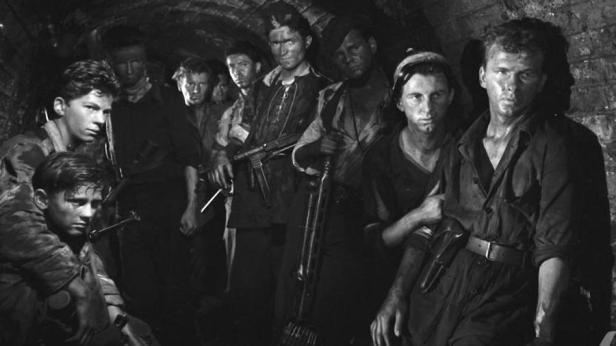
We might argue that as the narrative develops this focus on individuals begins to make the narrative more conventional. As the survivors of the last German attack descend into the sewers the narrative moves between Lt. ‘Zadra’ (Wienczyslaw Glinski) and his loyal follower Sergeant ‘Kula’ (Tadeusz Gwiazdowski), Lt. ‘Madry’ (Emil Karewicz) and Halinka (Teresa Berezowska). The composer/musician Michal (Wladyslaw Sheybal) is an odd figure who has only just joined the company but the lead roles in the film are played by the stars Teresa Izewska as ‘Skorotka’ who supports Tadeusz Janczar as Officer Cadet ‘Korab’, wounded in an attack on an early example of self-driving mini-tank. Once in the sewer system of tunnels the camerawork is by necessity much more organised on mid-shots and close-ups, demanding much more of the actors presenting the individuated characters. I don’t know if the sewers were ‘real’ or created on a sound stage in a studio but they certainly feel claustrophobic as well as toxic with an ominous ‘mist’ forming above the water level and plenty of human waste and detritus floating in the waist deep waters. ‘Zadra’ and ‘Skorotka’ claim to know the system of tunnels but the others just follow them blindly. Michal is the character who seems to provide a form of commentary. Earlier in the ruins he has played a piano and in the sewers he quotes Dante and plays an ocarina. The narrative is based on real events so we know that the surrender took place a few days later. For the company depicted most of the remaining members die in the sewers or are shot by the Germans when they emerge onto the street. But for the most prominent of the company the fate of a trio of central characters is unclear.
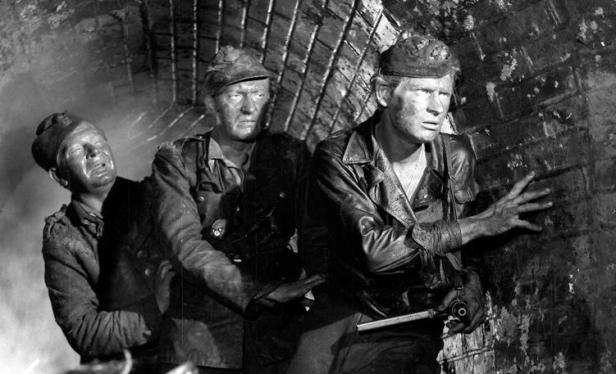
It’s difficult now to appreciate just how important Wajda’s war trilogy was outside Poland from the 1950s and through the next thirty years. As I watched it again on BFI Player I struggled to remember my first viewing on television. I do remember watching it but I’m sure I would have been too young for its first appearance on the BBC in 1963. Presumably it was shown again in the late 1960s or 1970s. Thanks to the diligent research of Sheldon Hall published in his book Armchair Cinema (Edinburgh University Press 2024) we know that Kanał was one of the first subtitled films broadcast on BBC1’s ‘Late Night Film’ slot and that it attracted an audience of over 5 million, a staggering increase on the small audiences for subtitled films in London’s specialised cinemas. The BBC screening was also accessible across the UK . In many regions it was difficult to find subtitled films of this kind in cinemas despite the work of film societies and what became regional film theatres. It would be interesting to know what the impact of Wajda’s films was on the post-war Polish diaspora in the UK.
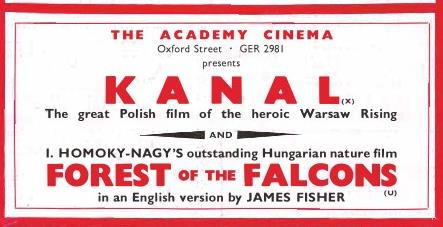
I decided to do a little more digging using the newspaper archives. I discovered the film opened at the Academy in London in June 1958 with a supporting feature, a Hungarian nature documentary Forest of the Falcons (1954) made by Dr. Istvan Homoky-Nagy quite a contrast, I imagine. On the whole the UK press were very positive about the film but there were some odd/interesting comments which perhaps tend to say more about the journalists than the film. One review echoed some conservative critics in Poland who thought that the film was literally “too filthy” in the depiction of the sewers. The Polish reviewers thought it showed Polish heroism in a bad light. Admittedly the film is a hard watch but one critic complained that the two women were “too beautiful”! Another suggested that the actors weren’t able to fully deliver the emotions of the experience of the characters they played. I took this to mean the reviewer simply had problems with a film that didn’t have Hollywood stars. I think the performances are very good and some of the leading players appear in other films by Wajda. One intriguing bit of ‘gossip’ I found was a journalist who attended an official reception for the film hosted by, I think, the Polish embassy. The journalist suggests it was quite a ‘wild party’ for a formal occasion and he was amazed to discover that there were three kinds of vodka on offer. All in all, the film made a big splash and from the 1950s through to the 1980s Wajda was a major figure in what was termed ‘World Cinema’ alongside Ray, Kurosawa, Bergman etc. In the last part of his directorial career he was finally able to make a film about the death of his father, an officer in the Polish Army who was one of the thousands of Polish officers and intelligentsia murdered by decree from Stalin in 1940 in the forest of Katyn (Poland 2007) in Western Russia after the Soviet invasion.
I should also point out that Kanał invokes the idea of Polish romanticism about heroism. Lt. Zadry, I think, makes the point about dying as a hero during the uprising while Halinka suggests that it is easier to die when you are in love – a tragically ironic statement in the circumstances. Michal the composer expresses a form of ambivalence when he clearly appreciates finding a playable piano but also comments on the bourgeois household where he finds it. I’m no expert on Polish romanticism but I have read that it is not the same as that in Germany, France or the UK. I think that Kanał is a magnificent achievement and if you haven’t seen it I urge you to seek it out. Here’s a trailer for the film from the re-release of a restored version in France in 2019:
 itp Global Film