
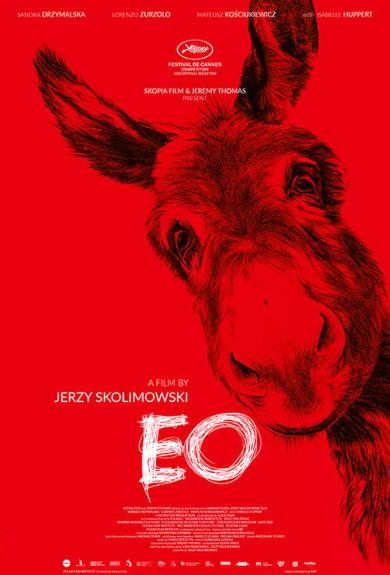
Jerzy Skolimowski is a writer-director and actor with a long career whose work doesn’t always receive the reception it deserves. I was surprised to see the low ratings for his films on IMDb and particularly for his film 11 Minutes which I thought was an intriguing work. He was in his mid 80s when EO was screened in competition at Cannes where it shared the Jury Prize in 2022 and won the Music prize for Pawel Mykietyn. I realise now that it shares some aspects with the ideas behind 11 Minutes – specifically a structure designed to allow some kind of commentary on aspects of contemporary society.
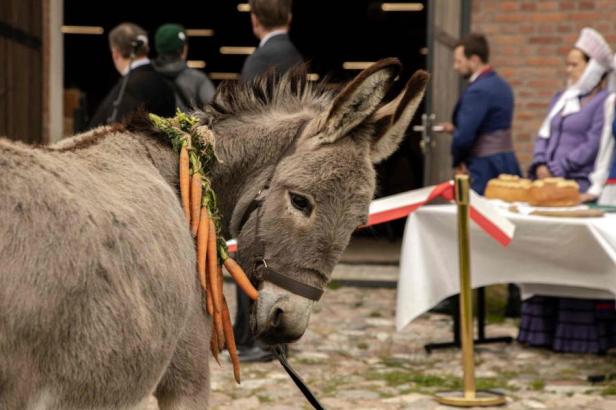
Many reviewers reach for Bresson’s Au hasard Balthazar (France 1966) as a reference point in discussing Skolimowski’s film about a donkey. I haven’t seen the Bresson so I’ll reach for a more recent film, the Latvian animation feature Flow (2024) about a cat suddenly facing a partially flooded world seemingly devoid of human activity.The two films are similar in focusing on an animal and its journey through various landscapes and streetscapes and the challenges it faces. But there are two big differences. Animation frees the director from having to train an animal to behave in particular ways and the donkey is faced with humans some of whom decide to treat it very badly. In fact, Skolimowski seems to used six different named donkeys, though I believe that donkeys have a limited range of colours and other distinguishing features so although I wondered about how the animal seemed to ‘perform’ so well, I didn’t really notice it wasn’t the same individual donkey.
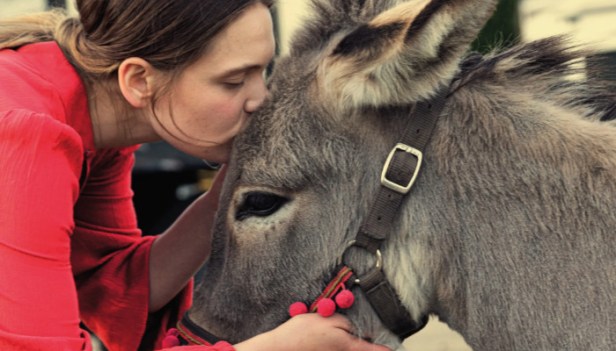
At the beginning of the narrative we meet Eo in a circus ring as part of an act with a young woman. She clearly loves the animal and it reciprocates. We realise this when animal rights activists bring in the local authority to remove the animals to protect them. The donkey will find itself placed in a sanctuary on a farm outside the city but when the young woman visits briefly, our hero is moved to act. After she has gone it breaks out of its paddock and heads back towards the city. This is a lonely and dangerous journey, especially at night and there are many natural perils. This sequence gives us the donkey’s perspective on the natural world but soon we are aware of how in the modern world an animal like a donkey is rarely able to move about without human intervention. The film is a co-production between Poland and Italy and although there are only a few clues to where we are at any one time it would appear that the narrative begins in Poland and ends in Italy, possibly passing through Switzerland but there would be other countries too. For such a long journey the donkey finds itself being transported in a range of vehicles some reasonably comfortable, others not so much. There are three or four interactions between different groups of people, a couple involving violent confrontations and the last including a bizarre cameo by Isabelle Huppert. I specifically noted a credit for ‘Ms Huppert’s Make-up’ and I’m not surprised as she looked amazing. Having said that I have no real idea why her character appears or really why a couple of other people appear since they have no direct relationship with Eo. They simply represent the human world with its own concerns., offering a contrast to Eo’s observations perhaps?
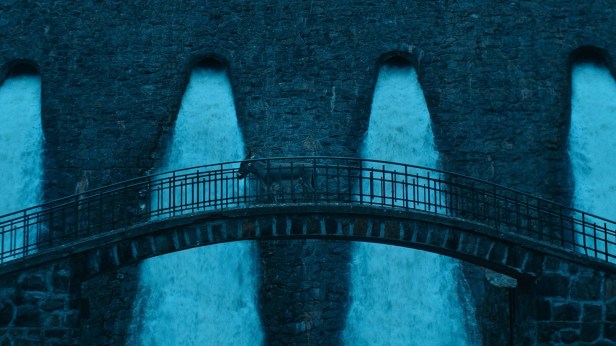
I think that many of the reviewers who cite Bresson’s film are thinking of its claims to some kind of spiritual message but I don’t think that Skolimowski is aiming for anything similar. There are observations from the donkey’s perspective that we might interpret but that is really up to us. There are stunning visual moments such as a narrow bridge over the ferocious waters tumbling from a dam (?) and we marvel at seeing the donkey against this backdrop of a demonstration of human exploitation of the natural world. The ending of the film is ‘open’ with a simple cut to black. I’m glad it’s like that so that we don’t get either the tragedy of the donkey or some kind of ‘magic realist’ triumph for the donkey. I’m with those who think this is an art film revelling in the cinematography by Michal Dymek (this is the third of his shoots I’ve seen in the last 12 months) plus extra second unit work and the editing by Agnieszka Glinska (who also edited 11 Minutes). Jerzy Skolimowski scripted the film with his marriage partner Ewa Piaskowska. I guess you might call it a road movie of sorts. Others call it a poetic essay. The reviews of the film are mixed, much as the general reaction to Skolimowski’s work over the years. I guess at his age he isn’t bothered too much. In a slight alteration to the usual closing about ‘no animals were hurt’ during the production the credit refers to the filmmakers’ love of animals and nature as their prime concern. The images of Eo are offered to us in a bravura piece of filmmaking and it’s up to us what we make of them. I found the film engrossing and also troubling. The donkey is an animal with strong cultural resonances throughout history – present in certain powerful images but also the definition of workaday beast of burden. I recommend the film, but beware that it isn’t Bresson!
 itp Global Film