
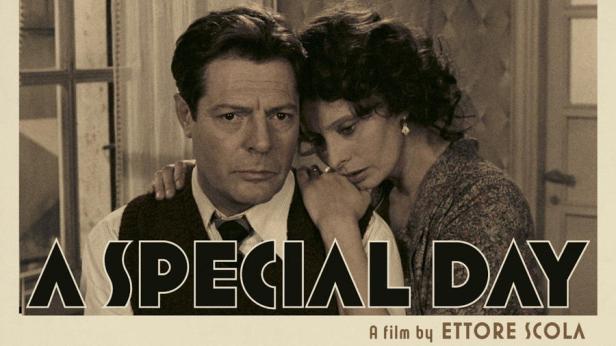
The ‘Special Day’ of the title of this film is during the state visit to Italy of the Nazi leader Adolf Hitler who arrives in Rome on May 3rd 1938 to the acclaim of crowds lining the railway tracks and is greeted by Benito Mussolini (il Duce) and King Victor Emmanuel. The film narrative opens with a long sequence (nearly six minutes) of archive propaganda footage emphasising the pomp and ceremony of Hitler’s arrival. The action then cuts to the single location that will comprise the setting for the rest of the narrative. The first image of this second section begins with a close up of a huge flag presenting the Nazi swastika. The camera pulls back to reveal that the flag is being unfurled over the main stairway of a large modern housing block with an interior courtyard. It is early in the morning of the next day and the building’s caretaker is engaged in draping an even larger Italian fascist flag on the balcony. The propaganda footage was in black and white but the stock now appears to be ‘desaturated’ colour with an almost sepia tone. Lights are coming on in the individual apartments and families are getting up to celebrate the fascist festivities. The camera cranes around the inner courtyard tilting up to reveal the height of the block of many storeys. Eventually, the camera moves into one of the windows to explore a large apartment with the woman of the household waking her husband and six children, chiding them gently at first and then more urgently. Hers is the first voice we hear emerging from the silence of the early hour.
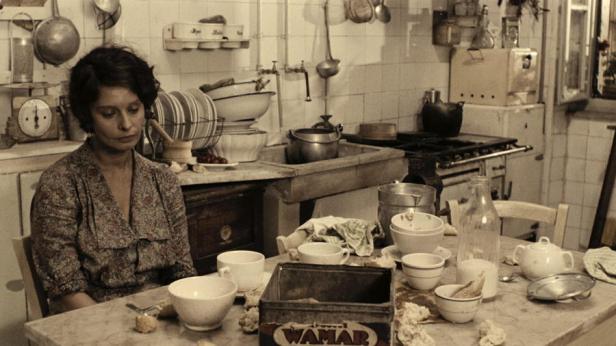
As we watch the family assembling around the kitchen table for breakfast we are introduced to Antonietta (Sophia Loren), her husband Emanuele (John Vernon) and their children. They are an ordinary working-class family with all the usual concerns expressed by a mother, father and children ranging in age from the toddler to the older teens. All except Antonietta are getting ready for the big parade, whether they want to go or not. After a few minutes there is a cut to a long shot of the courtyard as people begin to stream out of housing block. The sepia tone recedes a little to allow more colours to be evident, especially in the flags and the uniforms worn by most men and children. Each of them appears to belong to a fascist organisation. As they go through the gateway to the street the caretaker, an older woman, gives them a fascist salute. Only she and Antonietta are staying put. Antonietta has too much to do at home (and of course she doesn’t have a maid, as one woman points out when she is sending off her family). Antonietta watches them all go and the camera offers us several high and low angle shots of the towers to emphasise the scale of the building. When she stops trying to clear up the mess in her kitchen and sits down to drink the dregs of coffee we realise how tired (and bored) Antonietta must be with the constant drudgery of her housework. By this point most of the colour has drained away again and the sepia tone has returned. The cry of Rosamunda, the family’s mynah bird in its cage marks the next and major part of the narrative.
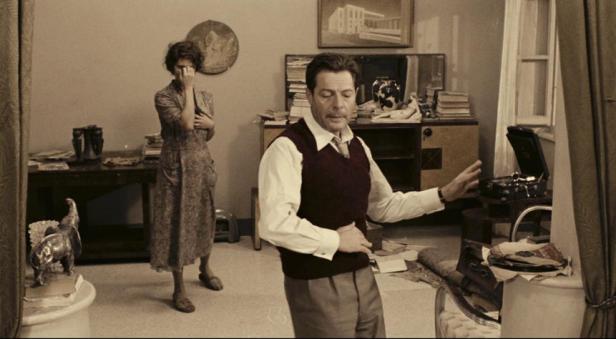
The bird escapes from its cage and flies out of the kitchen window and across the courtyard. Antonietta sees that there is actually someone else in the building and the bird is perched near their window. She runs across to the apartment and asks the man there to help her. He is, of course Marcello Mastroianni playing Gabriele, a rather diffident man some ten years older than Antonietta. From this point we are into an unconventional form of romantic comedy drama. I won’t spoil the narrative by describing what happens but simply point to some of the elements. The couple have different social backgrounds and she is worried because she feels inferior even though he does not imply any superiority. Mainly he argues to have fun and to laugh. We recognise that he is a gay man but she is unaware. The caretaker is suspicious and comes to Antonietta’s apartment to warn her against this weak man who may be ‘subversive’. When he is in Antonietta’s apartment later Gabriele discovers that she has swallowed the fascist propaganda or rather she has fantasised that Mussolini is her romantic hero taking the place of her uncaring husband.
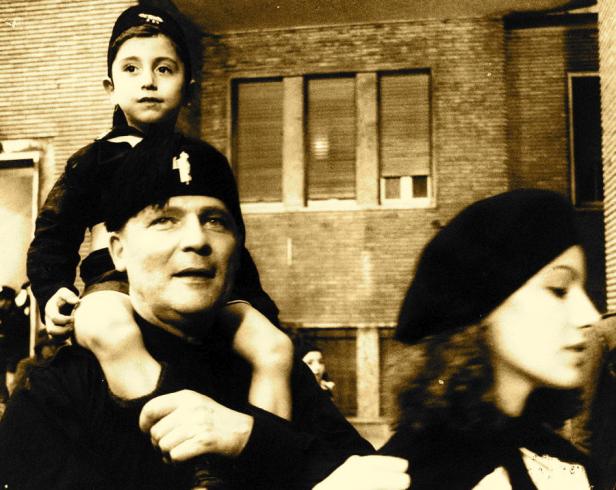
Loren and Mastroianni are excellent and I agree with those who feel that this may be Loren’s best performance. The film works for me because it is so subtle about the real horror of the fascist state and so effective in presenting two ordinary human beings who connect on a personal level. Director Ettore Scola and his fellow writers create a script which doesn’t need to lecture us on all the things wrong with fascism but just show us what it does to people and communities. It exposes the way in which Gabriele is punished for his ‘depraved’ life style which offends God and the fascist state. Meanwhile Emanuele who is ‘Head of Caretakers/Janitors’ at the Ministry for African Colonial affairs is a good fascist determined that Antonietta will have a seventh child for the fatherland (and a cash bonus). Meanwhile the relationship between Antonietta and Gabriele is handled with great sensitivity (and fun!). Many of the reviews refer to Loren in her least glamorous role as if warning readers to prepare for a different image of the star but for me she is possibly at her most alluring in this role. She may be in a crumpled house dress with tousled hair and little make-up but her eyes sparkle. Her beauty cannot be hidden and most of all her vitality and force of personality shine through.
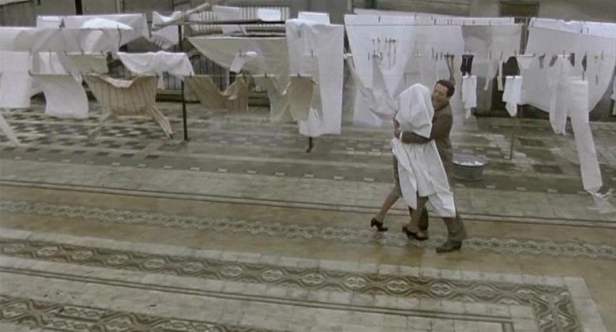
As a couple, Loren and Mastroianni are certainly ‘special’. The film also has an extraordinary soundtrack complementing the camerawork by Pasqualino De Santis and I like the sepia tone. It appears that some prints have been presented in full colour but the BFI and Criterion presentations have the correct sepia tone. The BFI has been running a Sophia Loren season at BFI Southbank during August and there is a selection of five of her films, including A Special Day on BFI Player. I’ve already written about Yesterday, Today and Tomorrow (1963) and Marriage Italian Style (1964) and I’ll try to post on the other two films in the selection. A Special Day is also available from Apple or Amazon Prime (but check the colour/sepia offer).
 itp Global Film