
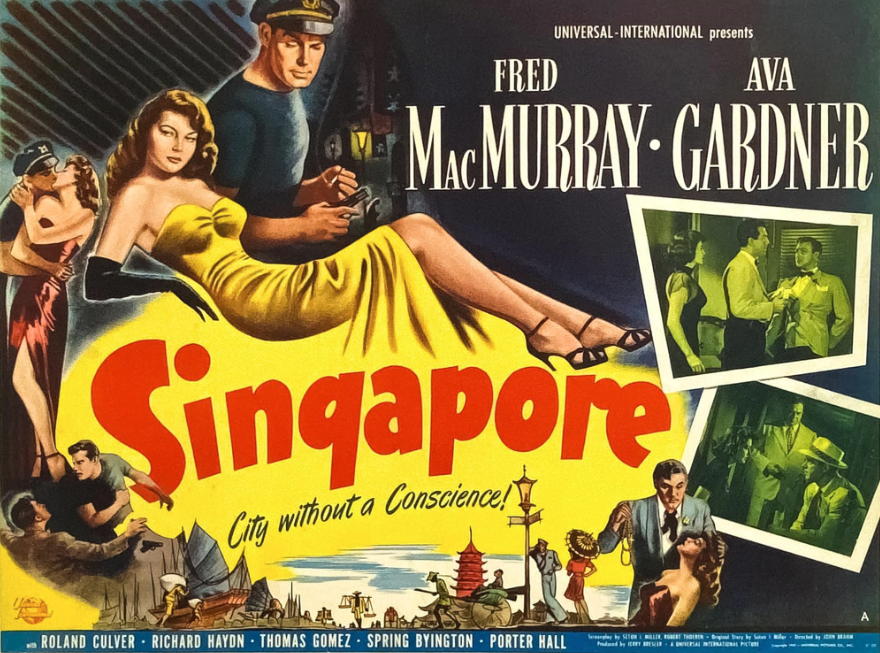
Singapore is one of several Hollywood films from the late 1940s/early 1950s that feature American characters in ‘exotic’ foreign cities. I watched this film as part of the Powerhouse/Indicator boxset of ‘Universal Noir Vol. 2’ following a viewing of Tokyo Joe with Humphrey Bogart (US 1949) that I found online. Other examples of this cycle include Calcutta (1946) with Alan Ladd, Saigon (1947), again with Alan Ladd and Macao (1952) with Robert Mitchum. There are also numerous films set in Cairo and other locales. Here, I’m concentrating solely on Singapore, a much better film than Tokyo Joe, which copies some of its main elements.

The American ‘hero’ of Singapore is Matt Gordon (Fred MacMurray) who returns to Singapore after the war. In December 1941 he had left the island on his schooner as the Japanese forces moved quickly towards the city, completing the worst-ever British defeat in wartime. (The script alters the dates associated with the rapid Japanese advance.) In a later dialogue exchange we learn that Gordon served in the American forces during the Pacific War with some distinction. However, his arrival now is closely monitored by Deputy Commissioner Hewitt (Richard Haydn), a laid-back but astute character who still wants to know what Gordon did with a large number of pearls he was attempting to smuggle out of the country five years earlier. MacMurray seems very much in his ‘Double Indemnity‘ mode here – on the face of it a cheery, polite and friendly fellow, but still intent on cashing in on the pearls that he hid in his hotel room when the Japanese invasion force was close by. He’s the perfect romantic good/bad character. Soon we discover the other memory he carries – of the woman he was about to marry when the bombs began to fall. He believed her dead and we begin to learn the story of their affair through a series of flashbacks.

If we’ve seen the poster we know that Ava Gardner is the second-billed star, borrowed from MGM for this Universal production and we assume that she plays the woman he lost. Gardner was in the process of becoming an ‘A List’ star at this point. The Killers (1946) had been her breakthrough film just a year earlier after 5 years as a supporting player – she was on a long contract at MGM who really didn’t know what to do with her (yes, it seems inconceivable!). Here as second lead she was too important to kill off so not only does she appear in the flashbacks but Gordon discovers that she didn’t die. Instead she was in hospital with a form of amnesia and in the following years she recovered and married a British planter, Van Leyden (Roland Culver), with Gordon wiped from her memory. Gordon’s re-appearance in Singapore also alerts the local criminals who remember his exploits at finding pearls and they seek to find whatever he can recover of his stash. Can he find and hold on to the pearls and Gardner who is now Mrs Van Leyden and return to the US with both the girl and the booty? No spoilers here so don’t worry.
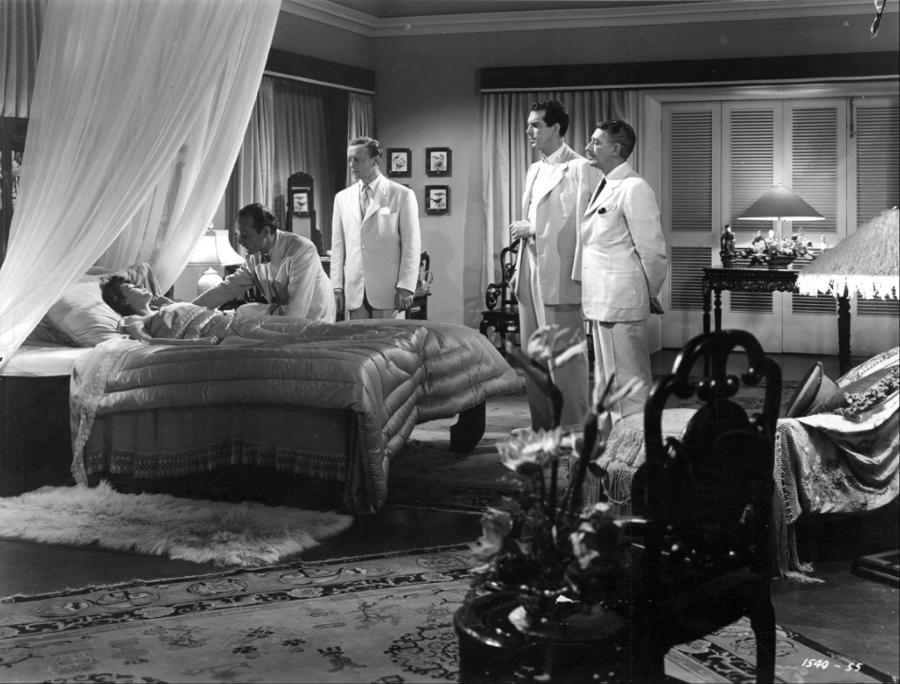
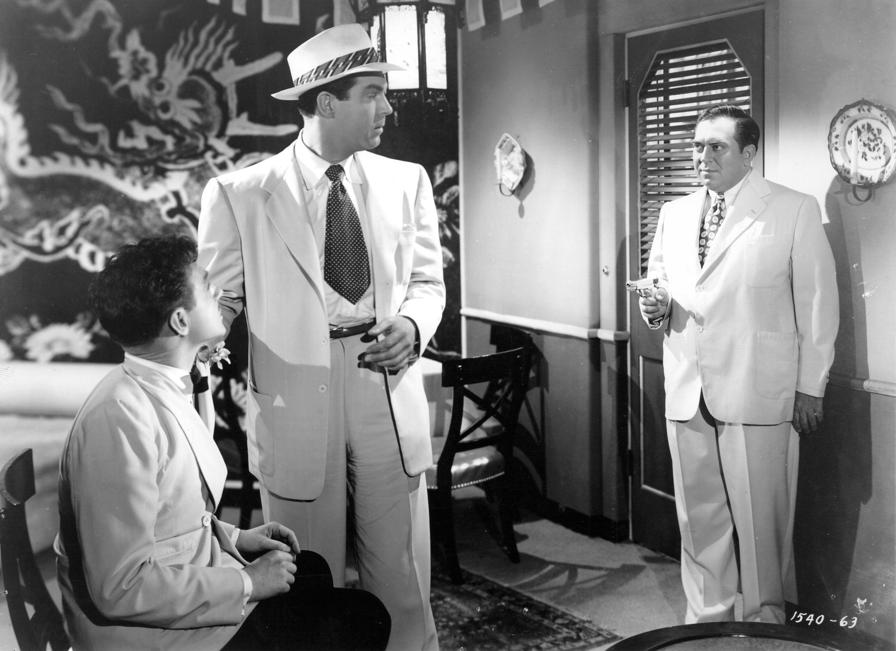
The other key cast member is Thomas Gomez as the criminal boss who operates with a front as an antiques shop-owner. The story is by Seton I. Miller one of the most distinguished Hollywood writers of ‘adventure stories’. He also wrote Calcutta and his biggest hit was The Adventures of Robin Hood (1938) for Errol Flynn at Warners. The film was directed by John Brahm, one of the earliest German migrants escaping Nazism who arrived in Hollywood in 1937. His experience was mostly in horror and film noir productions hovering between Bs and relatively low budget A films. Photography is by Maury Gertsman whose experience was mainly on B pictures as a Universal contractee. The film runs for only 79 minutes – the industry definition of a B picture was often taken to be a film of less than 80 minutes. But overall this doesn’t feel like a B. It’s much more like an inexpensive A picture. In fact the American Film Institute Catalog suggests that there was once an 85 minute version. Universal scanned this film for a 2K digital print but don’t seem to have included any previously discarded footage. Gardner was probably hired before her fee rose after The Killers. Fred MacMurray’s appearance is more difficult to understand. Double Indemnity was a hit for Paramount but after it, MacMurray appears to have worked for Fox, Columbia and Universal as well as again for Paramount. In 1948 he had films released through United Artists and RKO so his career was in flux at this time.
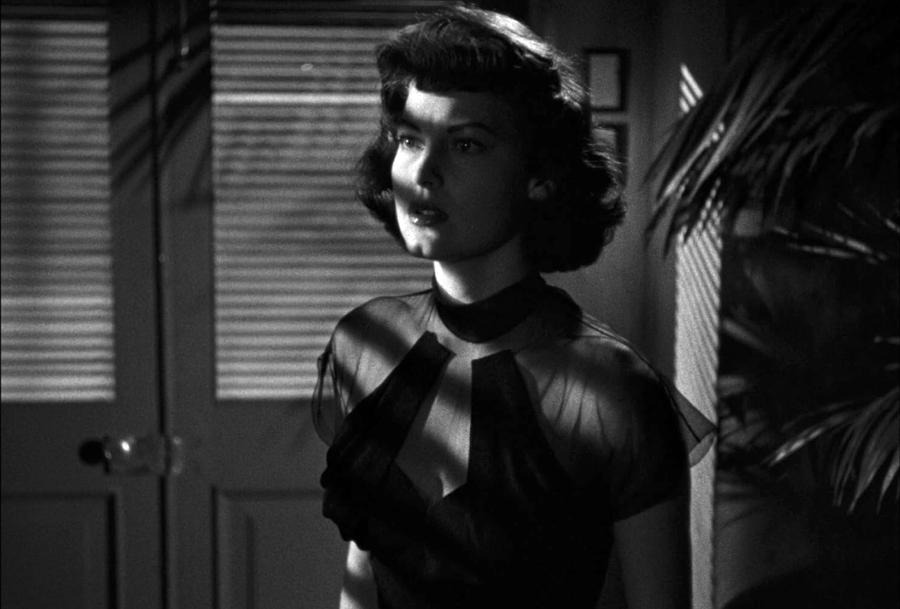
In an essay in the booklet included in the boxset Philip Kemp focuses on Brahm as director and he suggests that this film resembles Casablanca from 1942. It’s less successful than the original he argues but still has worthwhile qualities. I’m not sure I agree with the Casablanca connection. The crucial difference is that the earlier film took place in Morocco controlled by Vichy France and amidst a community of migrants, non-combat Americans and Nazis. Singapore is a British colony before and after the Japanese occupation and the story is about criminality rather than escaping to freedom. I’m not sure that it is a film noir either, although the flashback structure, the voiceover and some of the photography would suit a noir. The same might be said of other titles in the boxset despite the title of the collection. I suggest that in Hollywood terms this is more an ‘adventure romance’. Linda (Ava Gardner) has no back story and she has only known Matt for a few weeks at most. There is certainly a sense of romance about their planned marriage but Matt is also a smuggler.
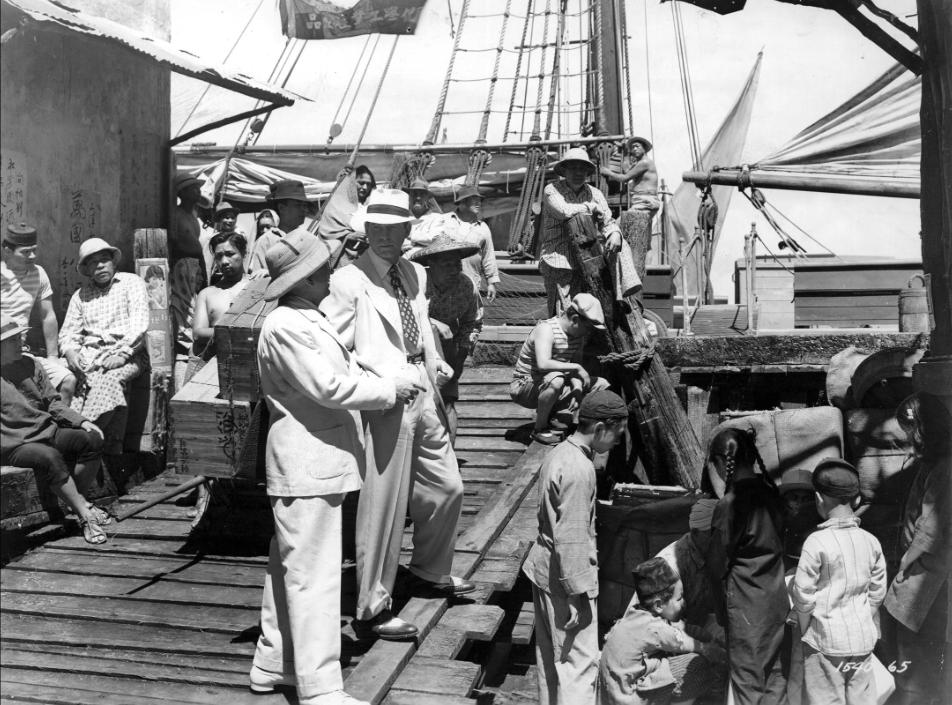
The film was, of course, shot completely in California but it’s actually rather well done and reasonably convincing with a few stock footage shots of Singapore. The two leads are strong, I think and the supporting cast as well. Gertsman’s photography is worthy of an A feature and there is a romantic score by Daniele Amfitheatrof. There are no politics as such in the script but I think in all of these films (i.e. ‘the American hero in an exotic locale’ cycle) there is a sense of an American able to have an adventure in the post-war world while all the local people are caught up in struggles to free themselves from colonialism or in the case of European colonisers to work out what to do when independence for the colonies comes along in the not too distant future. It will then be a few years later that the American hero becomes the imperialist lackey of foreign policy in the Cold War. The film did provide some employment for Asian-American extras and a supporting part for Maylia Fong as Linda’s maid Ming Ling. Singapore received mixed reviews but was generally accepted as good entertainment. I am however, intrigued to find out how it was viewed by British audiences at the time since the defeat of British and Allied forces in Singapore (and the sinking of the Prince of Wales and Repulse by Japanese fighter-bombers) had been so shocking during December 1941 – February 1942. Many men (and some women) spent the war in Japanese camps and many died, including those who worked on the construction of the ‘Burma railway’.

