
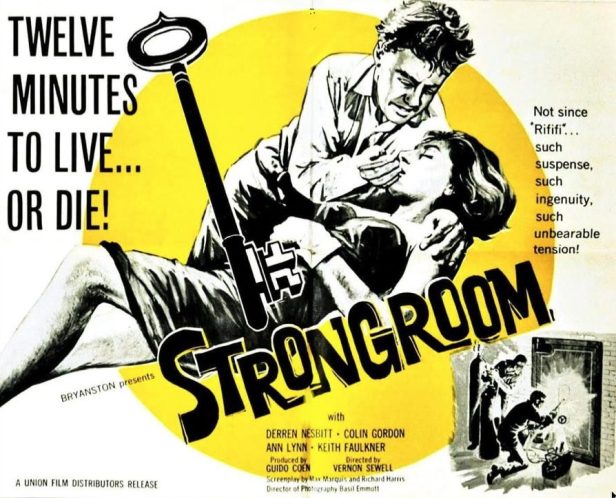
Strongroom is the perfect primer for anyone wanting to understand the British crime ‘B’ film. It’s 80 minutes of almost unbearable tension with no star names but a director-cinematographer partnership of long experience in Vernon Sewell and Basil Emmott orchestrating events. The writing team of Richard Harris and Max Marquise were in the early years of their careers but they would both become major writers for television drama. The film was produced by a small independent known as ‘Theatrecraft’ and presented by Bryanston the company which was behind a number of British New Wave features. The British Film Institute released a Blu-ray disc of Strongroom earlier this year and I was able to watch the film on the Subscription offering on BFI Player. In the April 2026 edition of Sight and Sound the disc is reviewed alongside the Indicator box set of ‘Made in Britain: Columbia Noir #7‘ which carries another Sewell-Emmott B from 1957 and three other examples of Emmott’s work.
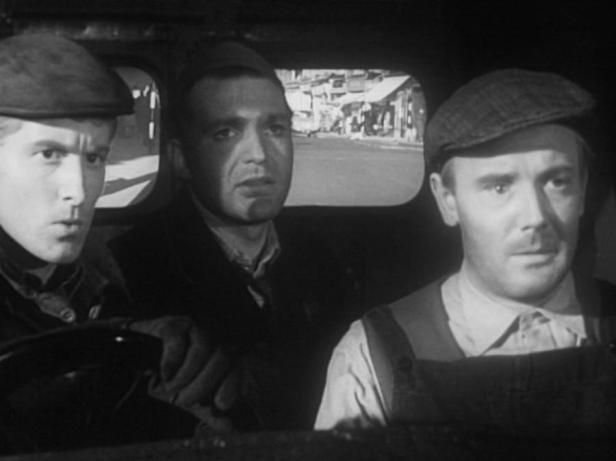
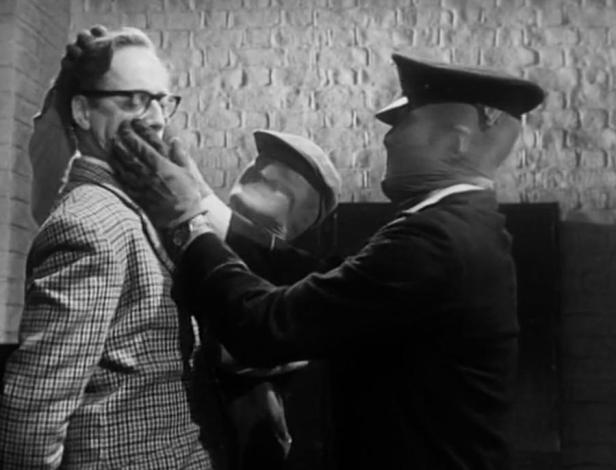
The plot outline is very simple. Three young men wait in a car opposite a bank (conveniently located close to Twickenham studios). It’s lunchtime on Easter Saturday and they are waiting for most of the staff to leave for the bank holiday weekend. They will enter when only the manager and his PA are left. These two carry the keys to the strongroom – although the trio don’t know this yet. One of the trio played by Derren Nesbitt, a familiar character actor of the period, puts on his Dad’s postman’s uniform and bangs on the bank door. The trio enter and overpower the PA and then the manager and head for the strongroom below. It seems like a carefully planned bank raid but then two cleaners let themselves into the bank. The trio panic and lock the manager and his PA in the strongroom before escaping with the loot. So now we have the suspense narrative. The trio will soon realise that the strongroom is airtight and if the bank employees aren’t discovered within the next few hours they will die. The bank holiday weekend means that they aren’t likely to be found for nearly three days.
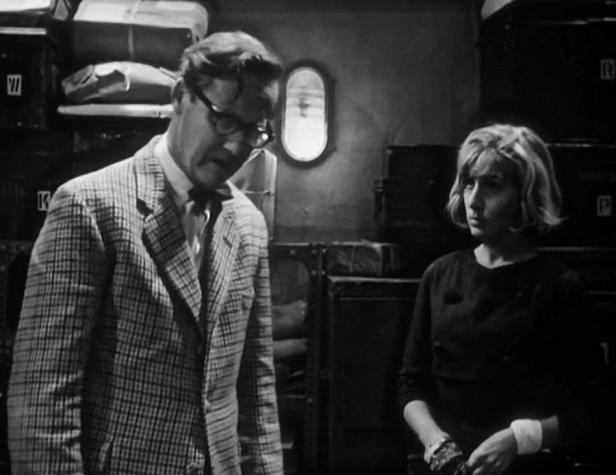
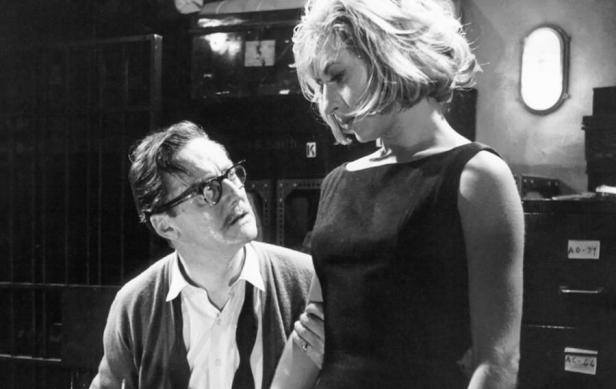
We need to know more about the three robbers and in a parallel narrative about how the two ‘prisoners’ attempt to escape from the strongroom. A third narrative strand will involve the police. The script enables this by having the robbers contrive to make the keys available to the police while they make a getaway, the suspense in this case being whether the police will find the keys and work out which bank they belong to. What’s notable here is that the individual elements of the plot are all conventional but that they mesh together in interesting ways. I don’t want to spoil the narrative suspense so I’ll focus instead on the presentation of the action. The trio of robbers are always likely to squabble with two versus one but the script teases us with two brothers who could easily fight each other rather than teaming up against the Derren Nesbitt character. Similarly the manager and his PA are two very different characters. How will they react to their frightening predicament? Colin Gordon as the bank manager was one of the most respected British character actors with over 100 credits in film and television productions plus a distinguished stage career. Here he is resolutely middle-class but ‘decent’ and practical in trying to find a way out of the strongroom. It’s clear that his manner as manager has been intimidating as viewed by his PA but once incarcerated together both begin to understand each other’s qualities. the PA, ‘Rose Taylor’ is played by Ann Lyn, who was also a well-respected character actor and perhaps a little more than that. She is a revelation for me in this role and I’ve recently seen her in other roles. Checking her credits I realise I must have seen her in several TV roles and I now remember her as the wife of the Earl Cameron character in Flame in the Streets (UK 1961). In Strongroom, Rose seems a modern young woman who was expecting to spend her Bank Holiday on a solo trip to the seaside and then reveals what she has learned on other holidays that might be useful in the crisis she faces. Ann Lynn, like Colin Gordon, had a stage career and went on to just 100 film and TV appearances. As one of her obituarists put it, her serious demeanour made her more suitable for roles in crime and social realist/’kitchen sink’ productions rather than the more sensational and ‘shocking’ films featuring young women in 1960s British cinema. Lynn met Anthony Newley when she was eighteen, eventually marrying him but it was a difficult relationship. His links to film producers (especially via Warwick Films) may have helped her career but she suffered in other ways including abortions and a child with spina bifida who died after only six weeks. I won’t have forgotten her when she turns up next in my British cinema explorations.
Besides Vernon Sewell and Basil Emmott, there were other important crew members. John Trumper was an experienced editor across the 1950s and the sound designer was Stephen Dalby whose illustrious career included work at ATP/Ealing from the mid-1930s until the studio closed in 1959. He was the genius behind the sound in films like The Man in the White Suit (UK 1951). Strongroom has only around half a dozen locations/sets and most of them are quite tight in small rooms or confined spaces such as the car in which the robbers wait. The sound design and use of silence as well as music by John Gregory are supremely important in building the tension, complementing the black & white imagery and the confining Academy ratio (1:1.37). The performances, the editing, Emmott’s photography and Sewell’s direction maintain the tension throughout. The film cost just £17,000 to make (source Duncan Petrie’s 2017) article on Bryanston available on the York University Research pages). It’s this kind of taut economical B picture that restores my faith in filmmaking.
 itp Global Film