
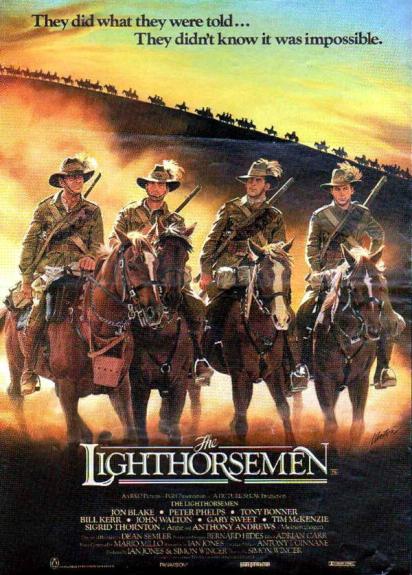
During the First World War, the still relatively new independent countries of Australia (1901) and New Zealand (1907) sent significant armed forces to join the ‘British Empire’ war effort against the ‘Central Powers’ of Austria, Germany and Turkey. Anzac (i.e. the Australian and New Zealand Army Corps) troops suffered heavy losses in the failed British-French campaign in Gallipoli in 1915 but Australian Mounted troops played an important part in the success of campaigns in Egypt and Palestine, culminating in the capture of Jerusalem, late in 1917. The war effort was seen in both Australia and New Zealand as influential in developing a sense of national identity and in the 1980s, three films were made in Australia which in different ways explored this sense of identity presented through stories of military action. Peter Weir’s Gallipoli (Australia 1981) followed Bruce Beresford’s Breaker Morant (Australia 1980) which dealt with Australians fighting with the British Army in the Boer War.
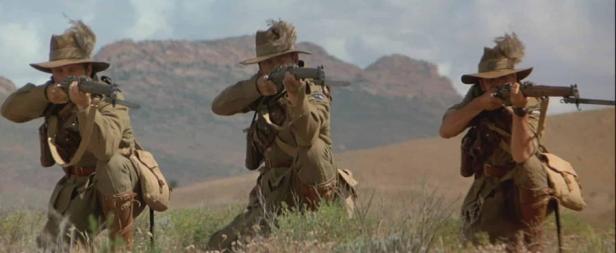
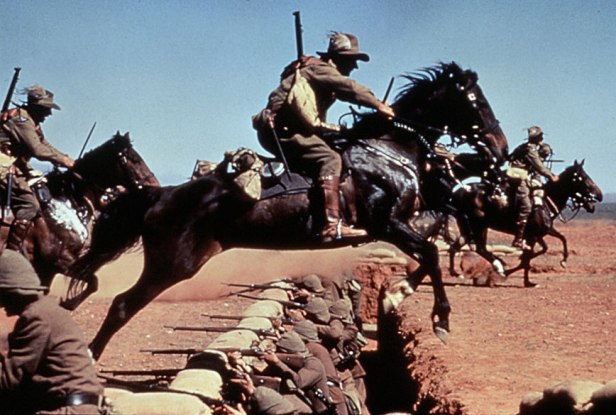
The ‘Lighthorsemen’ were the regiments of the Australian Light Horse who were not cavalry in the 19th century sense but mounted infantry who rode into battle but dismounted to confront the enemy. Ironically the success of the Light Horse in Palestine was actually achieved through a cavalry charge. The film narrative is largely based on historical record and the characters are based on real people as revealed in the closing credits. This was the third film made about the decisive battle officially known The Battle of Beersheba on October 31st, 1917, a key moment in the larger third Battle of Gaza (the British having already failed twice). Success at Beersheba allowed the British Empire forces to advance on Jerusalem and in effect to secure Palestine. An earlier film 40,000 Horseman (Australia 1940) was directed by Charles Chauvel, the nephew of one of the senior officers of the Light Horse in Palestine. The film was successful both in Australia and overseas. The Lighthorsemen of 1987 was directed by Simon Wincer, who had earlier made a successful horse-racing drama, Phar Lap (1983). There were hopes that his film about the Light Horse would also do well and Wincer had a relatively large budget including some Hollywood investment. It was made in ‘Scope and the photography by Dean Selmer was highly praised he was clearly familiar with John Ford’s cavalry pictures. (Wincer and Semer both later worked on other films featuring horses.) Although The Lighthorsemen was commercially successful in Australia, it generally didn’t make money in the UK or US (although the final battle sequence was widely praised). The original Australian cut of 131 mins appears to have been reduced to 115 mins in the UK and US.
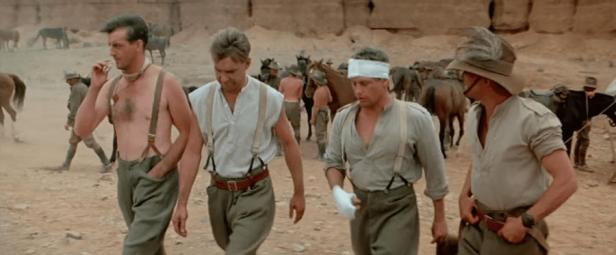
There seem to be two main reasons why the film failed to reach expectations outside Australia. Many critics refer to the lack of stars. Whereas Weir’s Gallipoli starred a young Mel Gibson and Breaker Morant (about Australian horsemen in the Boer War) featured Jack Thompson and Bryan Brown, The Lighthorsemen had no stars among the four central characters. The second weakness identified is the script by Ian Jones. I’m not sure what was cut from the overseas prints but the lack of stars is compounded by the seemingly unbalanced approach to representing a four man ‘unit’. The narrative picks out a young man who is first seen as a farmer’s son who joins up after he sees a train carrying horses for the Light Horse racing through his locality. However, we have to wait some time before he joins one of the four-man units to replace a man who has been shot in a skirmish. Dave (Peter Phelps) turns out to be a good horseman and a crack shot but he shows a weakness that threatens his three partners – he can’t pull the trigger and kill the enemy. He will prove his bravery but he will be moved to the Ambulance Unit. Dave is the only character presented as ‘fully-rounded’ out of all the Lighthorsemen and in a sense he needs to feature in all the conventional scenes assigned to the hero, such as getting injured and being tended by a nurse in a field hospital. Their relationship will also bring them both to play a part in an intelligence ruse which is key to the success in the Battle of Beersheba. This sequence features Anthony Andrews as a rather camp British officer who has an idea about how to fool the Germans and the Turks. I did wonder at first if he was based on T. E. Lawrence (‘Lawrence of Arabia’) but the end credits suggest this was based on another ‘real’ person. All of this means that the other three/four men in the Light Horse unit don’t have such important roles, although they each feature in skirmishes or the final charge.
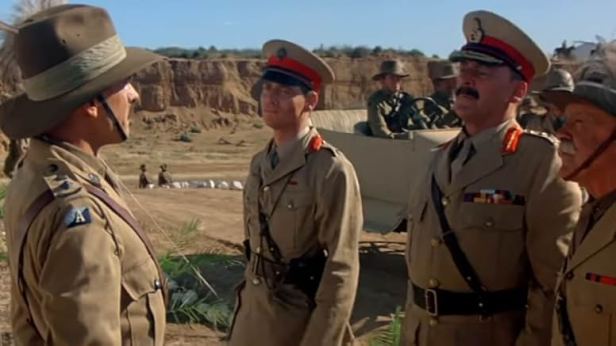
The other major issue in the narrative structure is that the final section, the attack on Beersheba which is so brilliantly executed, tends to to mean that the earlier sequences building up to the battle are perhaps rendered less exciting. The point here is that like Gallipoli this film will suggest that the senior officers, all British, lack imagination and adaptability to the desert conditions. Also they don’t really understand the potential of using the Light Horse in battle and therefore tend to underestimate the Australians as a fighting force. The script actually emphasise this by showing the Germans (who because of their air power and other technologies to some extent direct the Turkish forces) recognise the British failure to use the Australians effectively. The ‘anti-pom’ rhetoric is not as strong as in Gallipoli but the story does require the British commander to be replaced by a more flexible Brit who in turn is forced to use the Australians in a way that brings out their best qualities. I won’t spoil what happens in the battle itself but it is certainly spectacular.
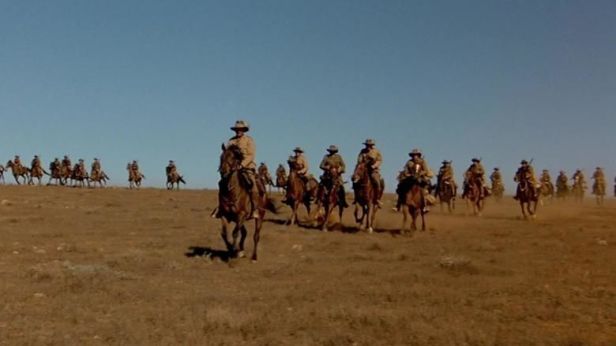
I can appreciate that for a general audience the criticisms of the film are perhaps well made, but for anyone interested in a relatively under-represented aspect of the First World War and in an example of identity-building in the Commonwealth of Australia, I think it works well. I enjoyed the film very much. The clip below shows an air attack on the resting Light Horse in their tented camp and the attempt by ‘Dave’ to save horses.
 itp Global Film