
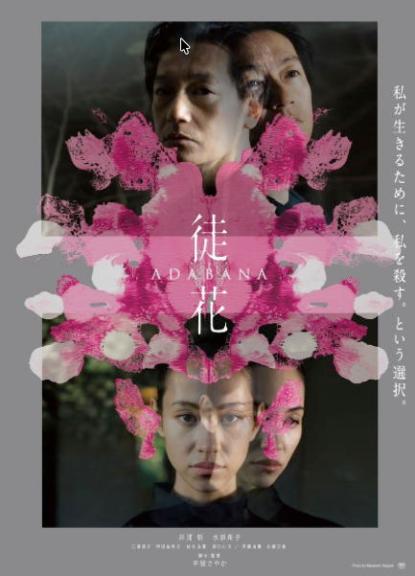
The Japanese Foundation Film Tour is an annual event in the UK that offers a range of films from Japan, mainly recent but sometimes classics, presented in specialised cinemas. Over the years I’ve watched these prints in Manchester, Sheffield, Leeds and Lancaster and once in Halifax I think. During COVID lockdown in the UK the tour moved online and I was able to watch many more films than usual. This year I again went to Lancaster to see Adabana. This proved to be a science fiction/speculative fiction (SF) film dealing with ideas that have informed several other films over the years but here with a new angle, I think, and the presentation is also quite original. The film comes from writer-director Kai Sayaka and the screening was prefaced by a short filmed introduction by Ms Kai. I understand that she attended other screenings in person and conducted a Q&A. At the Dukes in Lancaster we were given some notes written by Dr Anton Bitel before the screening.
The premise of the film is that in a near future Japan there is an outbreak of viruses which are cause early deaths for many people. A private health company has developed a programme which enables wealthy clients to have themselves cloned and their clone lives in the company’s facility until the point when the client is threatened by a virus. The company will then offer the client the chance to ‘possess’ the clone body through a form of transplant. The clones are referred to as ‘units’ in an attempt to emphasise their functionality and to deny any sense of their ‘humanity’. At the beginning of the narrative we see a woman with a young child trying to enter the system but she is rejected because of discrimination against people of lower social classes. The whole scenario is familiar from novels and films such as Never Let Me Go (UK-US 2010) the adaptation of Kazuo Ishiguro’s novel by Mark Romanek. This is the most obvious link but others are also available and several of the films inspired by Philip K. Dick’s stories deal with the ideas of ‘replicants’ or ‘androids’. Although these are not quite the same as ‘clones’, they still raise the central question of what makes something or somebody ‘human’?
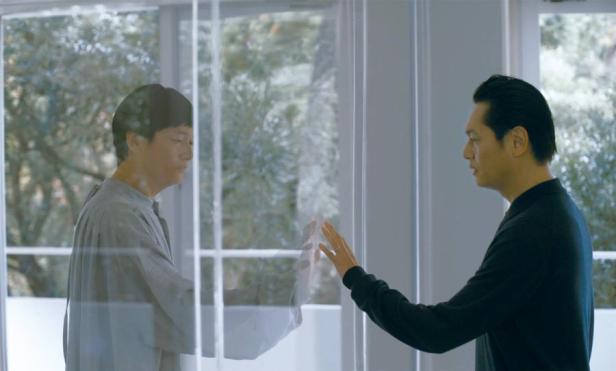
The setting of the ‘facility’ and its presentation on screen strikes me as important. The film is presented in the aspect ratio of 1.66:1. This was introduced as early as 1953 to widen the original Academy ratio by masking the full frame and slightly enlarging (‘blowing up’) the image without the use of new lenses or anamorphic squeeze. This ratio remained popular in Europe for many years and this Japanese film is officially a co-production with France – a common feature of independent cinema in East Asia which France has long supported. With modern digital film, any ratio can be arranged relatively easily so there are more films now returning to these ‘boxy’ screen shapes. In this case audiences might feel that there is a sense of classical 1950s Japanese cinema being invoked. Alongside the choice of screen ratio Kai has decided on a quite austere sound mix and there are seemingly quite long passages inside the facility without music. Similarly the architecture and décor within the facility express an austere feel. However, this is done by replacing the sliding panels and doors of classical Japanese buildings. Also instead of the plastic and chrome of modern health facilities, some of the rooms are furnished with wooden furniture more familiar from twentieth century settings. The facility is located in a wooded area and there appears to be an entrance through an old tunnel from the woods. At points rather than offer a realist representation, Kai has the ‘units’ represented by small roughly made figurines. There are also some scenes by the sea or lakeshore. These may be memories of the characters rather than presentations of the location.
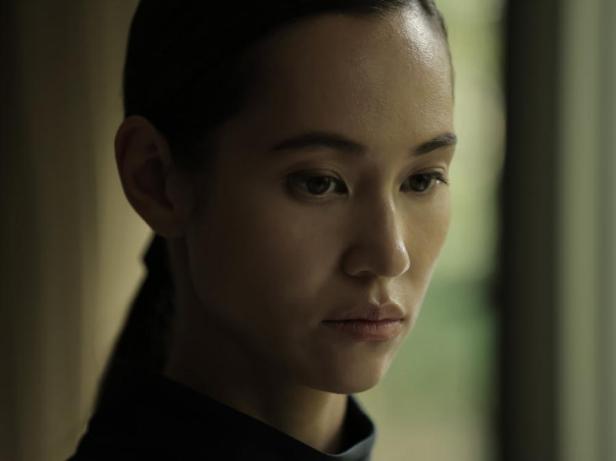
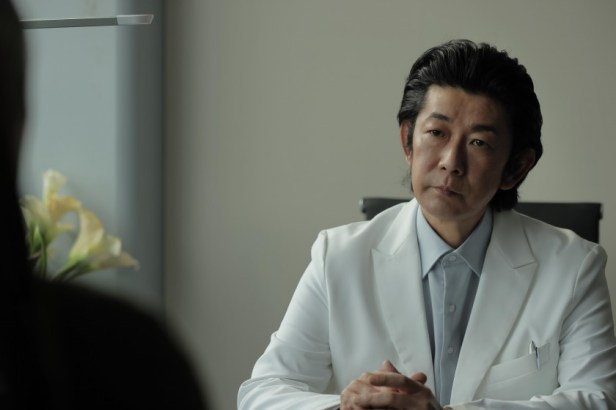
There are two central characters. Shinji (Iura Arata) has a virus and has been brought to the facility. He appears to be an investor in the company or a member of the family that owns the facility. He is offered the usual service but is also able to request more, in a sense breaking some of the house rules. He is assigned a form of counsellor/therapist, a young woman Mahoro (Mizuhara Kiko) to help him through the process of deciding how he wishes to proceed. Shinji has a wife who seems to be quite cold towards him and a young child, possibly too young to understand the process their father is going through. We get a sense of Shinji’s memories and his state of mind and these lead him to wish to see his ‘unit’ (also played by Iura). We learn that the ‘unit’ seems to be content with ‘his’ daily routine which includes arts and craft activities. Shinji is much less happy with his situation and this begins to have an impact on Mahoro. At one point, when Mahoro meets the doctor who would perform the ‘transplant’, I was left wondering how one could tell who was a ‘real’ human and who might be a combination of clone and ‘original’ human.
There is little ‘action’ in this narrative but there is tension in the meetings between human and clone and in Shinji’s memories. But the calm progress of the main narrative allows the audience to contemplate the meaning of human/humanity and how this is significantly different to that of the ‘unit’/clone. You can probably guess what Shinji decides to do. The title ‘Adabana’ translates roughly to ‘infertile flowering tree’. Given the importance of the cherry blossom in Japan this helps to raise the question of whether a blossom loses its beauty because it cannot reproduce. Or, more prosaically, does the ‘unit’ have less value as a sentient being? I thought this was an interesting SF narrative that certainly made me think.
 itp Global Film