
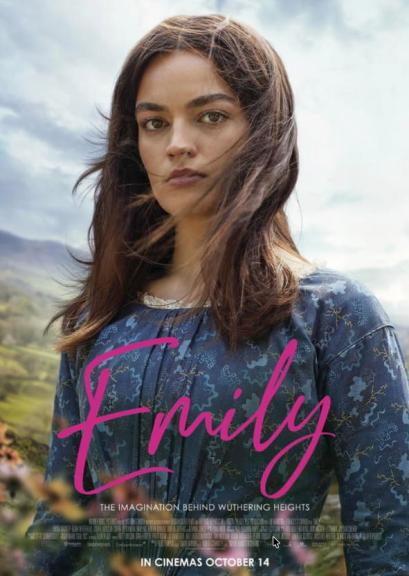
With all the brouhaha over the latest Wuthering Heights adaptation, which I don’t find an appealing prospect, I found myself exploring this biopic of Emily Brontë which the BBC are streaming on iPlayer in the UK. The film was shooting down the road in April-May 2021 just after the third COVID lockdown and somehow I missed its release in October 2022 when I had just started to return to cinemas. I’m grateful to the BBC because it’s a very good film.
I read Wuthering Heights many years ago and I live only a few miles from Haworth, visiting regularly, though not to the parsonage – although I’m told the Museum is well worth a visit. But there are two or three reasons why I enjoyed this film. Firstly, I wrote about the earlier Warner Bros. version of a similar story that was released in 1946, starring Ida Lupino as Emily Brontë. I watched this film, titled Devotion projected from an American DVD in a church close to the parsonage in Haworth. It’s not very good but the casting is strong and Ida is terrific as always. The Hollywood film was shot on a backlot whereas this recent film seems to have been shot in Haworth, Keighley, Bradford and Otley – and that was the second reason I wanted to watch it. Finally this new film was written and directed by Frances O’Connor who I remember as the young heroine in the only Jane Austen adaptation that I really rate – Mansfield Park (UK-US 1999). (This Austen narrative at least begins to explore the impact of slave trade.) Ms O’Connor played Fanny Price and the film was scripted and directed by the Canadian Patricia Rozema. I was hoping some of Patricia Rozema’s ideas would rub off on Ms O’Connor and that certainly seems to have been the case.
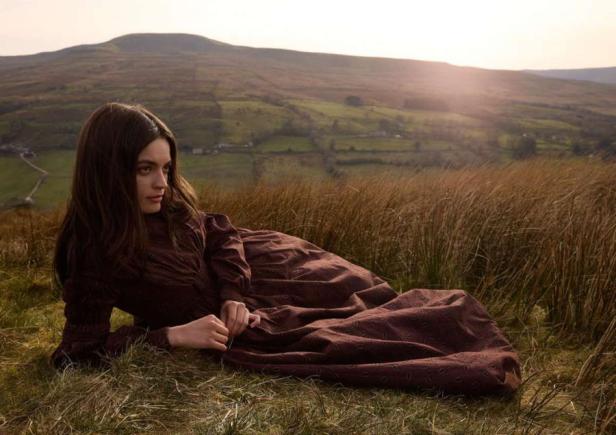
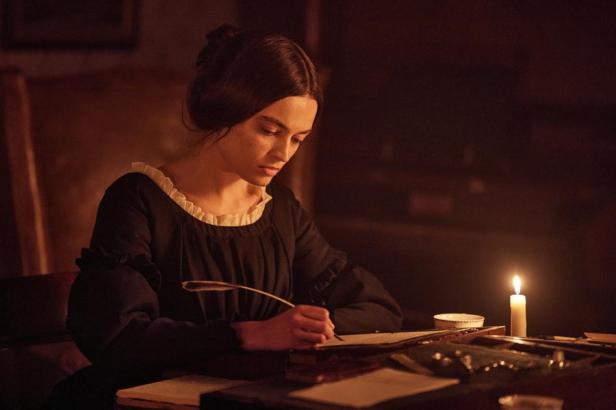
The film is presented in 2.35:1 ‘Scope ratio and it was photographed by Nanu Segal who has done a terrific job. I’m biased of course but I think she has captured shots of Pennine moorland around Haworth that work very well. It is an unusual landscape with the wind and rain and tussocks. It’s hard and somehow mournful but we love it. The other Brontë narratives that shoot in the Yorkshire Dales or the Peak District don’t really work as well for me. Much of the film comprises interiors and these are also captured well. I thought I recognised Main Street in Haworth but I’m not sure where the parsonage scenes were shot. The score by Abel Korzeniowski has been criticised in some reviews but it worked for me. It was recorded in Poland and a European sensibility seems to me appropriate for the Brontë sisters even if Emily left Haworth only briefly. I should also give a shout out for Michael O’Connor’s costume designs. I note he was also responsible for the costumes on the 2011 adaptation of Jane Eyre.
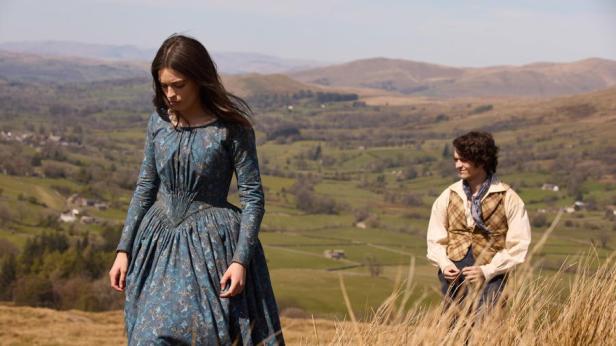
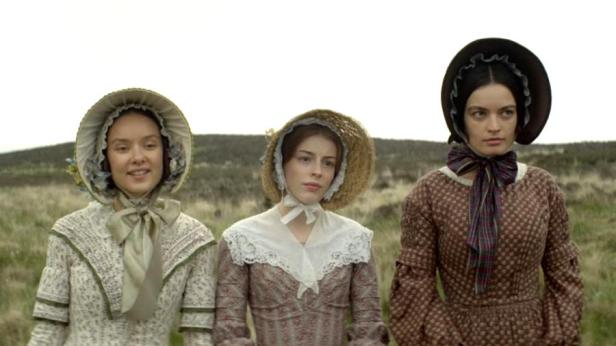
We know relatively little about the life of Emily Brontë, certainly as compared to her older sister Charlotte. We know Emily wrote poetry like her sisters and that it was well received. We also know that Wuthering Heights was published a couple of months after Charlotte’s Jane Eyre in 1847. Frances O’Connor sticks with the broad outline of what we know about Emily but she emphasises three narrative developments in particular, a couple of which seem to be fictitious. Her main aim is to present Emily as different from her two closest sisters (two older sisters died when Emily was a child). Emily is played by Emma Mackey who is taller than Alexandra Dowling as Charlotte and Amelia Gething as Anne. Mackey is very good as Emily and is often seen in isolation, especially out on the moor and in the wind and rain or alone in rooms in the parsonage. Charlotte is seen as loving towards Emily but also quite critical, adopting a surrogate mother role. Emily goes her own way most of the time but O’Connor suggests that Emily was closer to Branwell than to her sisters. Brother and sister enjoy their rebellious behaviour and this develops into one of the three developed narrative sequences. A second involves an evening’s entertainment when Emily is pressed by her siblings to use a mask kept by her father as a prop to tell stories. This gets out of hand when Emily’s performance goes rather beyond what even she has expected , signalling perhaps the excitement and danger associated with her imagination.
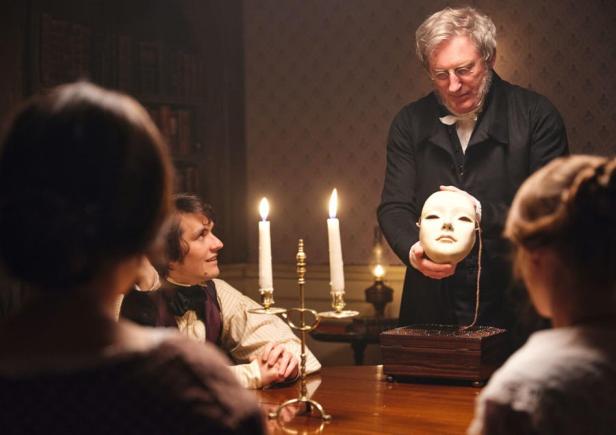
The mask episode also leads into the most substantial of O’Connor’s inventions which concerns a new curate at the parsonage. This is a little confusing because Emily’s father, Patrick Brontë is officially the ‘perpetual curate’ of Haworth, a traditional title for what was in effect a parish priest in a small community which was outside the established parishes. The new curate would be mentored by Patrick Brontë and as one of his duties he was assigned to teach Emily French (she was educated at home for most of her youth. The new curate is William Weightman (Oliver Jackson-Cohen). (Wikipedia tells me that Weightman was actually said to have had an affair with Anne Brontë.) In the first instance, as in all the best romances, Emily is unimpressed by the new curate despite the fact he is ‘talk dark and handsome’ but she eventually falls into a passionate physical relationship with him. She is able to keep this affair secret, at least from Charlotte and Anne who, after Wuthering Heights is published, both wonder how Emily could write such a passionate love story without experiencing something similar. Haworth is a remarkably unhealthy location at this time and William succumbs to cholera soon after he breaks up with Emily.
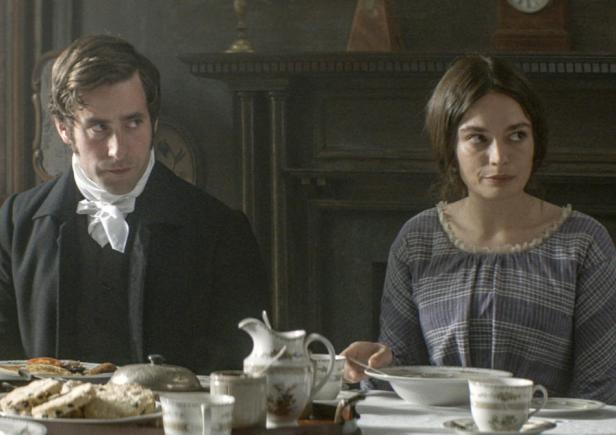
The other casting decisions including Fionn Whitehead as Branwell and Adrian Dunbar, an Irishman as Patrick Brontë also work very well. My only query about the production concerns a length of 130 minutes. I think it could be trimmed a little without losing the pacing and the necessary scenes of Emily alone on the moor. (Having said that the BBC screening is given as 121 minutes, suggesting a possible cut.) I don’t know if the length was an issue on release. I was surprised that though Warner Bros. released the film in the UK, in the US it was the smaller independent Bleeker Street with a release several months after the European opening. Overall, the UK opening was modest with low returns for a wide release and a UK total of only $1.1. million and worldwide not much more than $4 million. The Australian box office also seems modest. I can only hope that, like me, audiences have found the film online and appreciated it. It’s still on iPlayer in the UK for 15 more days from today and is available from commercial streamers.If you’d like a taste of what Haworth might have been like for the Brontës, I’d recommend this production.
 itp Global Film