
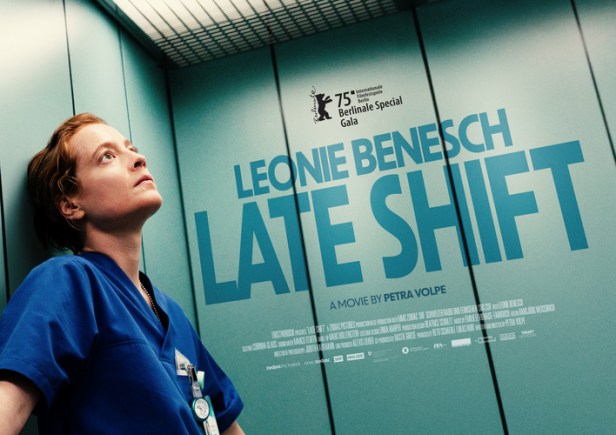
I’ve been waiting to see this since its release last year and it has been well worth the wait. The film’s German title ‘Heldin’ translates as heroine which aptly describes Floria, a senior nurse in a Zurich hospital. The English title is perhaps a little confusing. Many reviewers seem to have taken it to mean ‘night shift’ but that is mentioned as happening later. I think this shift runs from mid-afternoon into the evening. You might think that is nit-picking but when you start to analyse what we actually see it makes sense. When I think about it, what seems to be a narrative set in a specific time period is actually compressed by leaving out some of the fairly routine ‘in between’ scenes. My slight confusion is possibly because of the presentation of what seems to be a ‘documentary procedural’, at least for the first half of the film. This is emphasised by the camerawork and editing as we follow Floria from room to room and bed to bed.
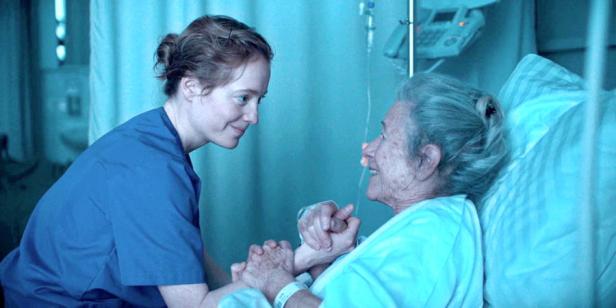
This is a modern hospital, a multi-story block close to a bus service that seems to operate very efficiently. The ‘wing’ on which Floria makes her rounds comprises a central staff ‘station’ and a corridor with perhaps twelve rooms. Most have two beds (there are female and male rooms) but one is for a patient with ‘Private Insurance’ who gets a room to himself. Each room has a large single door, wide enough to push beds through. Floria is alone in charge of the wing with just the support of a student nurse who she shares with the nurse on the other wing. The camerawork and editing (and music/sound design) present Floria’s ’rounds’ as seamless as she goes from one room to the next administering medicines, taking readings, carrying out procedures. She never stops and the camera is constantly moving. It’s breathtaking stuff partly because Floria seems able to keep up verbal interaction with her patients and to change her demeanour at will from pleasantries to instructions and encouragement and occasionally to admonishment of patients who flout the rules of the hospital. I’ve mentioned documentary but the other end of the spectrum is medical drama like the TV soap operas of hospital life that have traditionally battled with cop shows on TV stations around the world. But this is different. Staff interactions are limited and we learn just a little about many patients but none becomes ‘the story’.
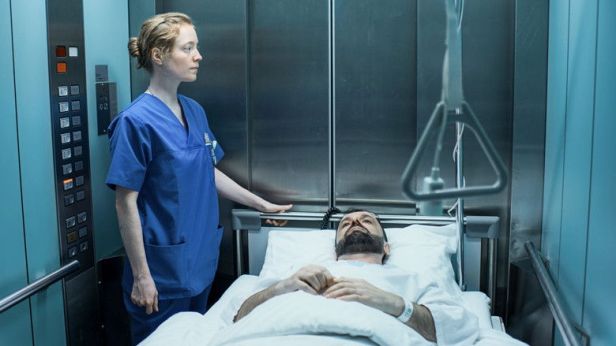
By now you’ve probably worked out that this is a narrative about the everyday pressures of nursing. Floria has been told at the start of her shift that another nurse is off sick and there is no cover. I want to spend a little time thinking about this hospital compared to the British hospitals in which I’ve spent time as a patient or as a visitor. Although I recognised several of the procedures, there seem to be some major differences. British hospitals seem to operate much more ‘open’ wards with several beds in one open space and there always seem to be staff around (except during the night shift). And I don’t just mean nursing staff. My memory is of tea trolleys and catering staff, porters to move patients, technicians to operate equipment etc. Floria has to move beds herself. Most of the patients in this Swiss hospital wing seem older or are being diagnosed or treated for life threatening conditions. Perhaps that is why it seems that smaller rooms are more important.

The second half of the narrative does have a change of tone and the creation of more drama. The shift in tone is marked by a couple of mistakes that Floria makes with medication and when she loses her temper on one occasion. She isn’t superwoman. One of the patients dies during the shift but the system overall doesn’t crash. I think this switch to more ‘drama’ might be why there are one or two reviews which go against the majority opinion which I share. This is a terrific film with a stand out performance by Leonie Benesch who carries the film just as she did with The Teachers’ Lounge (Germany 2023). I note also that she had a leading role in Michael Haneke’s The White Ribbon (Germany-Austria 2009) when she was a much younger woman. The writer-director is Petra Volpe whose career seems to have been built first on TV drama and short films and then The Divine Order (Switzerland 2017), an award-winning feature as a comedy-drama dealing with the campaign for women’s suffrage in Switzerland in 1971. She has also had her latest film Frank and Louis (2026) screened at Sundance this year so watch out for that. Volpe is also a successful writer on other features. The Late Shift is in fact a film created mainly by women and featuring a predominately female cast and crew. It is photographed by Judith Kaufmann who also shot The Teachers’ Lounge and Corsage (Austria 2022). The music is by Emilie Levienaise-Farrouch and production design by Beatrice Schultz.
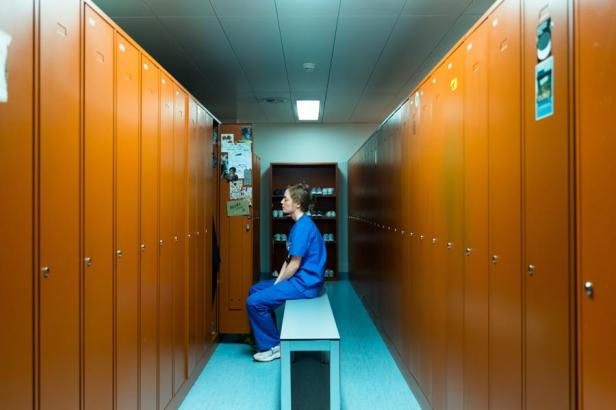
The shift itself determines the narrative structure of the film. It starts with Floria arriving by public transport and entering the locker room to prepare for the shift and then ends back in the locker room and finally on the bus/tram to head home. The first sequence in the film is actually the automated laundry line of ‘scrubs’ which signifies the efficiency of Swiss procedures (Switzerland also ranks as the country with the best rail and urban transport system). All of this in turn accentuates Floria’s humanity as she negotiates what might feel like a soul-less system. The music too seems to work to contrast with the business of Floria’s work by offering a form of melodrama scoring. I realise that at one point I thought of my favourite scoring, Michael Nyman’s score for Michael Winterbottom’s Wonderland (UK 1999). This is one of those films where you must stay until the very end which features a moving moment of fantasy as an exhausted Floria slumps on her seat on the bus. Then, as the screen goes black Petra Volpe gives us an ominous warning about the statistics for nursing recruits worldwide. The job is so demanding that new recruits leave after only a few years. Having said that, like all the great humanist films this feels like a life-affirming positive film – terrific, don’t miss it. Here’s the UK trailer. It’s streaming on BFI Player and most other major streamers in the UK.
 itp Global Film