
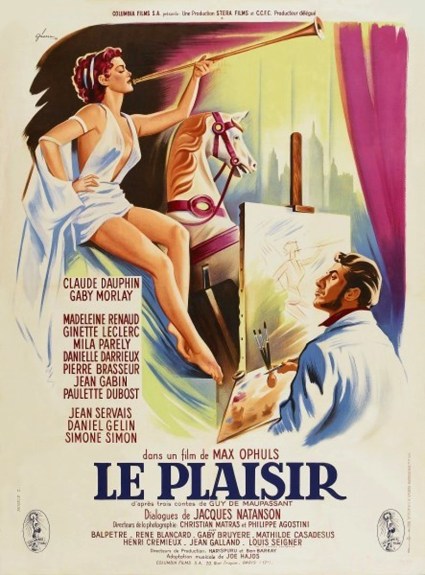
For his second film back in France following his return from Hollywood, Max Ophüls adapted three short stories by Guy de Maupassant written in the late 19th century. The first of these is titled ‘Le masque’ and the others are ‘La maison Tellier’ and ‘Le modèle’. Each of the three stories has a starry cast and features some stunning sets as well as fine location work in the French countryside for the second story. Narration by Guy de Maupassant is spoken by Jean Servais in the French language version and Peter Ustinov and Anton Walbrook in the American and German versions respectively. Unusually in this triptych, the central story is much longer than the other two so, even though they are not directly linked, the first and third stories are like a prologue and epilogue. In thematic terms, the bookends are tales which involve some kind of loss or coming to terms with life, whereas the central tale is a joyous celebration albeit one with a similar sense of ‘acceptance’ of personal foibles.
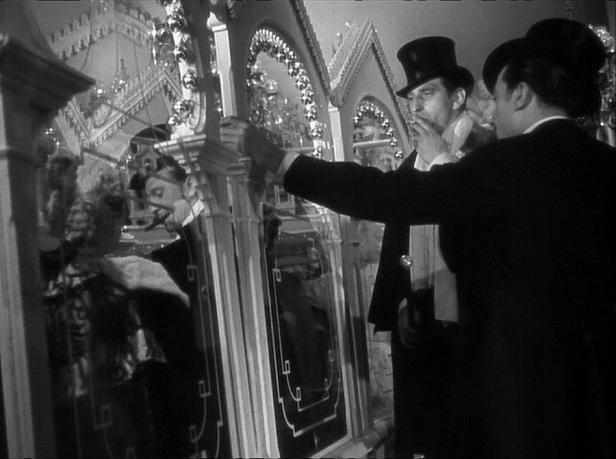

‘Le masque’ takes us to the ‘Palais de la danse’ in a Paris district. In the dark of the evening many of the men from all classes of society descend on the dance hall which is brightly lit with an interior seemingly composed of mirrors, doors and frames around dance floors, all captured by the lens of a roving camera. Suddenly a single man arrives and is soon cavorting wildly. He’s not the most elegant of dancers but he is certainly enthusiastic until he suddenly collapses. A doctor is called and we realise that the man is wearing a full face mask that creates the illusion of a young man with a white painted face. When the doctor cuts him free of the mask and his tight clothes, a rather different character is revealed and after the doctor takes him home we learn his story. ‘Le modèle’ is a similar simple story about an artist who one day sees a young woman walking by and, captivated by her walk (and her figure and beautiful face), he runs after her and persuades her to pose for him. The couple fall madly in love but it is soon evident that the marriage is not going smoothly and the couple separate. But they cannot forget each other and the young woman wants the artist back. They are driven to a crisis but I won’t reveal what happens.


In the central story, ‘La maison Tellier’ is a brothel in a small town on the Normandy coast. With more time for the story we get to see the brothel and its clientele at night-time. We don’t, however, get inside the brothel. We can see some action through the windows and we are essentially situated as voyeurs (though not of any sexual activity). Like the dancehall it is a ‘house of pleasure’ and attracts many of the men in the town as well as sailors from the port. The activities of the house are presented as ‘joyous’ rather than sordid, presided over by the strict madame Tellier. But one night the light over the door isn’t lit and the house is closed. The men of the town are devastated but the closure is only temporary. We see the madame and her ‘girls’ catching the train the next day and heading for a country halt where they are picked up by a man in a cart and taken to a village. He is Madame Tellier’s brother, a carpenter, and his daughter is about to take her first communion. The next day sees the communion service and a large family dinner outside before the women from the brothel must return to business by nightfall to the relief of the men of the town.

This is one of the those now rarer occasions when the ‘extras’ on the Second Sight DVD are really helpful in getting the most out of a film. There is an introduction by Todd Haynes, himself a great director of melodramas. He expresses his admiration for the skill of Ophüls and his DoPs, Christian Matras for the first two stories and Philippe Agostini for the third, in presenting the fluid camera movement that characterises most of Ophüls’ work but in this film reaches the heights. Of course the success of this camerawork, which often hovers outside the windows and doors of a building and ‘sees’ inside as well as sweeping through walls and following characters from room to room, is dependent on the fantastic sets designed by Jean d’Eaubonne and decorated by Robert Christidès. Haynes makes the important observation that in this film, as in many melodramas, the interior is of the woman’s world and the exterior is the man’s world. This is most obvious in the long central story and in the first story set in the dance hall. The second valuable ‘extra’ is a talk by Jean-Pierre Berthomé in which he explains that the production changed producers part way through the shoot and the new producers would not allow Ophüls to shoot the third story as scripted. It included a scene in which a young woman breaks up with her boyfriend and is seduced by one of a group of lesbians. In 1950 this proved too much for the producer’s sensibility. Ophüls was forced to find another de Maupassant story and to shoot it quickly.
This was a film that I bought on DVD several years ago but didn’t watch all the way through. I can’t remember why I stopped watching it. Now, when I’m researching Ophüls, I find it to be a masterpiece, not just because of the amazing tracking, crane and dolly shots but also because of the humanism in the stories and the all round excellent performances. I’ve always enjoyed the films of Max Ophüls but this film proved to me just how good he was as a director of costume melodramas. The two shorter narratives are perhaps ‘slighter’ as single narratives beautifully presented but the central story has several different elements. It suggests that the ‘House of Pleasure’ has an important societal function helping to keep ‘order’ in the town and also as a commercial attraction for sailors which brings income into the town. A modern viewer has to remember it is a nineteenth century narrative which accepts that French men are not necessarily to be criticised for escaping the family home once a week to enjoy the charms of Mme Tellier’s girls. But the narrative also has the time and space to explore the camaraderie of the ‘girls’, especially on the train journey and the cart ride through the meadows. The communion service and the family dinner are also a delight. One of the women, Rosa (Danielle Darrieux), is the focal point of another narrative thread when she becomes an object of desire for Mme Tellier’s brother, Joseph Rivet (Jean Gabin). Rosa does not respond, partly perhaps because she is a leader of the five women employed by Mme Tellier. Perhaps also because she recognises that the trip is about the purity of a first communion. Mme Tellier is strict in marshalling the women and ignoring her brother’s calls for them to stay a little longer. She’s adamant they must catch the 3.55 pm train to be back to open the ‘House of Pleasure’.

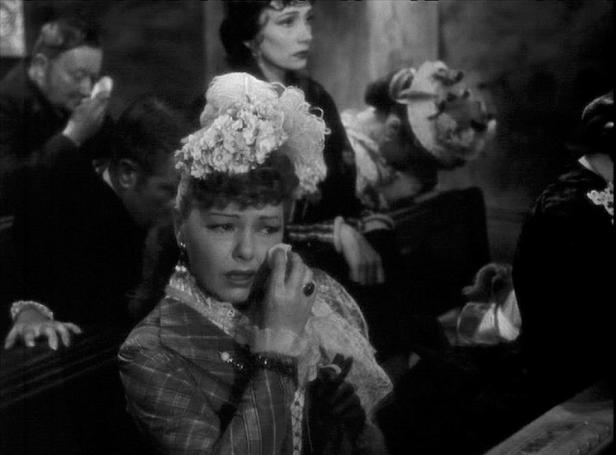
Watching the central story again I was struck by how much the trip into the country reminded me of Jean Renoir’s Partie de campagne (1936), literally ‘a trip to the country’. In fact both were de Maupassant stories included in the same volume of short published in France in the 1880s. This central story is so much longer and more rich in meanings it makes me think of other readings that are perhaps less about the usual concerns of Ophüls. The scenes in and around the village and in the church for the First Communion are both finely detailed studies of the village v. town and tradition v. modernity binarisms so common in narratives from the mid-19th to mid 20th century. Ophüls imbues these scenes with a real sense of emotion, especially in the church where Mme. Rosa starts off the round of crying.
I’m going to write about some more Ophuls films over the next few weeks. I’ve already posted on The Trouble With Money (Netherlands 1936) and La ronde (France 1950) and there are more to come and also a dedicated Ophüls page. The best trailer I could find for Le plaisir is without subs but it is very good in presenting the visual splendour of Ophüls:
 itp Global Film