
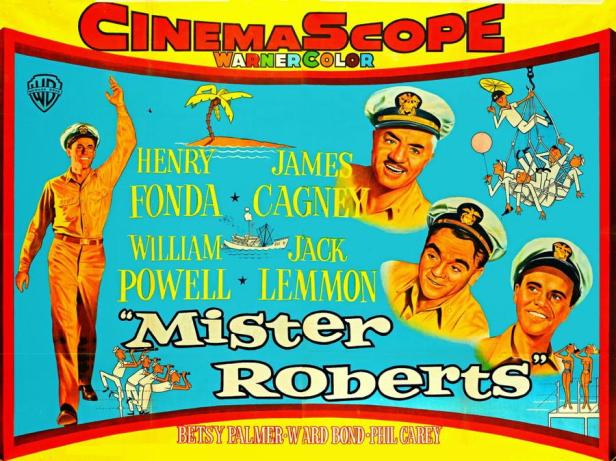
One of two films that John Ford made in CinemaScope in 1955 (The Long Gray Line was the other) Mister Roberts was recently screened in Bradford’s Widescreen Weekend. I thought about going to see it but I knew something about the problems with the production and decided against it. A week later, with storm ‘Amy’ restricting local activities I decided to try to find it online. It isn’t available on streamers in the UK but I found a good print and now I can add it to my list. It’s not a great film but it’s interesting and raises questions. I was surprised that at the time it won an Oscar and received other awards and nominations. However, it was, and remains, popular with audiences in the US and spawned a later TV series and TV movie (all based on the original property) plus a sequel, Ensign Pulver in 1964. The film was financially a great success for Warner Bros. but in this post I want to explore the problems in the production and what it meant as an entry in Ford’s long list of credits. But first here’s a brief plot outline.

Mister Roberts is an adaptation of a Broadway stage play (in turn an adaptation of a 1946 novel) about the tensions aboard a US Navy supply ship in the Pacific towards the end of the Pacific War in 1945 (VE Day occurs during the narrative). It is ostensibly a ‘service comedy’ with most of the action confined to the inter-relationships of the four officers on the ship and the antics of the rest of the crew which are driven by the conflicts between the captain and his officers. There are also elements of drama but the comedy is seemingly expanded for the film. The Caine Mutiny (1954) was a successful drama with Humphrey Bogart as a wayward captain the year before. In this case the captain is played by James Cagney and ‘Mister Roberts’, his second-in-command, is played by Henry Fonda. William Powell as the ship’s doctor and Jack Lemmon as ‘Ensign Pulver’ are the two other officers.

The basis of the comedy drama is that the ship is kept far from the action in the war and its duties comprise in the words of Lt Roberts “journeys from Tedium to Apathy and back again with occasional diversions to Monotony”. Roberts wants to see action on a destroyer but Cagney’s Captain doesn’t want to lose him and refuses to approve any of his letters requesting a transfer. Roberts is the cargo officer and his efficiency has won the Captain a prize of a potted palm tree. The Captain was once in the Merchant Marine and he is driven to maintain and hopefully improve his status. He rules his ship mercilessly and the crew are forbidden any liberty ashore or freedoms on the ship as he strives for perfection. Roberts finds himself caught between the men, who he tries to protect, and his captain. The ‘Doc’ simply tries to keep his own sanity and Pulver tries to keep out of the captain’s way until he is forced into the open in the second half of the narrative.

But why did Ford want to direct the picture and what went wrong so that two other directors completed the shoot and the studio supervised the edit? I’ve read around the production and I’m using the two main books on Ford by Tag Gallagher and Joseph McBride as well as other material. The first surprise was to see Ford working with Warner Bros., as far as I know for the first time. He began his career with Universal and then worked mainly with Fox/20th Century Fox, Columbia and RKO plus Republic and United Artists. He was well-known for ‘editing in the camera’ and basically getting his own way. But on this shoot he was a gun for hire, working just for a flat fee. Warner Bros. had bought the rights to the play and the play’s director Joshua Logan wanted to direct himself, but his producer Leland Hayward persuaded Warners to go with Ford, arguing that Ford guaranteed good box office. Logan got a screenplay credit but was miffed and took against Ford. Why did Ford want the job? In many ways it was right up his street. Nobody in Hollywood knew the US Navy like Ford (he had made two Oscar winning documentaries for the Navy during The Pacific War and he was made a Rear-Admiral). He had already made They Were Expendable (1945) about MTBs in the Philippines and earlier The Hurricane in the Pacific (1937) and he sailed the Pacific himself in his own ship ‘The Araner’. Added to this, Ford was able to cast his own stock company regulars including Ward Bond, Harry Carey Jr., Ken Curtis, Pat Wayne, Danny Borzage, Jack Pennick and others. He’d worked with Cagney before on What Price Glory? (1952) and he’d chosen Jack Lemmon after a screen test for The Long Gray Line. He also had Frank Nugent for the screenplay and Winton C. Hoch as DoP. What could go wrong?
Ford’s health was becoming a problem at this point and his home life was causing concern. His family had been forced to move home and his beloved ‘Araner’ had needed repairs so money was tighter than usual, but the biggest potential problem was Henry Fonda who had been Ford’s leading man on several films from 1939 to 1948 when he was cast against type and opposite John Wayne in Fort Apache. Fonda hadn’t appeared in feature films since Fort Apache and he had played Mister Roberts on stage for nearly four years. He seems to have believed the stage adaptation should have been more of an influence on the film, especially the dialogue and it is suggested he wanted Logan to direct the film. Added to this he believed that Ford and his close colleagues such as John Wayne and Ward Bond had moved further right in their politics and Fonda himself was more ‘progressive’. And indeed it came to pass that Fonda and Ford fell out quite badly. Cagney too became a problem. Ford broke his own rules about drinking in working hours and this affected his direction. He was off the set for a few days but when he returned he became seriously ill with a gall bladder problem. Warner Bros. then brought in Mervyn LeRoy the trusted ‘house director’ to replace Ford. Leroy seems to have tried to match Ford’s completed work and not to go in a different direction but it seems that at the end of the shoot Joshua Logan stepped in and shot some extra material as well as taking out some of Ford’s scenes. Warner Bros. then re-inserted some of that material. Ford and LeRoy were credited as directors but Logan was only credited with a script contribution (he would go on to direct films such as Picnic (1955), Bus Stop (1956) and South Pacific (1958) as well as others).

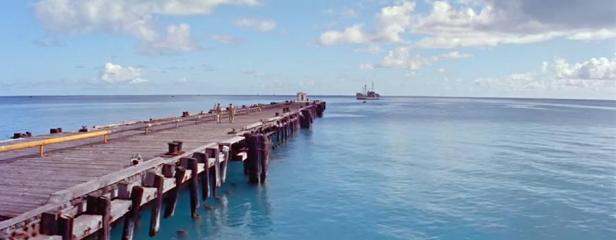
The reviewers of the film do not seem to have noticed the three contributions as distinct or else they claimed that the acting skills of the cast covered up the ‘joins’. I would have to disagree. I did most of my digging after watching the film. I knew about Fonda’s misgivings before watching the film but not the other details. I did feel that I could recognise the Ford scenes when I watched the film – the exteriors shot on Midway and elsewhere in the Pacific. The usual Ford compositional eye is evident, even in the relatively new ‘Scope framing and as Gallagher suggests, Ford’s scenes are livelier. LeRoy was a competent but not visually inspired director. Ford didn’t take to ‘Scope and in 1955 he was working with the widest possible aspect ratio for CinemaScope of 2.55:1. This was because 4 track magnetic sound was on a separate film reel allowing a larger image. In 1956, though he was still in a relationship with Warner Bros. he was able to shift to Paramount’s answer to ‘Scope, ‘VistaVision’, which gave more high resolution images and was adaptable for a variety of aspect ratios for The Searchers (1956) which was generally shown at 1.85:1 or possibly close to 2.00:1.

I’m not sure what to make of Mister Roberts. I didn’t find it particularly funny. That’s a shame because I think Ford wanted to make a comedy and there are moments in the film when the ensemble playing of the Ford stock company generate a real vitality. Ford chose Lemmon who went on to win the Best Supporting Actor Oscar. I found Lemmon immensely irritating on this film so I find myself in disagreement with American reviewers and Oscar voters in the same way I did with Kieran Culkin in A Real Pain (US-Poland 2024). Otherwise it may simply be that the three different directors just makes the film feel disjointed. Most US reviewers liked it and certainly audiences did, but for me it doesn’t pass muster as a John Ford film. Still Ford survived and went on to make The Searchers, perhaps his best film, a year later. No decent trailer for Mister Roberts seems to be available but there are plenty of clips. Here’s the scene in which Cagney’s Captain finally meets his junior officer, Ensign Pulver.
 itp Global Film