
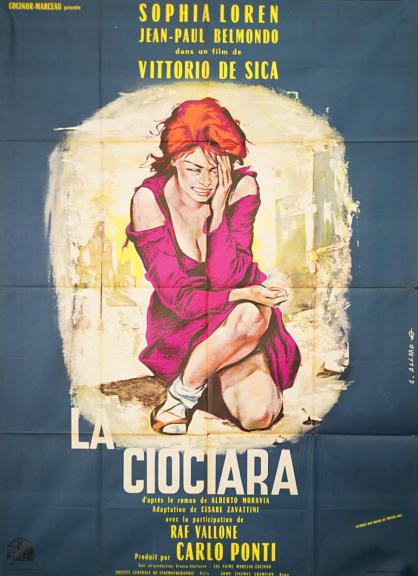
Vittorio de Sica was responsible for Bicycle Thieves (Italy 1948), which has since inspired first-time filmmakers around the world by demonstrating how to create a neo-realist film with a story taken from the streets and recognisable by popular audiences everywhere. Twelve years later he directed Two Women which some critics view as another neo-realist film. I’m not sure that is necessarily a helpful reference. De Sica dominated Italian cinema in three different ways. He was initially a star performer in 1930s melodrama (and an actor again from the 1960s). As a director of neo-realist films in the late 1940s he also made Shoeshine (1946), Umberto D. (1949) and Miracle in Milan (1951). From 1960 he made more mainstream commercial pictures with major stars and bigger budgets. Two Women was the first of these with Sophia Loren and Jean-Paul Belmondo as well as Raf Vallone in a smaller part. For this film he ventured into narrative territory first navigated by Roberto Rossellini in his neo-realist films Roma citta apertà (1945) Paisà (1946) and later in 1960 in Era notte a Roma. This was the period following the Allied invasion of Sicily and then mainland Italy in 1943, when many Italians found themselves caught between the Fascist militias and the partisans and the Germans and the allies. De Sica returned to work with his long-term collaborator scriptwriter Cesare Zavattini who helped him adapt an Alberto Moravia story from 1957.

I enjoyed Two Women very much but I found it an odd film in some ways. For instance, the opening credits sequence takes place against a series of still photographs of a city (Rome?) going about its business during wartime when Mussolini is firmly in power. These are marvellous images, teeming with life and detailed crowd scenes. But relatively few of these scenes are representative of the whole narrative of the film which is mainly set in the hills and small villages of Lazio, some distance from the centre of Rome. After reading several reviews I found one on ‘Senses of Cinema’ by Gwendolyn Audrey Foster in which she gives some background to the production. The rights to Moravia’s novel were acquired by Carlo Ponti who entered into a co-production deal with Paramount to make the film with Anna Magnani as the mother, Sophia Loren as her daughter and George Cukor as director. But Magnani then withdrew, possibly because she worried that Ponti would favour the role of the daughter (Ponti and Loren were already married at this stage). Paramount then withdrew leaving Ponti to find the money himself, which he did through a co-production deal with a French company. This prompted the choice of De Sica as director and the casting of a young Jean-Paul Belmondo. The ‘two women’ became Loren as the mother and 12 year-old Eleanora Brown as her daughter. Loren at this point was only 25 but she is certainly credible as the mother ,appearing to be more like 30. The final twist was that the film’s American rights were then acquired by Joseph E. Levine who had already had big hits in the US with dubbed (and re-edited) versions of Godzilla (Japan 1954) and Hercules (Italy 1959). The film eventually went into Public Domain in the US and for a while only existed in the form of 16mm film prints and poor quality DVDs before more recent restorations such as that used for the BFI print. On the upside, Levine’s promotion of Sophia Loren across the US helped her to win the Best Actress Oscar in 1961.

This production context explains something about the odd feel of the film but the change of title is also important. The Italian title La ciociara, I think means ‘The woman of Ciociara’. ‘Ciociara’ refers to the rural district in Lazio which is seen to have its own distinct culture, including language, music and food. These are all evident in the film, I think but not directly commented upon. They would however, be known to the Italian audience? My overall impression is that Two Women is similar to the ‘war dramas’ that were made in several European countries (including the Soviet Union) during the 1950s and early 1960s but the focus is arguably more on the personal story of Cesira (Sophia Loren) rather than on the narrative of the Allied Advance through Central Italy and the German response.

The film begins in the backstreets of Rome where Cesira, a widow, runs a grocers shop. Rome is being bombed by the Allies and Cesira’s daughter Rosetta (Eleanora Brown) is frightened by the bombing. Cesira decides to leave Rome with her daughter and she gives the key to her shop to the fuel merchant Giovanni (Raf Vallone) for safekeeping. Getting away from Rome is difficult with the railways disrupted by the bombing. Eventually the ‘two women’ are obliged to walk into the hills towards Cesira’s home village. When they finally arrive, she is welcomed back and finds somewhere sleep. The people of the village are mainly concerned with keeping hold of their food and keeping out of the way of the Germans. Among the villagers are the poor and the rich, Fascists and anti-Fascists. Michele (Jean-Paul Belmondo) is the odd one out as an educated young man and a communist. He is attracted to Cesira despite her lack of education and very practical/pragmatic approach to her situation. Life in the hills and in the villages is about survival but is relatively uneventful until the Allied advance creates the danger of armed conflict in which the villagers might become what is in modern parlance known as ‘collateral damage’. Towards the end of the narrative, the brutality of war is shockingly evident when Cesira and Rosetta, attempting to return to Rome, are caught one night sleeping in a ruined church when they are attacked by a group of Moroccan soldiers. (The Italian campaign by the Allies included several instances of ‘atrocities’ or war crimes. The Moroccans were part of the French Armée d’Afrique during the Italian campaign.) Throughout the time spent in Ciociara the cinematography by the Hungarian Gábor Pogány makes very good use of the locations, but the final section in the church is almost expressionistic in presentation with a distinctive final image of mother and daughter.
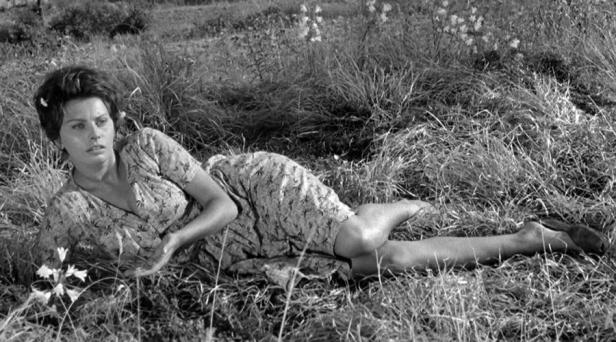
It’s difficult to imagine how the film in both subtitled and English-dubbed forms was received across America. It would have found a different audience to Rossellini’s films which were so shocking and forceful that they propelled Ingrid Bergman in Los Angeles to write to Rossellini and beg to be allowed to work with him. But the shock of Two Women is to see Sophia Loren in all her magnificent glory. She dominates the film completely, forcing her personality on all those around her until the final sequence when the brutality cannot be denied. Loren was one of the first of the new breed of European stars (and particularly the female stars) to re-vitalise American screens. I’m not sure what cuts might have been made in America but, although Two Women is not an exploitation film, Loren’s sexuality and erotic appeal is clearly evident in her performance. De Sica was a director who knew how to get the best performances from his actors. Eleanora Brown is also very good in her first film role and the young Belmondo is transformed by the spectacles he wears as a studious young man. Raf Vallone is excellent and I wish it was a bigger part. He would be re-united with Loren in El Cid a couple of years later.

Foster in her review cites the film and Loren’s central role as an example of a woman with agency in a largely patriarchal society. She goes on to claim the film as “a story of survival and triumph on all levels, and, as such, is one of the crowning glories of international feminist cinema”. I think that’s a good call. It may be a retrospective view (i.e. was feminist cinema a thing in 1960?) but it is an important observation. Loren’s performance forces us to think about the impact that the film had. Here’s a good trailer for the restored version. It has French subtitles and Italian audio but the visuals tell the story very well.
 itp Global Film