

I was reminded that I had started a post on this John Ford film when I was completing a recent post on The Last of the Mohicans (US 1992). The two film narratives share the same location, albeit some twenty or so years apart, had similar aesthetic concerns and both were actually shot on different locations for various reasons. Both films are also early examples of the Western genre.
In 1939 John Ford had three major films released at the start of a period of staggering creativity with his second and third Oscar-winning pictures to come in 1940 and 1941. In all he released seven titles in three years. I doubt any other filmmaker has managed anything quite like that record. Four of the seven have an historical basis and Drums Along the Mohawk is the earliest setting at the time of the War of Independence.
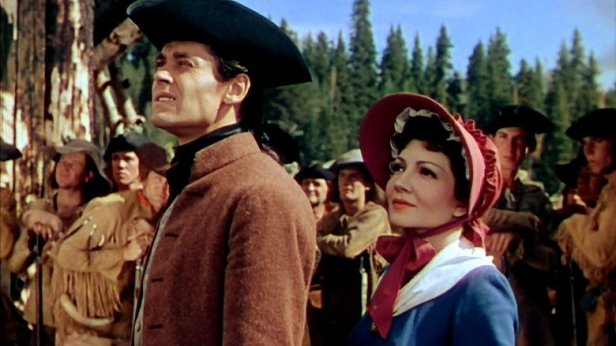
The film stars Henry Fonda in the second of his three films for Ford in this period, following Young Mr Lincoln and preceding The Grapes of Wrath. In one of the relatively few lead roles by major female stars in Ford’s films, Claudette Colbert plays Fonda’s wife and the film begins with their marriage and subsequent journey to their new house in the Mohawk valley north of Albany – and effectively on the ‘frontier’ of the new American state in its fight against the British. The film narrative was adapted from a novel by Walter D. Edmonds published in 1936. It is a 20th Century Fox picture with Darryl F. Zanuck producing an early Technicolor film shot by Bert Glennon and Ray Rennahan. Shooting with early colour cameras on location was challenging but Ford decided that the main shoot would be in Utah. This proved very difficult because of the weather but did enable the film to include some landscapes that benefited from colour.
Outline
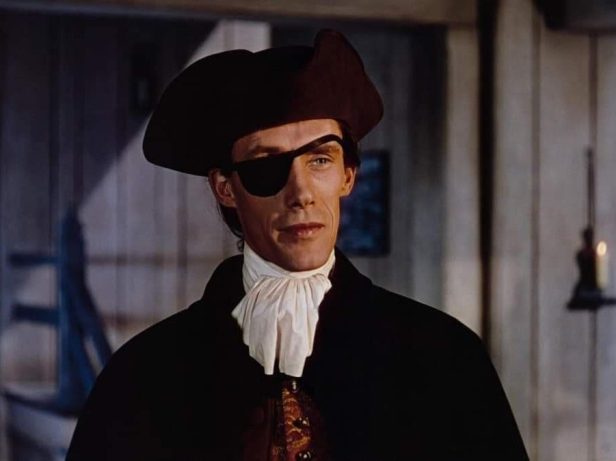
Gilbert Martin (Henry Fonda) marries Magdalena (Claudette Colbert as ‘Lana’) Borst in her parents’ grand house in Albany. The couple make their way North to Martin’s remote farm at Deerfield. On the way they encounter a strange man with an eye patch who enquires about Martin’s ‘politics’. This is Caldwell (John Carradine) who will appear later as a British agent organising Iroquois* warriors to attack settlements in the Mohawk valley. Gilbert and Lana settle to develop the farm before the first attack drives them to seek shelter in the nearest fort with the other settlers. They become settled around the fort before the men leave for first battle against the British and their allies.
Martin survives the first engagement and becomes a prominent figure among the settlers and it is he who volunteers to (literally) run for reinforcements from Fort Dayton when a British siege begins. His action will save the day and soon after his return with fresh militia troops, a unit of the Continental Army arrives to announce that the war is over and the thirteen colonies are now states of the new Union. The ‘Stars and Stripes’ is raised above the fort.
* The specific nation or ‘band’ is never mentioned. ‘Iroquois’ refers to a confederacy or family of nations. Some historical records refer to the Mohawks as being the principal allies of the British in this campaign.
Commentary
I rely mainly on the two comprehensive tomes on Ford, namely those by Joseph McBride and Tag Gallagher. McBride is very down on the film, describing it as the weakest of the three pictures from Ford in 1939 (i.e. Stagecoach and Young Mr Lincoln as the other two) and partly blaming the use of colour (which is too ‘bright’ and not as subtle as shades of grey in monochrome stock) and the casting of Claudette Colbert. Both writers, however, acknowledge that it was a commercially successful film (the original novel had been a bestseller). Perhaps the most cogent observation is that it was a film of its time, appearing as the US had climbed out of the Great Depression and was preparing itself for a world in which war was already apparent for many countries in Europe – it opened in the UK in March 1940. Gallagher captures something ambiguous when he notes that the life for the new settlers in the valley is sometimes gloomy but at others enlivened by the Technicolour brightness of the location.
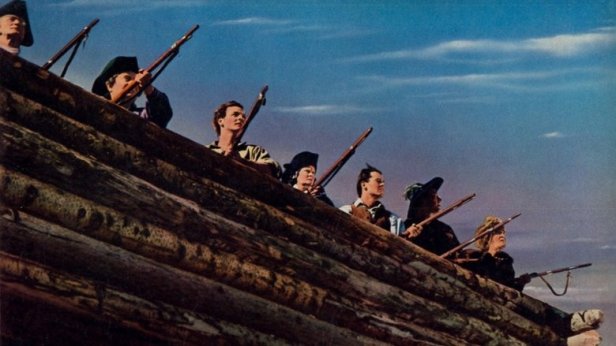
There are several interesting aspects of the film as a historical drama about the War of Independence/Revolutionary War. Dates are never mentioned but the narrative seems to span the whole time period from 1775 up to the British surrender and withdrawal in 1981. The marriage took place before fighting was expected in the West and the film ends with the news of the surrender of the British under Cornwallis. The battle to which Gilbert Martin and the other men in the small community march towards is the battle of Oriskany in the Mohawk valley in 1777. This was a ‘real’ battle but the siege of the fort is fiction. The language in the dialogue exchanges is interesting. The enemy is described as the ‘Tories’ (rather satisfying for the left in the UK) and the locals tend to call themselves ‘Americans’. However apart from the Caldwell character and some British uniforms (perhaps worn by indigenous warriors) no British soldiers are identified. There is no direct reference to the ‘Loyalists’, i.e. those Americans who wished to remain ‘British’, many of whom migrated to ‘British North America’ which later became Canada.
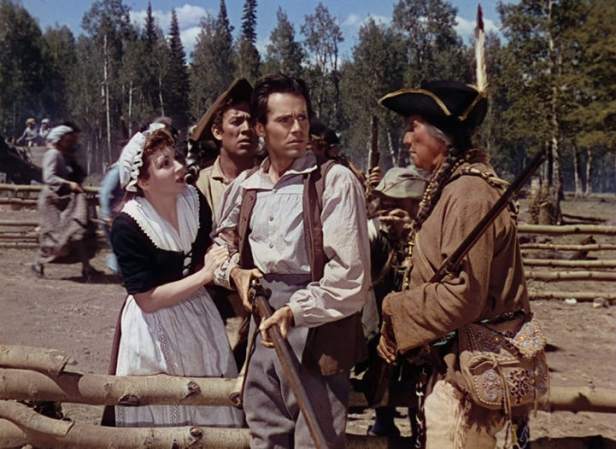
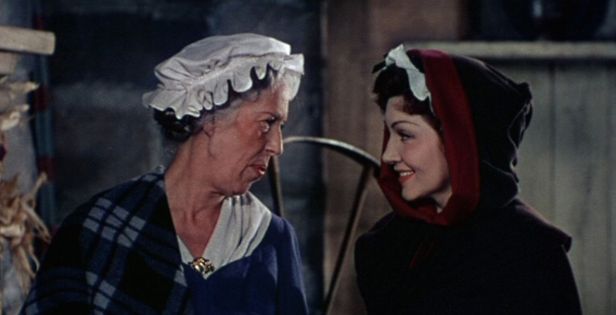
The shocking aspect of the film for modern audiences is the depiction of the indigenous warriors, simply as whooping ‘savages’ gleefully burning the cabins of settlers and in no way ‘humanised’. The worst example is when two warriors break into the house of Mrs McKlennar (Edna May Oliver). The scene is almost farcical and one of the warriors speaks English as they attempt to burn the bed she is lying on. Gallagher contrasts this with Ford’s presentation of warriors in Stagecoach in which they are shown mostly in long shot and as “noble savages”– problematic but not insulting. Meanwhile, within the American settlement is BlueBack (Chief John Big Tree). The same actor would play a more serious role in Ford’s She Wore a Yellow Ribbon (US 1949) but here he is a largely comic figure, first seen frightening Lana with his stillness and later interrupting scenes with cries of “Halleluja” as a committed Christian convert. There is also a Black servant, Mrs McKlennar’s maid Daisy (Beulah Hall Jones) who is presented as very much part of the community and in the finale is seen overjoyed at the establishment of the Union and the raising of the Stars and Stripes. There is no reference as to whether she is a freed slave. Beulah Hall Jones did appear in small parts in Ford’s Judge Priest (1934) and The Prisoner of Shark Island (1936). Drums Along the Mohawk was her last film. Ford has often been criticised for what critics have seen as racist presentations in his films, but Ford’s behaviour and his understanding of American culture were complex. He was one of the few Hollywood directors to cast and support Black and indigenous actors during the studio period, even if it took until 1960s for him to finally cast Woody Strode in the lead in Sergeant Rutledge (US 1960).
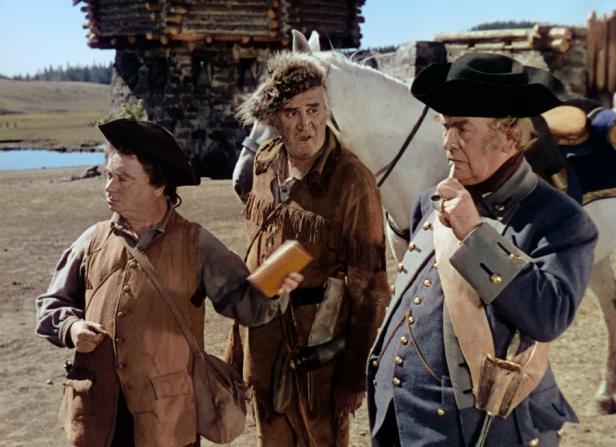
The other major criticism of Ford concerns his sense of comedy, seen as too broad for ‘serious critics’. The comic characters and situations are an integral part of what is central to many of Ford’s films – the sense of ‘community’. In this case the characters in the fort are a motley crew of often Ford regulars including his brother Francis, Ward Bond, Russell Simpson, Jack Pennick and Arthur Shields as the preacher. Comedy and music/songs is what holds Ford’s communities together in order to build a structure all can support. This is a recognisable Ford film and perhaps it is more closely aligned to Ford’s later cavalry trilogy in developing the Western genre than is the more ‘standalone’ Stagecoach which preceded it. Drums Along the Mohawk has one of the earliest settings for a Westerns and some critics might rule it out for that reason but it will be found in all the best reference books covering the Western in all its forms. Technicolor was still a novelty in 1930s Hollywood and it may be that it doesn’t allow some of the subtleties of Ford’s other work in this period but it helped make the film good box office (and won an Oscar nomination for Edna May Oliver). I don’t think Claudette Colbert ruins the picture. Her performance is fine but probably in spite of Ford rather than for him. Why she insisted on the glamorous make-up I don’t know but it does detract from the general realism and Ford would get a much better response from stars like Maureen O’Hara, Joanne Dru and in a different context, Ava Gardner and Grace Kelly.
References
Gallagher, Tag (1986) John Ford, the Man and His Films, Berkeley: University of California Press
McBride, Joseph (2003) Searching for John Ford, London: faber & faber
 itp Global Film