
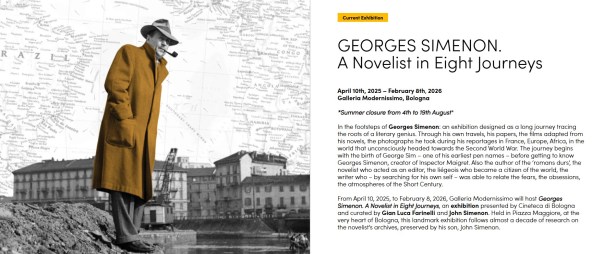
This is an exhibition curated by Gian Luca Farinelli the Director of Il Cinema Ritrovato and John Simenon (Georges Simenon’s son). It is sited in the Galleria Modernissimo, part of an underground complex which includes the Cinema Modernissimo. The complex was originally constructed early in the C20th and it opened as movie venue in 1915. It has been restored in recent years and is an important venue in Il Cinema Ritrovato. The gallery hosts major exhibitions such as the present Simenon exhibition and also has a bar and other facilities. It is sited in the Via Rizzoli, close to the Piazza Maggiore in the centre of the City of Bologna.
The eight journeys of the exhibition relate to different aspects of Simenon’s career: as a writer, an inveterate traveller, as a talented amateur photographer and as a major source of film and television adaptations.
In the footsteps of Georges Simenon: an exhibition that promises to be a long and fascinating journey to discover the roots of a genius, exploring his own travels, his writings, the films inspired by his works, and the photographs he took during his reportages in France, Europe, Africa, and around the world, a world that unconsciously approached the Second World War.
Following in the footsteps of the young Georges Sim (the name by which he signed his early works), we will discover the evolution of Georges Simenon: the creator of Maigret, the author of the ‘hard novels’, the novelist who acted as an editor, the liégeois who became a citizen of the world, the writer who, in his search for himself, managed to recount the fears, obsessions and atmospheres of the ‘Short Century’.
The early section present the youthful Simenon, born and raised in Belgium and including his experiences under German occupation in World War I. Then his early writing career in Paris where he worked as a journalist and then moved on to writing for publication. He spent much of his life in France, but also sometimes returned to Belgium and in later life lived in the USA and then in Switzerland. In Paris he was a friend with Josephine Baker and with Colette. He tended to move in conservative circles. As his career developed Simenon started on his frequent travels, illustrated by detailed wall maps, and developed his abiding interest in photography with a substantial number of his photographs on display. They are very fine and capture places he visited and the ordinary people he encountered there. In Africa he wrote critically of French colonialism.
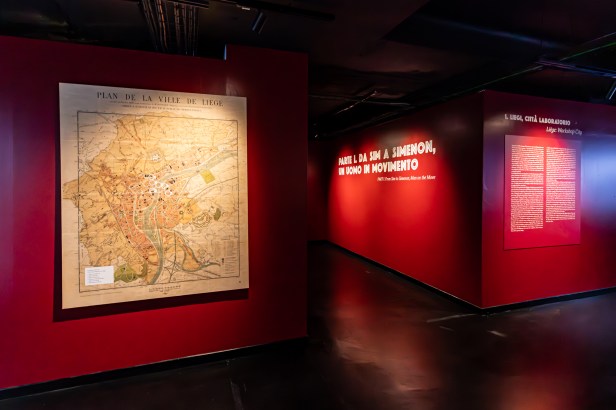
The exhibits are described in wall-mounted frames in both Italian and English. And there are video excerpts from interviews and objects of his including his cameras. Simenon has 192 credited publications and there are early works under other names. The Maigret series is the most famous and these were best sellers in France and abroad. But there are also other fictional works and reportage. He consciously wrote and published ‘hard novels’, less popular but more critically praised.
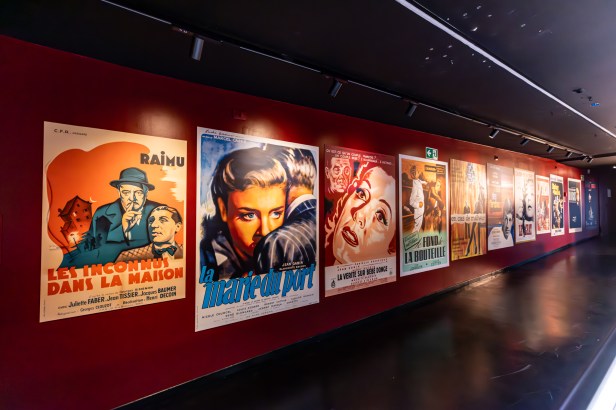
The finals sections look at the adaptation of Simenon’s literary works to film and television, there are over seventy adaptations on film. One wall has a chain of photographs of the various actors who have played Maigret; including Charles Laughton, Jean Gabin and Rupert Davies (whose series I avidly followed on British television and of whom Simenon approved).
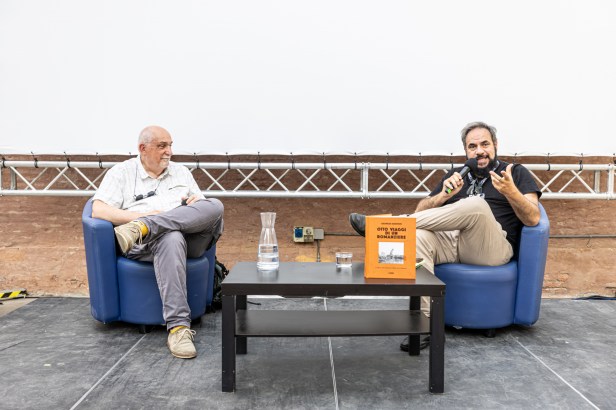
This is a substantial exhibition; it took me one and half hours in two bouts between Ritrovato screenings. I could have spent longer. I did rather like the idea of a catalogue to bring away but it is only available in Italian and is a heavy tome, though it is splendidly illustrated. There was also a discussion on the exhibition and Simenon in the Piazzetta Pasolini led by Michele Smargiassi and Luca Ricci. The exhibition runs until February 8th 2026. If you are in Bologna before then this is a real treat and a fascinating presentation on both literary and cinematic masterworks.
 itp Global Film
Simenon was from Liège a city which I very much enjoyed visiting. I’m not sure why the British make fun of the Belgians without recognising the culture(s) of the country. Most Brits think Walloon culture is part of French culture I’m afraid. I admire Simenon more than enjoy his writing. I’ve read a few of the books and, like Keith, I remember Rupert Davies in the classic British TV series. I’ve caught a couple of the French series shown on Talking Pictures TV but I think it’s Simenon’s creation of the model detective in the police procedural that endures. My passion is reserved for Donna Leon’s Brunetti, Andrea Camilleri’s Montalbano and the French procedural TV series like Engrenages. But the exhibition sounds great. I hope it comes to the UK.
LikeLike